
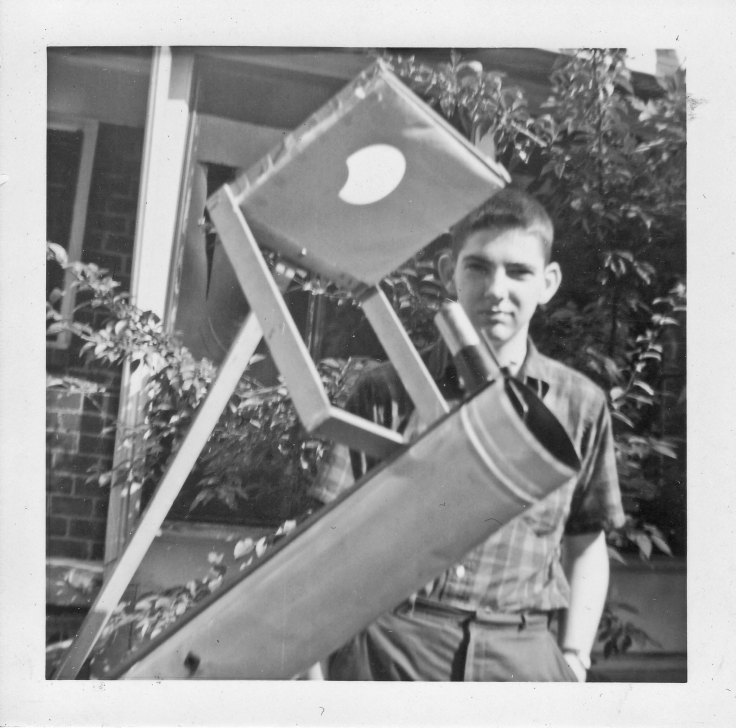
Whenever one reads about solar eclipse-watching, many warnings about eye damage are found. They tend to be repetitious, but they are very important. Rather than trying to “reinvent the wheel”, I would like to summarize them as two different types of mistakes that can be made:
First type of mistake: Looking directly at the Sun. Normally, we find it very painful to look directly at the Sun. Almost as a reflex, we turn our gaze away from the fiery disk. However, during the partial phase of a solar eclipse, the sensation of pain is not so strong, because the overall brightness of the Sun isn’t so great. Unfortunately, the light from the visible portion of the Sun is still very destructive.
“Eclipse glasses” from a reputable source are inexpensive, and allow one to view the sun safely.
Second type of mistake: Looking at the Sun through improperly filtered optics. This mistake is far more serious than looking directly at the Sun. A telescope or binocular is designed to concentrate the light from a dim object to make it easier to see. When it is aimed at the Sun, an enormous amount of energy is delivered to the eyepiece. Complete, permanent loss of vision can occur quickly.
Telescopes can be safely filtered for looking at the Sun, but mistakes can happen. I am apprehensive that in some unruly, crowded observing field, a filter will get knocked off of a telescope. This would expose the viewer to serious injury. So, in addition to setting up a safe telescope, steps have to be taken to keep it safe.
There are several ways to use a telescope as a projector, and view the image of the Sun indirectly. These work well, but someone needs to be on the lookout for any misuse of the equipment.
Finally, there is one time when eye protection is not needed: during the total phase of the eclipse. If you are wearing eclipse glasses, you will see uncovered portion of the Sun getting smaller and smaller. When you can’t see anything through the eclipse glasses, totality has begun, and you should take the glasses off (otherwise you will miss the reason you went through all of this trouble!). Enjoy watching the corona, until you notice that the Sun is no longer completely covered. At this point, put your eclipse glasses back on.
Having said all of this, you shouldn’t be afraid to enjoy solar eclipses. Like many other things, the extremes are to be avoided. There is no need to stay indoors and close the curtains. Likewise, watching the Sun without protection is unwise. The rules are fairly simple, and will help you have an unforgettable day!
Here is a link to good information on viewing the eclipse safely:
http://eclipse2017.nasa.gov/safety
 Real Simple Astronomy
Leave a comment