
A Star Party in an Unexpected Place
A month ago, I visited a cousin in New Jersey, who shared about his experiences at a local star party. I was surprised to hear that there was such an event in his area. This part of New Jersey is one of the most light-polluted areas of the country. It is about 6 miles from New York City.
This observing night was held at the William D. McDowell Observatory in Lyndhurst, NJ. At their viewing nights, they select objects which are bright enough to stand out against the bright background sky.
Here is more information about the McDowell Observatory programs:
Viewing Nights at the McDowell Observatory
It may seem odd to build an observatory in an area where the sky never gets truly dark, but it provides viewing opportunities for millions of people (but not all at the same time!). Consider the opposite extreme: an observatory on top of a mountain in the New Mexico desert. There would be outstanding viewing, but very few people would be able to travel the long distance to enjoy it. So, if you are in northern New Jersey, this ought to be fun!
The Best of the Best Objects to View
When you attend your star party, the astronomers will select objects that are interesting, and are in a good portion of the sky. Here are some of the most interesting things, roughly in order of visual impact:
The Moon – A quick look at the Moon reveals craters of all sizes, mountains, and flat dark “seas”. If you take more time to study the Moon, there is an endless variety of features, too many to describe here.
Saturn – for many people, the first look at Saturn through a telescope is an emotional experience. Even though larger and more detailed views can be found in books and on line, this is not the same as looking at the planet directly. Saturn is very bright, and has a sharp contrast to the background sky.
Jupiter and its moons – Because Jupiter is larger than Saturn, and is closer to us, it makes a larger image in the telescope. There are many features on the surface of Jupiter to enjoy. The main ones are the belts (dark bands which wrap around the globe), and the Great Red Spot (which nowadays is somewhat small and orange). The four largest moons of Jupiter are very bright, and move fast enough for changes to be noticed in a few hours.
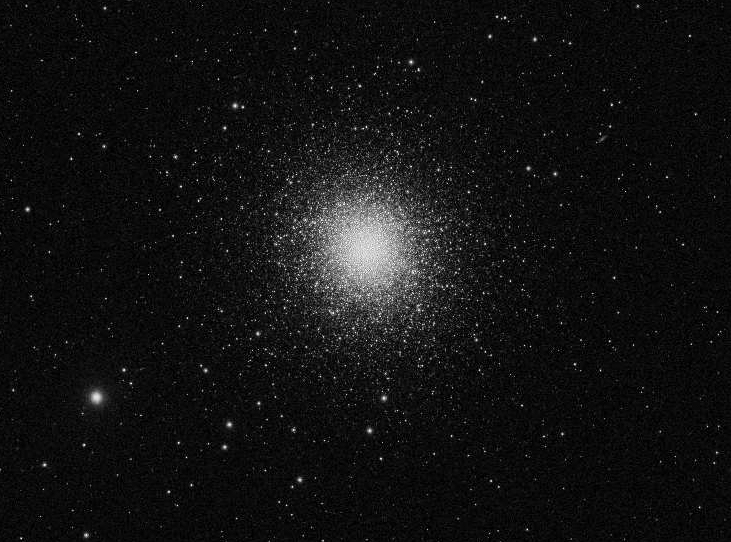
The Hercules Cluster – This object is a globular cluster, a spherical collection of hundreds of thousands of stars orbiting a central point.
The Orion Nebula – This is an immense cloud of gas which is being transformed into new stars.
The Ring Nebula – This object comes from a very old star, which has shed a layer of its surface. This expelled layer has taken a ring shape, and is expanding in size.
Mars – Mars is called “The Red Planet”, but would be better described as orange. A casual view of Mars shows only a bright orange disk. The constantly moving pockets of warm and cold air in our atmosphere prevent a good view of the details of Mars. Persistence pays off, however, because there are occasional moments when a sharp view gets through. During these split-second opportunities, polar ice caps and dark areas can be seen on the surface.
Albireo – This is a “double star”, a pair of stars which orbit each other, or appear to do so. Albireo is unique for its brightness and the colors of its two stars.
The Double Cluster of Perseus – This is a pair of star clusters somewhat close to each other. They are called “open clusters”, which have far fewer stars than globular clusters. In the Double Cluster, many bright stars are beautifully arranged against the dark background sky.
The Andromeda Galaxy – This is the closest large galaxy in our stellar neighborhood. Through a telescope, it appears as a fuzzy oval, a little bit bigger than Jupiter. Looks can be deceiving, because the Andromeda Galaxy is composed of billions of stars, and is over two million light-years away!
That’s all for now. My goal is to post something interesting every Sunday night.
lookin’ up,
John
 Real Simple Astronomy
Leave a comment