
“Did Pluto Disappear?”
This is an exact quote, from a young student at a star party. When I heard this question, I realized that the new definition of a planet has created confusion for students.
In 2006, the International Astronomical Union adopted a new definition of a planet. It requires that the body be large enough that it naturally assumes a spherical shape, and it requires that the body be large enough to “clear the neighborhood around its orbit.” Pluto does have the spherical shape, but it hasn’t “cleared the neighborhood around its orbit.” Therefore, Pluto was designated as a “Dwarf Planet”, rather than a “Planet”.
A new proposal by Kirby Runyon is the extreme opposite of that of the IAU. Runyon’s definition requires only that the body have a spherical shape. It doesn’t matter what kind of orbit it follows. This would mean that moons would called planets, if they are spherical. This would raise our list of planets to over 100 members!
My proposal is to define a planet to be any object orbiting the Sun, which is known to have a spherical shape. Other objects, such as asteroids and comets, are not spherical, and would not be called planets. There are several large objects, such as Eris, Haumea and Makemake, which are too distant for their shapes to be determined. Until better observations are made, these objects would not be listed as planets.
How big would the new list be? Only ten planets for now!
Here is the proposed list, in order of distance from the Sun:
Venus
Earth
Mars
Ceres
Jupiter
Saturn
Uranus
Neptune
Pluto
Note that our old friend Pluto is back on the list. Also, a new member, Ceres, has been added. Since most people have never heard of Ceres, the new list should encourage people to learn something about this planet.
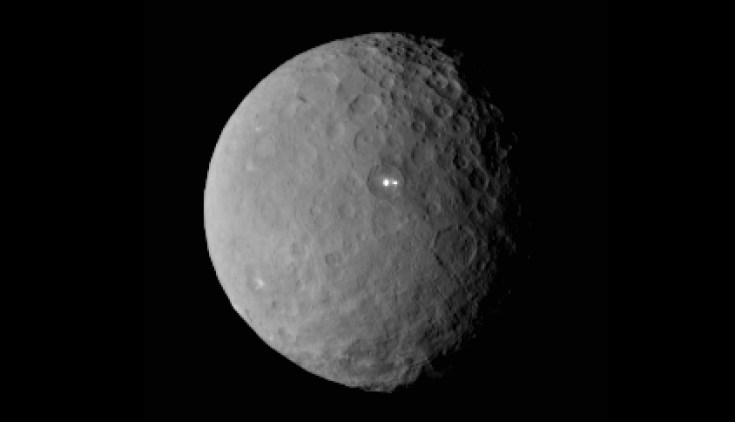
This method of defining the word “planet” may never make it to the text books, but it was fun putting it together!
As always, keep looking up!
John
For more information on the planet Ceres:
 Real Simple Astronomy
Leave a comment