
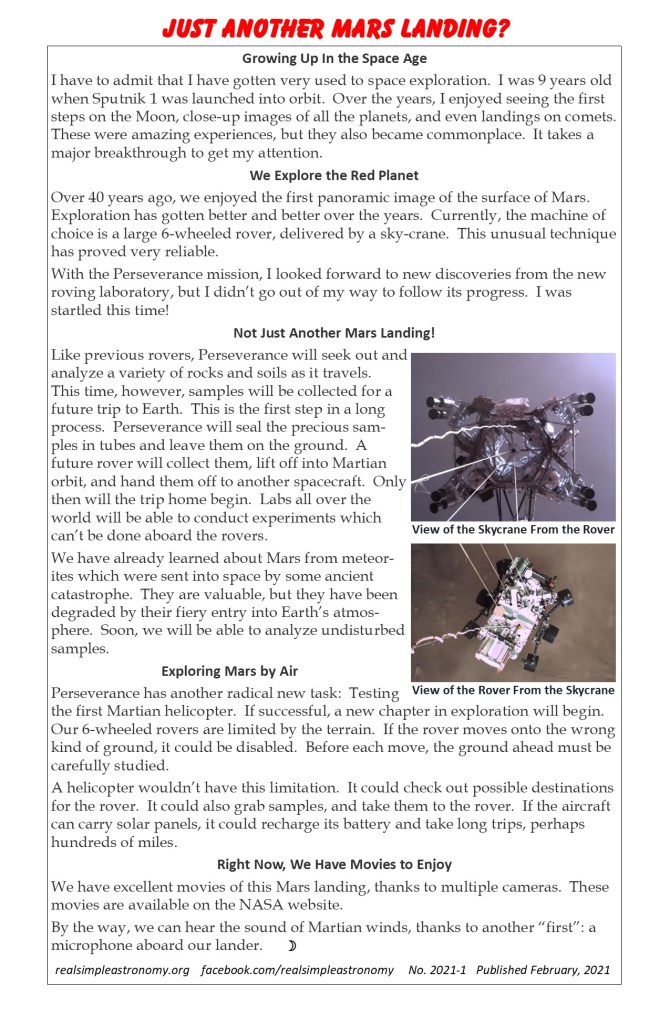
Click for movies and audio at NASA website.
(Plain text version)
Growing Up In the Space Age
I have to admit that I have gotten very used to space exploration. I was 9 years old when Sputnik 1 was launched into orbit. Over the years, I enjoyed seeing the first steps on the Moon, close-up images of all the planets, and even landings on comets. These were amazing experiences, but they also became commonplace. It takes a major breakthrough to get my attention.
We Explore the Red Planet
Over 40 years ago, we enjoyed the first panoramic image of the surface of Mars. Exploration has gotten better and better over the years. Currently, the machine of choice is a large 6-wheeled rover, delivered by a sky-crane. This unusual technique has proved very reliable.
With the Perseverance mission, I looked forward to new discoveries from the new roving laboratory, but I didn’t go out of my way to follow its progress. I was startled this time!
Not Just Another Mars Landing!
Like previous rovers, Perseverance will seek out and analyze a variety of rocks and soils as it travels. This time, however, samples will be collected for a future trip to Earth. This is the first step in a long process. Perseverance will seal the precious samples in tubes and leave them on the ground. A future rover will collect them, lift off into Martian orbit, and hand them off to another spacecraft. Only then will the trip home begin. Labs all over the world will be able to conduct experiments which can’t be done aboard the rovers.
We have already learned about Mars from meteorites which were sent into space by some ancient catastrophe. They are valuable, but they have been degraded by their fiery entry into Earth’s atmosphere. Soon, we will be able to analyze undisturbed samples.
Exploring Mars by Air
Perseverance has another radical new task: Testing the first Martian helicopter. If successful, a new chapter in exploration will begin. Our 6-wheeled rovers are limited by the terrain. If the rover moves onto the wrong kind of ground, it could be disabled. Before each move, the ground ahead must be carefully studied.
A helicopter wouldn’t have this limitation. It could check out possible destinations for the rover. It could also grab samples, and take them to the rover. If the aircraft can carry solar panels, it could recharge its battery and take long trips, perhaps hundreds of miles.
Right Now, We Have Movies to Enjoy
We have excellent movies of this Mars landing, thanks to multiple cameras. These movies are available on the NASA website.
By the way, we can hear the sound of Martian winds, thanks to another “first”: a microphone aboard our lander.
 Real Simple Astronomy
Leave a comment