
(Plain Text Version)
The Summer Triangle
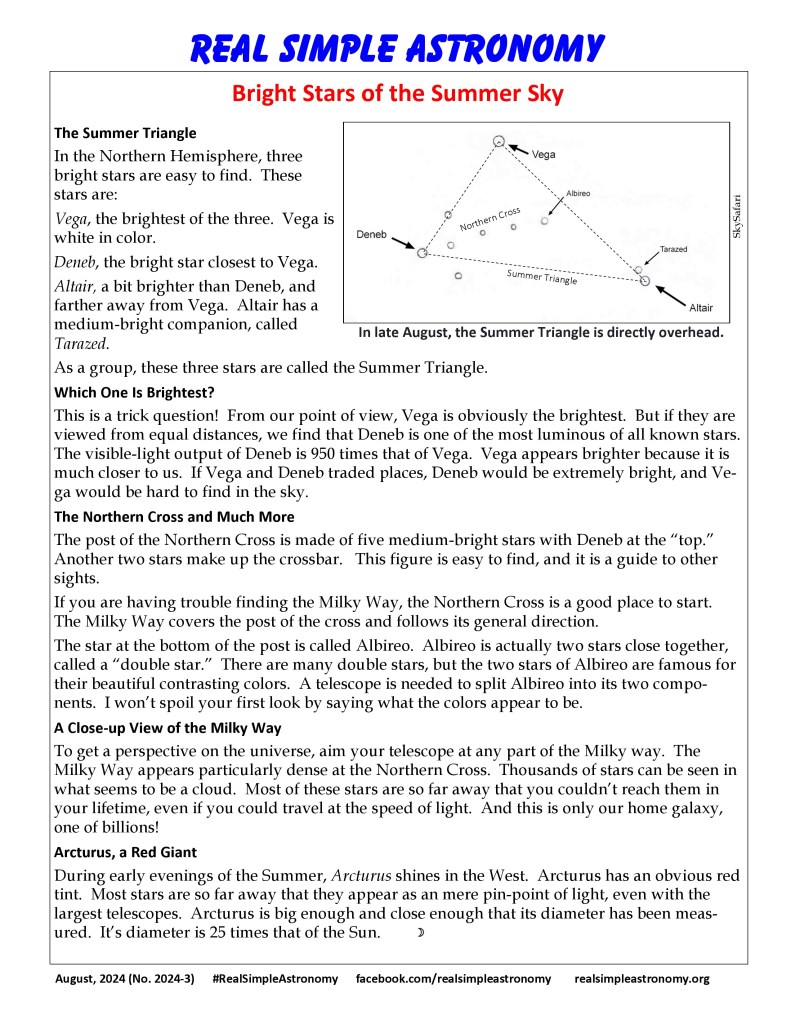
In the Northern Hemisphere, three bright stars are easy to find. These stars are:
Vega, the brightest of the three. Vega is white in color.
Deneb, the bright star closest to Vega.
Altair, a bit brighter than Deneb, and farther away from Vega. Altair has a medium-bright companion, called Tarazed.
As a group, these three stars are called the Summer Triangle.
Which One Is Brightest?
This is a trick question! From our point of view, Vega is obviously the brightest. But if they are viewed from equal distances, we find that Deneb is one of the most luminous of all known stars. The visible-light output of Deneb is 950 times that of Vega. Vega appears brighter because it is much closer to us. If Vega and Deneb traded places, Deneb would be extremely bright, and Vega would be hard to find in the sky.
The Northern Cross and Much More
The post of the Northern Cross is made of five medium-bright stars with Deneb at the “top.” Another two stars make up the crossbar. This figure is easy to find, and it is a guide to other sights.
If you are having trouble finding the Milky Way, the Northern Cross is a good place to start. The Milky Way covers the post of the cross and follows its general direction.
The star at the bottom of the post is called Albireo. Albireo is actually two stars close together, called a “double star.” There are many double stars, but the two stars of Albireo are famous for their beautiful contrasting colors. A telescope is needed to split Albireo into its two components. I won’t spoil your first look by saying what the colors appear to be.
A Close-up View of the Milky Way
To get a perspective on the universe, aim your telescope at any part of the Milky way. The Milky Way appears particularly dense at the Northern Cross. Thousands of stars can be seen in what seems to be a cloud. Most of these stars are so far away that you couldn’t reach them in your lifetime, even if you could travel at the speed of light. And this is only our home galaxy, one of billions!
Arcturus, a Red Giant
During early evenings of the Summer, Arcturus shines in the West. Arcturus has an obvious red tint. Most stars are so far away that they appear as an mere pin-point of light, even with the largest telescopes. Arcturus is big enough and close enough that its diameter has been measured. It’s diameter is 25 times that of the Sun.
#RealSimpleAstronomy
 Real Simple Astronomy
Leave a comment