
http://aerith.net/comet/weekly/current.html
http://nasa.gov/centers-and-facilities/marshall/nasa-global-astronomers-await-rare-nova-explosion/
(Plain Text Version)
Comet Tsuchinshan Comes to Our Neighborhood
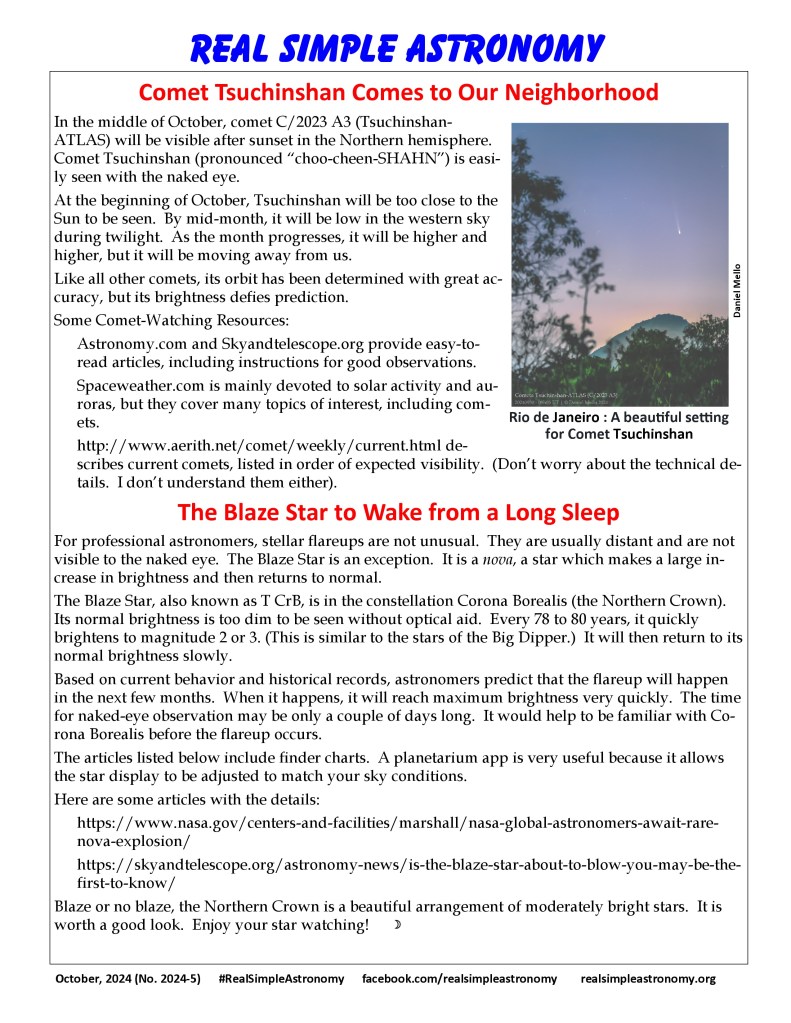
In the middle of October, comet C/2023 A3 (Tsuchinshan-ATLAS) will be visible after sunset in the Northern hemisphere. Comet Tsuchinshan (pronounced “choo-cheen-SHAHN”) is easily seen with the naked eye.
At the beginning of October, Tsuchinshan will be too close to the Sun to be seen. By mid-month, it will be low in the western sky during twilight. As the month progresses, it will be higher and higher, but it will be moving away from us.
Like all other comets, its orbit has been determined with great accuracy, but its brightness defies prediction.
Some Comet-Watching Resources:
Astronomy.com and Skyandtelescope.org provide easy-to-read articles, including instructions for good observations.
Spaceweather.com is mainly devoted to solar activity and auroras, but they cover many topics of interest, including comets.
http://www.aerith.net/comet/weekly/current.html describes current comets, listed in order of expected visibility. (Don’t worry about the technical details. I don’t understand them either).
The Blaze Star to Wake from a Long Sleep
For professional astronomers, stellar flareups are not unusual. They are usually distant and are not visible to the naked eye. The Blaze Star is an exception. It is a nova, a star which makes a large increase in brightness and then returns to normal.
The Blaze Star, also known as T CrB, is in the constellation Corona Borealis (the Northern Crown). Its normal brightness is too dim to be seen without optical aid. Every 78 to 80 years, it quickly brightens to magnitude 2 or 3. (This is similar to the stars of the Big Dipper.) It will then return to its normal brightness slowly.
Based on current behavior and historical records, astronomers predict that the flareup will happen in the next few months. When it happens, it will reach maximum brightness very quickly. The time for naked-eye observation may be only a couple of days long. It would help to be familiar with Corona Borealis before the flareup occurs.
The articles listed below include finder charts. A planetarium app is very useful because it allows the star display to be adjusted to match your sky conditions.
Here are some articles with the details:
Blaze or no blaze, the Northern Crown is a beautiful arrangement of moderately bright stars. It is worth a good look. Enjoy your star watching!
#RealSimpleAstronomy
 Real Simple Astronomy
Leave a comment