
(Plain Text Version)
NASA Makes a Good Call
Belated congratulations to NASA for putting crew safety ahead of staying on schedule. On the recent Crew Flight Test of the Boeing Starliner several thrusters of the Reaction Control System malfunctioned. These thrusters are used to adjust the position and motion of the spacecraft for docking and for re-entry.
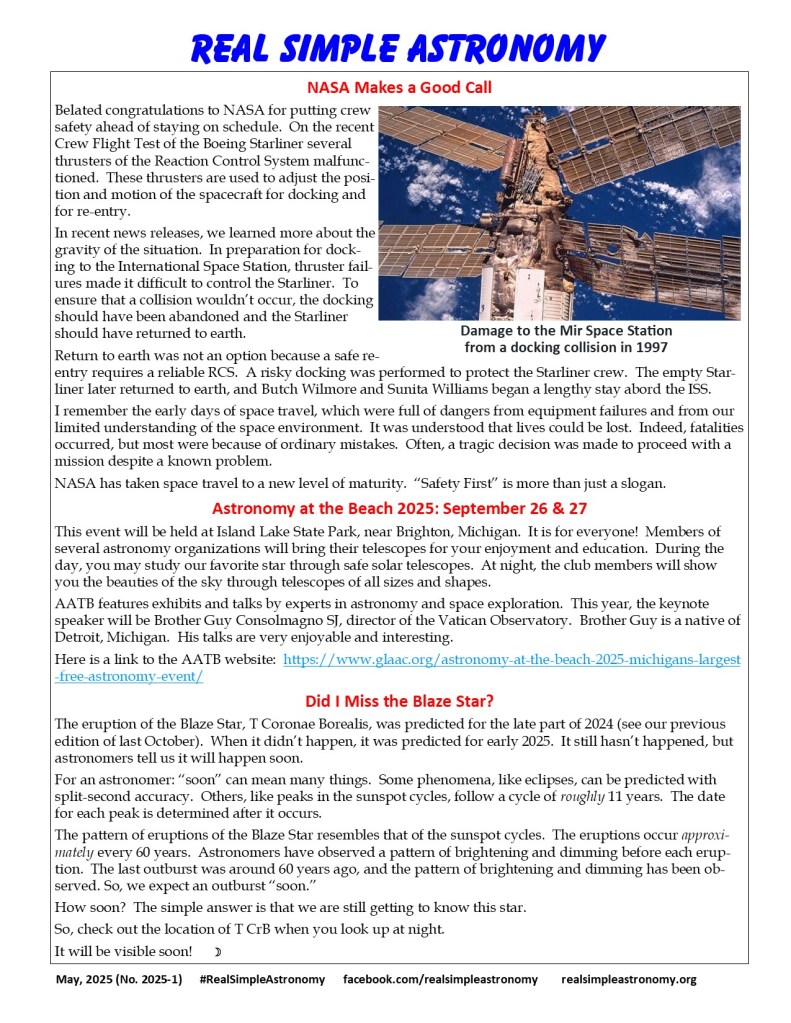
In recent news releases, we learned more about the gravity of the situation. In preparation for docking to the International Space Station, thruster failures made it difficult to control the Starliner. To ensure that a collision wouldn’t occur, the docking should have been abandoned and the Starliner should have returned to earth.
Return to earth was not an option because a safe re-entry requires a reliable RCS. A risky docking was performed to protect the Starliner crew. The empty Starliner later returned to earth, and Butch Wilmore and Sunita Williams began a lengthy stay abord the ISS.
I remember the early days of space travel, which were full of dangers from equipment failures and from our limited understanding of the space environment. It was understood that lives could be lost. Indeed, fatalities occurred, but most were because of ordinary mistakes. Often, a tragic decision was made to proceed with a mission despite a known problem.
NASA has taken space travel to a new level of maturity. “Safety First” is more than just a slogan.
Astronomy at the Beach 2025: September 26 & 27
This event will be held at Island Lake State Park, near Brighton, Michigan. It is for everyone! Members of several astronomy organizations will bring their telescopes for your enjoyment and education. During the day, you may study our favorite star through safe solar telescopes. At night, the club members will show you the beauties of the sky through telescopes of all sizes and shapes.
AATB features exhibits and talks by experts in astronomy and space exploration. This year, the keynote speaker will be Brother Guy Consolmagno SJ, director of the Vatican Observatory. Brother Guy is a native of Detroit, Michigan. His talks are very enjoyable and interesting.
Here is a link to the AATB website: https://www.glaac.org/astronomy-at-the-beach-2025-michigans-largest-free-astronomy-event/
Did I Miss the Blaze Star?
The eruption of the Blaze Star, T Coronae Borealis, was predicted for the late part of 2024 (see our previous edition of last October). When it didn’t happen, it was predicted for early 2025. It still hasn’t happened, but astronomers tell us it will happen soon.
For an astronomer: “soon” can mean many things. Some phenomena, like eclipses, can be predicted with split-second accuracy. Others, like peaks in the sunspot cycles, follow a cycle of roughly 11 years. The date for each peak is determined after it occurs.
The pattern of eruptions of the Blaze Star resembles that of the sunspot cycles. The eruptions occur approximately every 60 years. Astronomers have observed a pattern of brightening and dimming before each eruption. The last outburst was around 60 years ago, and the pattern of brightening and dimming has been observed. So, we expect an outburst “soon.”
How soon? The simple answer is that we are still getting to know this star.
So, check out the location of T CrB when you look up at night.
It will be visible soon!
#RealSimpleAstronomy
 Real Simple Astronomy
Leave a comment