
(Plain Text Version)
Saturn’s Rings Play “Hide & Seek”
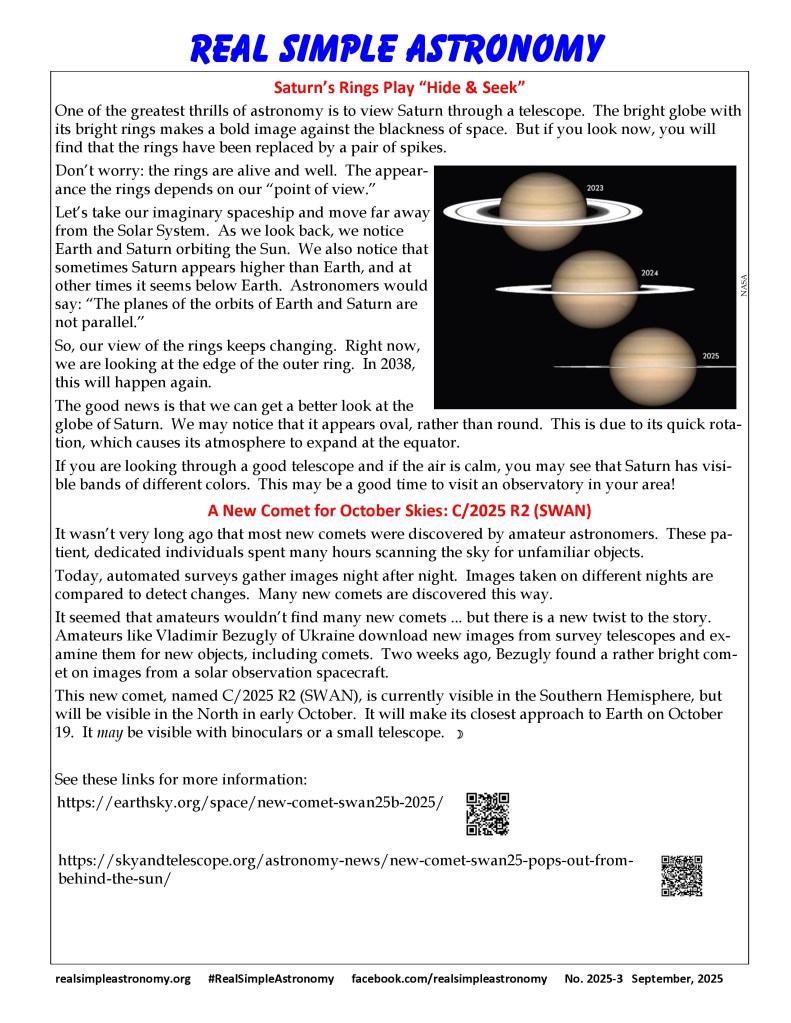
One of the greatest thrills of astronomy is to view Saturn through a telescope. The bright globe with its bright rings makes a bold image against the blackness of space. But if you look now, you will find that the rings have been replaced by a pair of spikes.
Don’t worry: the rings are alive and well. The appearance the rings depends on our “point of view.”
Let’s take our imaginary spaceship and move far away from the Solar System. As we look back, we notice Earth and Saturn orbiting the Sun. We also notice that sometimes Saturn appears higher than Earth, and at other times it seems below Earth. Astronomers would say: “The planes of the orbits of Earth and Saturn are not parallel.”
So, our view of the rings keeps changing. Right now, we are looking at the edge of the outer ring. In 2038, this will happen again.
The good news is that we can get a better look at the globe of Saturn. We may notice that it appears oval, rather than round. This is due to its quick rotation, which causes its atmosphere to expand at the equator.
If you are looking through a good telescope and if the air is calm, you may see that Saturn has visible bands of different colors. This may be a good time to visit an observatory in your area!
A New Comet for October Skies: C/2025 R2 (SWAN)
It wasn’t very long ago that most new comets were discovered by amateur astronomers. These patient, dedicated individuals spent many hours scanning the sky for unfamiliar objects.
Today, automated surveys gather images night after night. Images taken on different nights are compared to detect changes. Many new comets are discovered this way.
It seemed that amateurs wouldn’t find many new comets … but there is a new twist to the story. Amateurs like Vladimir Bezugly of Ukraine download new images from survey telescopes and examine them for new objects, including comets. Two weeks ago, Bezugly found a rather bright comet on images from a solar observation spacecraft.
This new comet, named C/2025 R2 (SWAN), is currently visible in the Southern Hemisphere, but will be visible in the North in early October. It will make its closest approach to Earth on October 19. It may be visible with binoculars or a small telescope.
See these links for more information:
https://earthsky.org/space/new-comet-swan25b-2025/
https://skyandtelescope.org/astronomy-news/new-comet-swan25-pops-out-from-behind-the-sun/
#RealSimpleAstronomy
 Real Simple Astronomy
Leave a comment