
I Love Visual Astronomy!
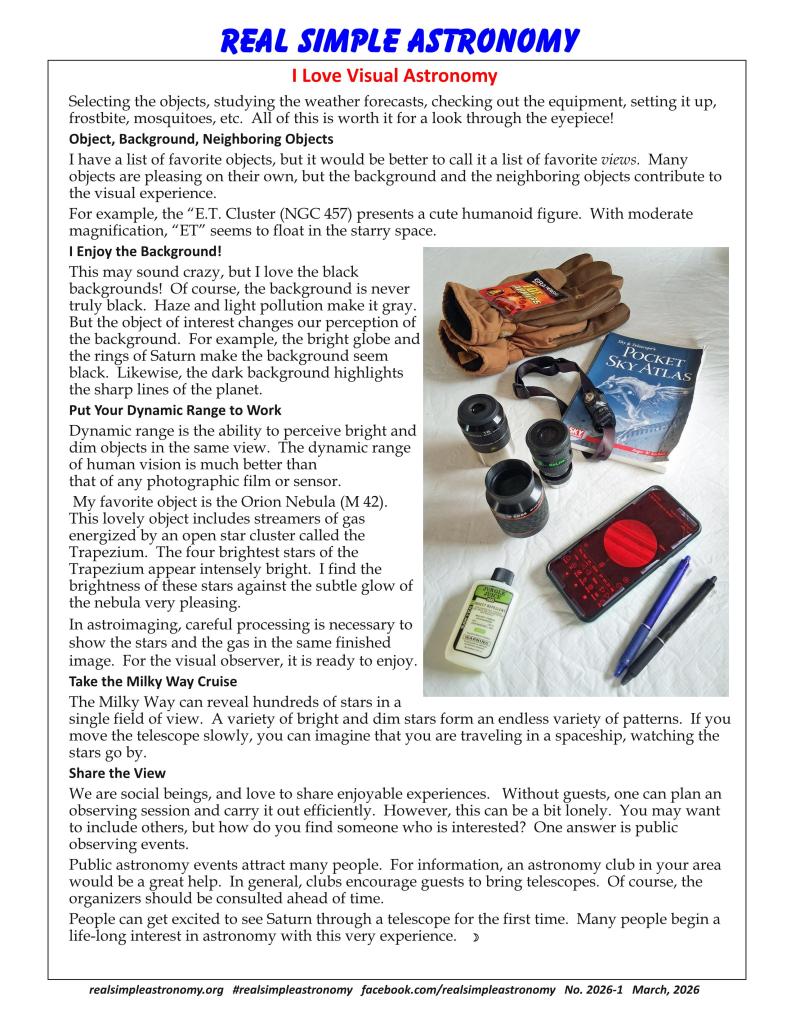
Selecting the objects, studying the weather forecasts, checking out the equipment, setting it up, frostbite, mosquitoes, etc. All of this is worth it for a look through the eyepiece!
Object, Background, Neighboring Objects
I have a list of favorite objects, but it would be better to call it a list of favorite views. Many objects are pleasing on their own, but the background and the neighboring objects contribute to the visual experience.
For example, the “E.T. Cluster (NGC 457) presents a cute humanoid figure. With moderate magnification, “ET” seems to float in the starry space.
I Enjoy the Background!
This may sound crazy, but I love the black backgrounds! Of course, the background is never truly black. Haze and light pollution make it gray. But the object of interest changes our perception of the background. For example, the bright globe and the rings of Saturn make the background seem black. Likewise, the dark background highlights the sharp lines of the planet.
Put Your Dynamic Range to Work
Dynamic range is the ability to perceive bright and dim objects in the same view. The dynamic range of human vision is much better than that of any photographic film or sensor.
My favorite object is the Orion Nebula (M 42). This lovely object includes streamers of gas energized by an open star cluster called the Trapezium. The four brightest stars of the Trapezium appear intensely bright. I find the brightness of these stars against the subtle glow of the nebula very pleasing.
In astroimaging, careful processing is necessary to show the stars and the gas in the same finished image. For the visual observer, it is ready to enjoy.
Take the Milky Way Cruise
The Milky Way can reveal hundreds of stars in a single field of view. A variety of bright and dim stars form an endless variety of patterns. If you move the telescope slowly, you can imagine that you are traveling in a spaceship, watching the stars go by.
Share the View
We are social beings, and love to share enjoyable experiences. Without guests, one can plan an observing session and carry it out efficiently. However, this can be a bit lonely. You may want to include others, but how do you find someone who is interested? One answer is public observing events.
Public astronomy events attract many people. For information, an astronomy club in your area would be a great help. In general, clubs encourage guests to bring telescopes. Of course, the organizers should be consulted ahead of time.
People can get excited to see Saturn through a telescope for the first time. Many people begin a life-long interest in astronomy with this very experience.
 Real Simple Astronomy
Leave a comment