My goal is to post enjoyable items about the skies. I don't have a schedule for new posts, so please check in from time to time. If you would like, you can sign up for email notifications about new posts. Enjoy!
For many years, I lived in a rural setting in Southern Michigan. It was a pleasure to have a dark sky and freedom from nearby lights. At the telescope one night, I was bothered by a light from the cornfield behind me. I ignored it for quite a while, but it persisted. At last, I turned around and found that my annoyance was caused by the Northern Lights. A few seconds later, the aurora ended and did not return.
Don’t forget…
When I was a brand-new observer, I heard many stories of people traveling to a dark-sky site, only to find that they had forgotten to pack their eyepieces. I resolved not to make this mistake, so I always triple-checked this item when I packed the car. One night, I arrived at a club event and found that I hadn’t brought the telescope.
The Mystery of the Great Square
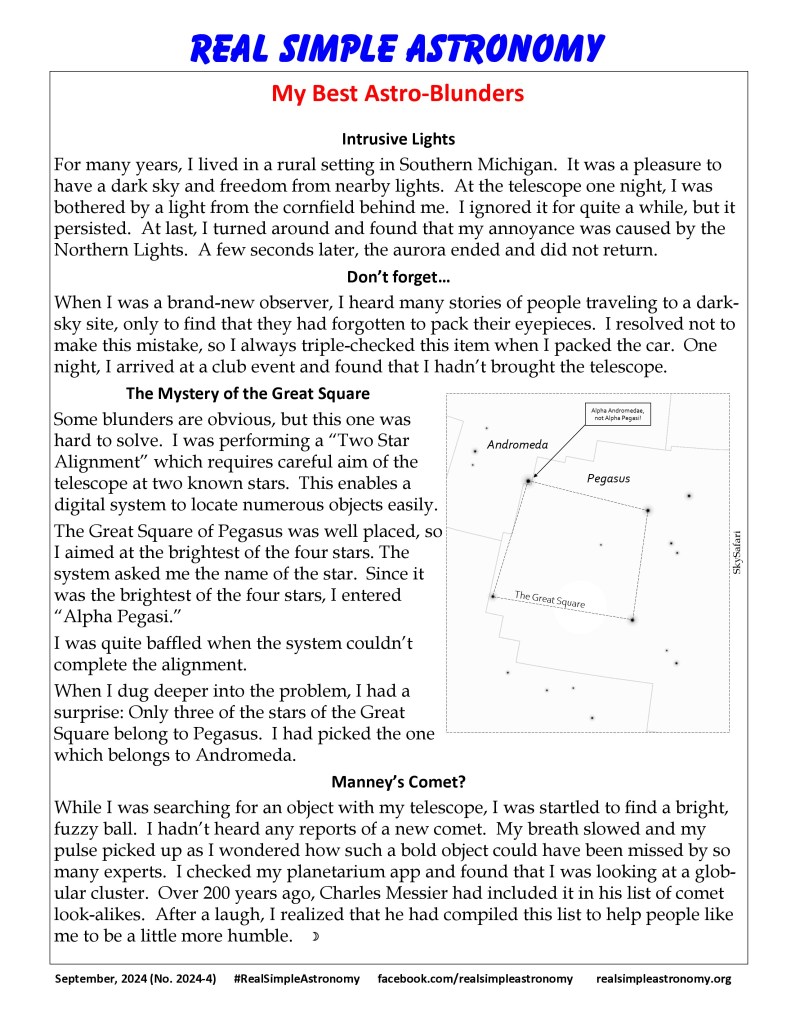
Some blunders are obvious, but this one was hard to solve. I was performing a “Two Star Alignment” which requires careful aim of the telescope at two known stars. This enables a digital system to locate numerous objects easily.
The Great Square of Pegasus was well placed, so I aimed at the brightest of the four stars. The system asked me the name of the star. Since it was the brightest of the four stars, I entered “Alpha Pegasi.”
I was quite baffled when the system couldn’t complete the alignment.
When I dug deeper into the problem, I had a surprise: Only three of the stars of the Great Square belong to Pegasus. I had picked the one which belongs to Andromeda.
Manney’s Comet?
While I was searching for an object with my telescope, I was startled to find a bright, fuzzy ball. I hadn’t heard any reports of a new comet. My breath slowed and my pulse picked up as I wondered how such a bold object could have been missed by so many experts. I checked my planetarium app and found that I was looking at a globular cluster. Over 200 years ago, Charles Messier had included it in his list of comet look-alikes. After a laugh, I realized that he had compiled this list to help people like me to be a little more humble.
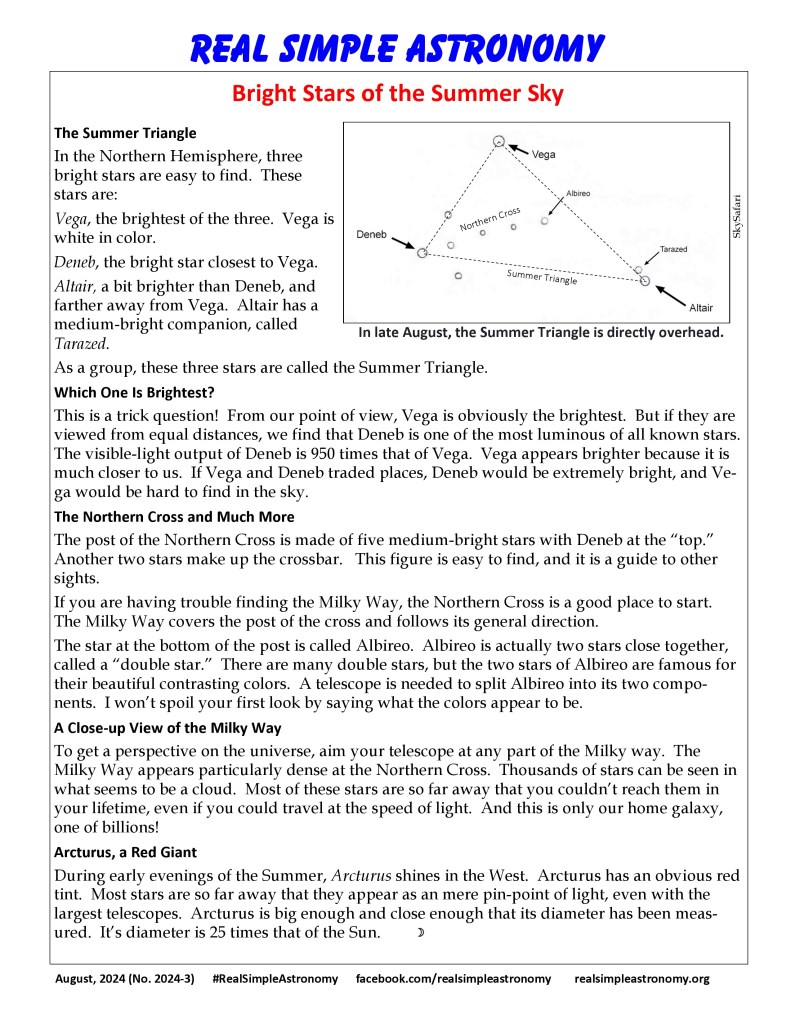
In the Northern Hemisphere, three bright stars are easy to find. These stars are:
Vega, the brightest of the three. Vega is white in color.
Deneb, the bright star closest to Vega.
Altair, a bit brighter than Deneb, and farther away from Vega. Altair has a medium-bright companion, called Tarazed.
As a group, these three stars are called the Summer Triangle.
Which One Is Brightest?
This is a trick question! From our point of view, Vega is obviously the brightest. But if they are viewed from equal distances, we find that Deneb is one of the most luminous of all known stars. The visible-light output of Deneb is 950 times that of Vega. Vega appears brighter because it is much closer to us. If Vega and Deneb traded places, Deneb would be extremely bright, and Vega would be hard to find in the sky.
The Northern Cross and Much More
The post of the Northern Cross is made of five medium-bright stars with Deneb at the “top.” Another two stars make up the crossbar. This figure is easy to find, and it is a guide to other sights.
If you are having trouble finding the Milky Way, the Northern Cross is a good place to start. The Milky Way covers the post of the cross and follows its general direction.
The star at the bottom of the post is called Albireo. Albireo is actually two stars close together, called a “double star.” There are many double stars, but the two stars of Albireo are famous for their beautiful contrasting colors. A telescope is needed to split Albireo into its two components. I won’t spoil your first look by saying what the colors appear to be.
A Close-up View of the Milky Way
To get a perspective on the universe, aim your telescope at any part of the Milky way. The Milky Way appears particularly dense at the Northern Cross. Thousands of stars can be seen in what seems to be a cloud. Most of these stars are so far away that you couldn’t reach them in your lifetime, even if you could travel at the speed of light. And this is only our home galaxy, one of billions!
Arcturus, a Red Giant
During early evenings of the Summer, Arcturus shines in the West. Arcturus has an obvious red tint. Most stars are so far away that they appear as an mere pin-point of light, even with the largest telescopes. Arcturus is big enough and close enough that its diameter has been measured. It’s diameter is 25 times that of the Sun.
Here are a few ideas which may or may not be included in the many excellent eclipse resources:
Where to Go
Many locations will probably have cloudy skies. So, try to have more than one place to go. Decide in advance how far you are willing to travel. Check the weather forecasts and say a prayer!
My ideal place would be in a large field without any distractions, such as floodlights which turn on in darkness. It would be interesting to find an elevated area, where the motion of the Moon’s shadow can be seen.
Some venues will have a sort of celebration, perhaps with music and fireworks. You may seek one or avoid one, as you prefer.
Lodging
Many eclipse chasers will change plans at the last minute, so keep checking for cancellations, even on Eclipse Day.
You Tube Videos
To get an idea what to expect, try watching videos of the August 2017 event from various locations. Ask yourself which settings you would enjoy.
Watching the Eclipse
Many people are overwhelmed by the sensations of the event and forget to carry out their plans. I met an experienced photographer who traveled thousands of miles to photograph a total solar eclipse. He forgot to take the pictures! Don’t feel bad if you do something similar.
If you have a camera which can operate automatically, try to set it up ahead of time.
Your basic equipment is a lawn chair and a pair of eclipse glasses. With just these, you can have a very good experience.
Immediately before and after totality there are many things to watch: shadow bands, motion of the Moon’s shadow, the Diamond Ring and Bailey’s beads. It would be difficult to see everything in the brief time available. If you see one or two of these things, call it a good day.
Safety
Please learn how to protect your eyes from the Sun.
There is a middle road between carelessness and over-caution. You don’t need to stay indoors and close the curtains!
During the Total portion of the eclipse, you may look at the Sun directly. You may take off your eclipse glasses when the last remnant of the Sun disappears. As soon as the Sun reappears, you should put your glasses back on.
This is a reprint of my account of the 2017 eclipse. I had never seen a total Solar Eclipse before. I hope you will find it helpful.
It has taken a week to catch up on a lot of neglected chores (like sleep), but now I am ready to tell the story!
Summary: The experience of the eclipse was worth four days of driving!
We had options to go to Missouri, Nebraska, or Tennessee. Based on the weather forecasts, we chose Lebanon, Tennessee. We arrived a day early, and searched for good places to watch the eclipse. The Cedars of Lebanon State Park looked good, but I was apprehensive that the viewing area would not be big enough for the expected crowds of people.
Early in the morning of eclipse day, my daughter and I returned to the park, and claimed a spot in the open field. It turned out that there was plenty of room for everyone. We were joined by a fellow-member of my astronomy club with some friends.
We wanted clear skies, and we got them! The Sun was high in the sky, and the air was hot and humid. Fortunately, we had two extra camera tripods and two umbrellas. We fastened the umbrellas to the tripods with hose clamps and duct tape, and positioned them near our chairs so that we had some relief from the scorching sunshine.
After a full day of clear skies, banks of clouds moved in, and covered the Sun at the start of the partial eclipse. Thankfully, the clouds left and did not come back.
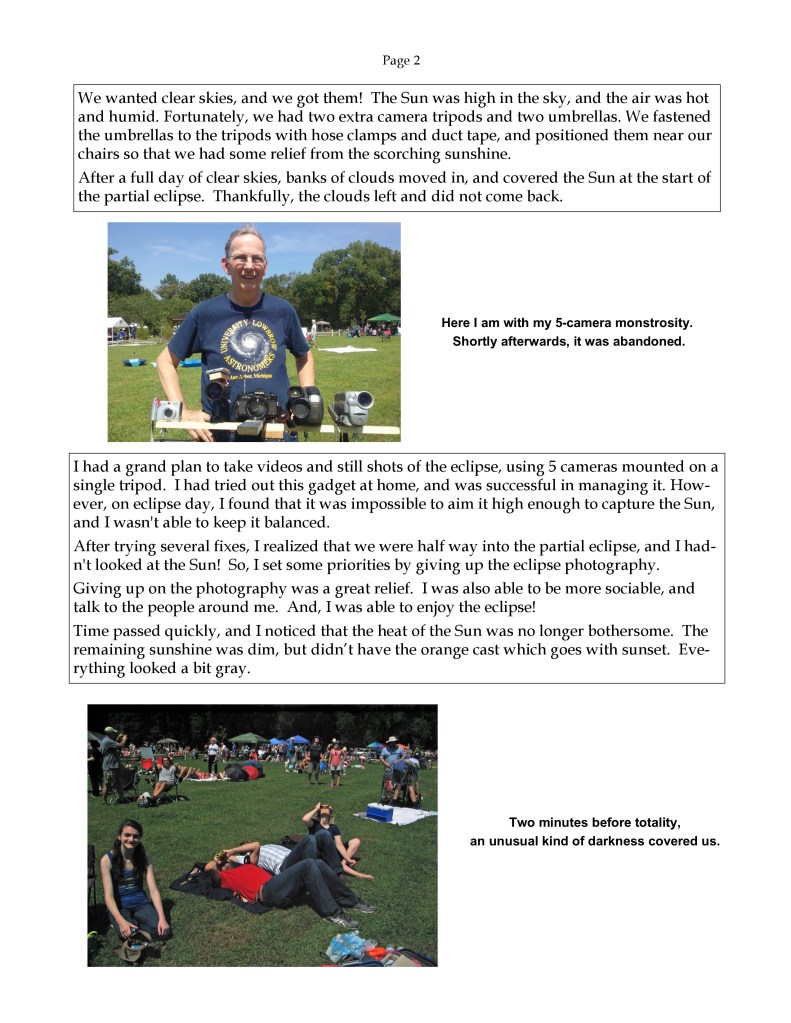
I had a grand plan to take videos and still shots of the eclipse, using 5 cameras mounted on a single tripod. I had tried out this gadget at home, and was successful in managing it. However, on eclipse day, I found that it was impossible to aim it high enough to capture the Sun, and I wasn’t able to keep it balanced.
After trying several fixes, I realized that we were half way into the partial eclipse, and I hadn’t looked at the Sun! So, I set some priorities by giving up the eclipse photography.
Giving up on the photography was a great relief. I was also able to be more sociable, and talk to the people around me. And, I was able to enjoy the eclipse!
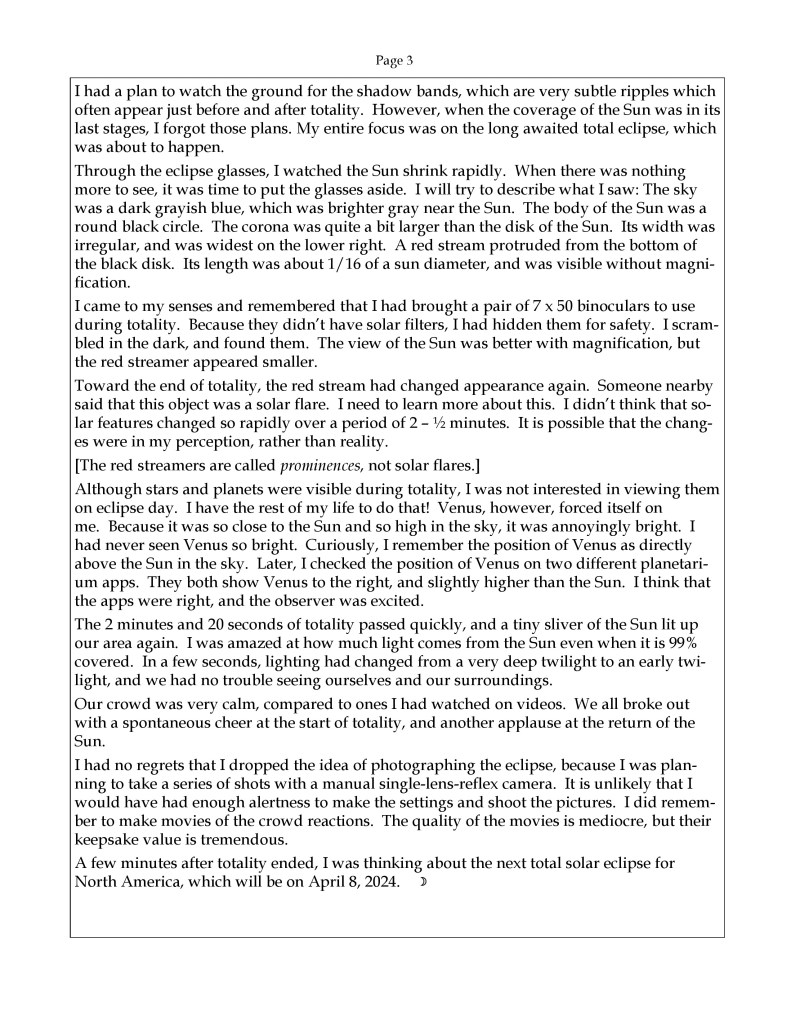
Time passed quickly, and I noticed that the heat of the Sun was no longer bothersome. The remaining sunshine was dim, but didn’t have the orange cast which goes with sunset. Everything looked a bit gray.
I had a plan to watch the ground for the shadow bands, which are very subtle ripples which often appear just before and after totality. However, when the coverage of the Sun was in its last stages, I forgot those plans. My entire focus was on the long awaited total eclipse, which was about to happen.
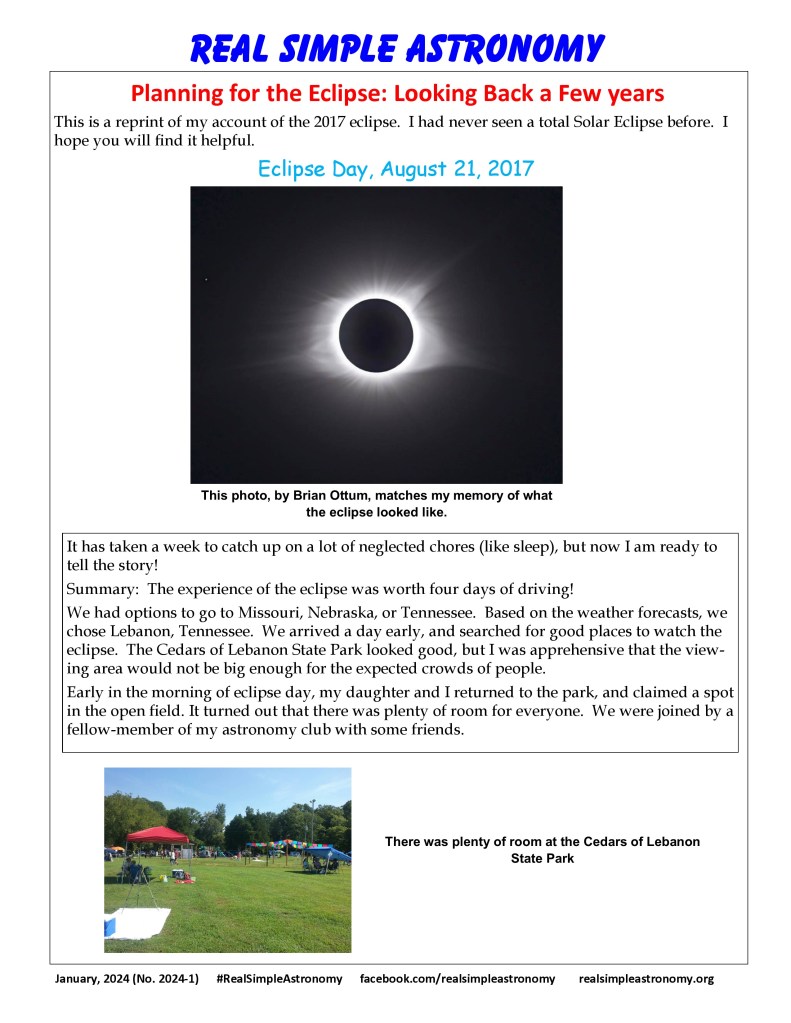
Through the eclipse glasses, I watched the Sun shrink rapidly. When there was nothing more to see, it was time to put the glasses aside. I will try to describe what I saw: The sky was a dark grayish blue, which was brighter gray near the Sun. The body of the Sun was a round black circle. The corona was quite a bit larger than the disk of the Sun. Its width was irregular, and was widest on the lower right. A red stream protruded from the bottom of the black disk. Its length was about 1/16 of a sun diameter, and was visible without magnification.
I came to my senses and remembered that I had brought a pair of 7 x 50 binoculars to use during totality. Because they didn’t have solar filters, I had hidden them for safety. I scrambled in the dark, and found them. The view of the Sun was better with magnification, but the red streamer appeared smaller.
Toward the end of totality, the red stream had changed appearance again. Someone nearby said that this object was a solar flare. I need to learn more about this. I didn’t think that solar features changed so rapidly over a period of 2 – ½ minutes. It is possible that the changes were in my perception, rather than reality.
[The red streamers are called prominences, not solar flares.]
Although stars and planets were visible during totality, I was not interested in viewing them on eclipse day. I have the rest of my life to do that! Venus, however, forced itself on me. Because it was so close to the Sun and so high in the sky, it was annoyingly bright. I had never seen Venus so bright. Curiously, I remember the position of Venus as directly above the Sun in the sky. Later, I checked the position of Venus on two different planetarium apps. They both show Venus to the right, and slightly higher than the Sun. I think that the apps were right, and the observer was excited.
The 2 minutes and 20 seconds of totality passed quickly, and a tiny sliver of the Sun lit up our area again. I was amazed at how much light comes from the Sun even when it is 99% covered. In a few seconds, lighting had changed from a very deep twilight to an early twilight, and we had no trouble seeing ourselves and our surroundings.
Our crowd was very calm, compared to ones I had watched on videos. We all broke out with a spontaneous cheer at the start of totality, and another applause at the return of the Sun.
I had no regrets that I dropped the idea of photographing the eclipse, because I was planning to take a series of shots with a manual single-lens-reflex camera. It is unlikely that I would have had enough alertness to make the settings and shoot the pictures. I did remember to make movies of the crowd reactions. The quality of the movies is mediocre, but their keepsake value is tremendous.
A few minutes after totality ended, I was thinking about the next total solar eclipse for North America, which will be on April 8, 2024.
A total eclipse of the Sun is an opportunity for a number of unique experiences. Here are some:
The Partial Phase
When the partial phase of the eclipse is progressing, the sky will darken. Unlike sunrise and sunset, the sky will take on a grey cast, rather than red or orange. Shadows, which are normally have a blurred outline, will get sharper and sharper as totality approaches.
As more and more of the Sun is covered, we will feel the chill.
The darkening of the sky and the chill will cause wildlife to make different sounds as they get ready for night time.
Totality Approaches
For a few minutes before totality, very subtle dark shadow bands are sometimes seen on the ground.
During the few seconds before totality, the last bits of sunlight form features called the Diamond Ring and Bailey’s Beads.
If you are in a high-rise or another good vantage point, you may see the central shadow of the Moon (called the umbra) as it covers the ground. It will move quickly, around 2000 mph!
Totality
Suddenly, all sunlight will be absent, except for a dim glow at the horizons. This light comes from distant places where the Sun is only partially eclipsed.
The Sun’s Corona will be visible. This is the outer region of the Sun’s atmosphere. It is not normally seen because it is overpowered by light from the disk of the Sun.
In addition to the corona, we will be able to see red solar prominences. Prominences are plumes of extremely hot gas protruding from the surface of the Sun. They are not a large feature, but can be seen at the edge of the eclipsed Sun.
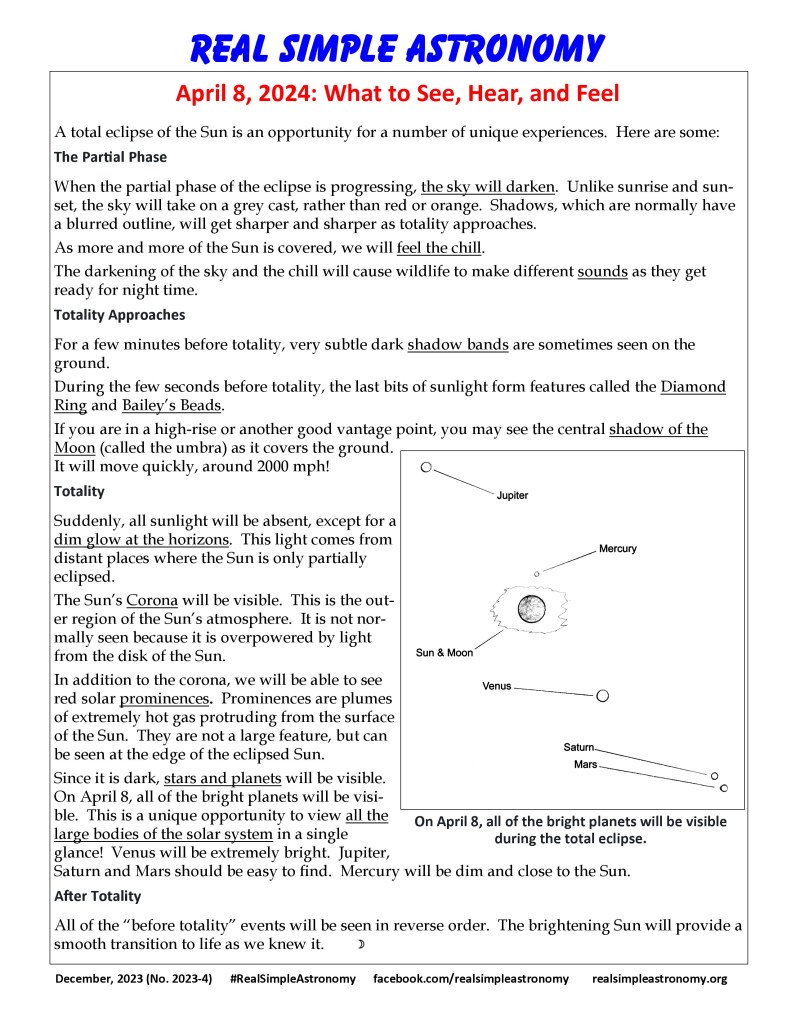
Since it is dark, stars and planets will be visible. On April 8, all of the bright planets will be visible. This is a unique opportunity to view all the large bodies of the solar system in a single glance! Venus will be extremely bright. Jupiter, Saturn and Mars should be easy to find. Mercury will be dim and close to the Sun.
After Totality
All of the “before totality” events will be seen in reverse order. The brightening Sun will provide a smooth transition to life as we knew it.
Of all the things one can see in the sky, the total eclipse of the Sun has the reputation of being the most spectacular. In this event, day turns into night as the Moon covers the bright face of the Sun. During this time, the outer region of the Sun, called the corona, is visible. Unfortunately, a total solar eclipse is visible only to people on a narrow strip of land. For the rest of the world, the Sun is covered only partially, or not at all.
Fortunately, residents of the continental United States will soon have a chance to see a total eclipse without making a long journey. On Monday, April 8, 2024, a total solar eclipse will be visible in Mexico, 15 states of the USA, and 6 provinces of Canada.
On-Line Planning Aids
To find out where you can experience this beautiful event, many planning tools are available on line. Here is one:
Go to: timeanddate.com/eclipse
Select “Path Map“ under “April 8, 2024 …”
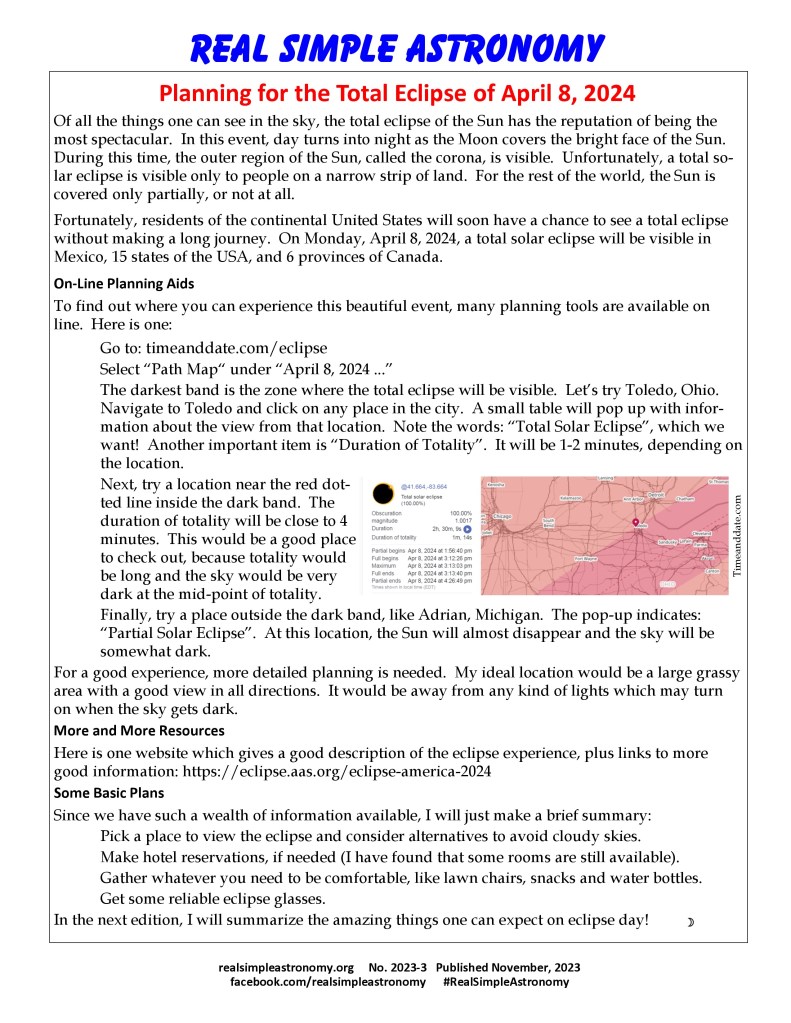
The darkest band is the zone where the total eclipse will be visible. Let’s try Toledo, Ohio. Navigate to Toledo and click on any place in the city. A small table will pop up with information about the view from that location. Note the words: “Total Solar Eclipse”, which we want! Another important item is “Duration of Totality”. It will be 1-2 minutes, depending on the location.
Next, try a location near the red dotted line inside the dark band. The duration of totality will be close to 4 minutes. This would be a good place to check out, because totality would be long and the sky would be very dark at the mid-point of totality.
Finally, try a place outside the dark band, like Adrian, Michigan. The pop-up indicates: “Partial Solar Eclipse”. At this location, the Sun will almost disappear and the sky will be somewhat dark.
For a good experience, more detailed planning is needed. My ideal location would be a large grassy area with a good view in all directions. It would be away from any kind of lights which may turn on when the sky gets dark.
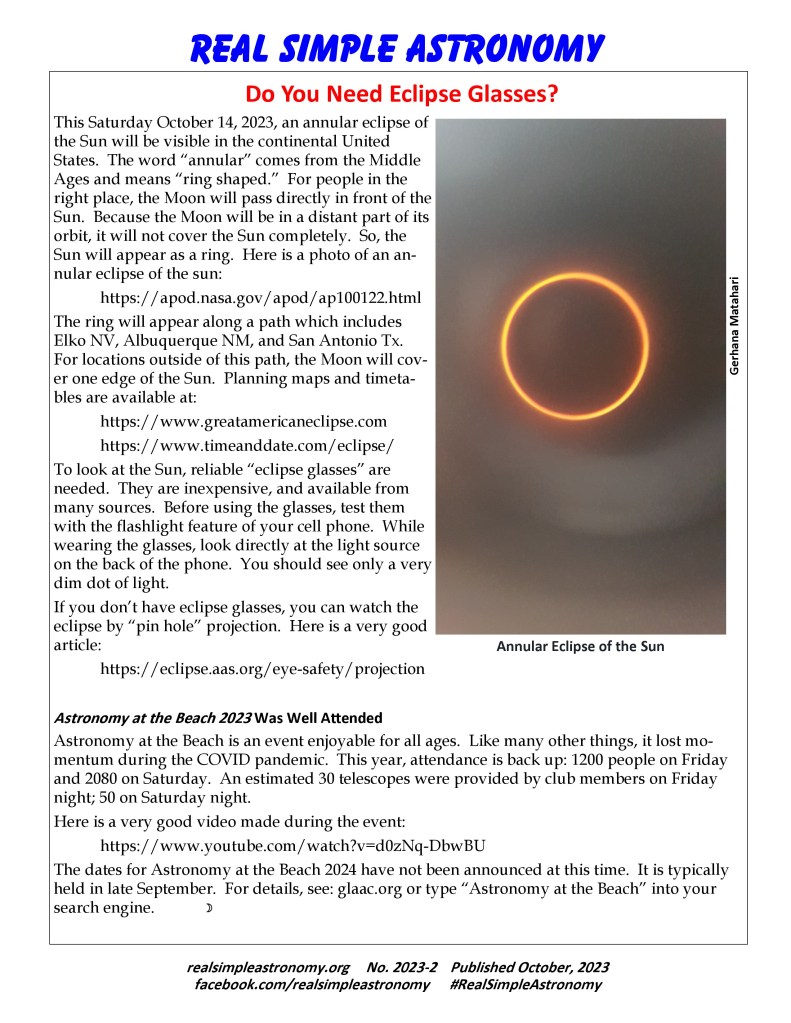
This Saturday October 14, 2023, an annular eclipse of the Sun will be visible in the continental United States. The word “annular” comes from the Middle Ages and means “ring shaped.” For people in the right place, the Moon will pass directly in front of the Sun. Because the Moon will be in a distant part of its orbit, it will not cover the Sun completely. So, the Sun will appear as a ring. Here is a photo of an annular eclipse of the sun:
The ring will appear along a path which includes Elko NV, Albuquerque NM, and San Antonio Tx. For locations outside of this path, the Moon will cover one edge of the Sun. Planning maps and timetables are available at:
To look at the Sun, reliable “eclipse glasses” are needed. They are inexpensive, and available from many sources. Before using the glasses, test them with the flashlight feature of your cell phone. While wearing the glasses, look directly at the light source on the back of the phone. You should see only a very dim dot of light.
If you don’t have eclipse glasses, you can watch the eclipse by “pin hole” projection. Here is a very good article:
Astronomy at the Beach is an event enjoyable for all ages. Like many other things, it lost momentum during the COVID pandemic. This year, attendance is back up: 1200 people on Friday and 2080 on Saturday. An estimated 30 telescopes were provided by club members on Friday night; 50 on Saturday night.
Here is a very good video made during the event:
The dates for Astronomy at the Beach 2024 have not been announced at this time. It is typically held in late September. For details, see: glaac.org or type “Astronomy at the Beach” into your search engine.
It has been a while since I have posted anything, but I hope you are following good sources of news and information. My goal is to avoid repeating things which other people have already explained. I like to simply share my own experiences and insights.
So, I will start off by encouraging everyone to make plans for a unique and beautiful event: the total eclipse of the Sun on April 8, 2024:
To Go, or Not to Go?
If you don’t live in North America, you probably aren’t excited about this event. But, if you do live in this continent, you may have an opportunity for an amazing experience. Millions of people won’t have to travel at all. They just need to go outdoors at the right time! For the rest of us, travel will be needed.
So, this is a good time to make plans.
I had a very good experience with the total solar eclipse of August 2017. I will re-post some freshened versions of articles from that time.
Where’s the Moon?
My 3-year-old grandson loves to look for the Moon in the daytime. If I’m around, he lets me know. On Memorial Day, he got a chance to see the Moon through a small telescope. The next time we met, instead of saying “Hi Grandpa”, he said: “WHERE’S THE MOON?”
Since the third quarter Moon hadn’t risen, I pointed to the ground and said: “It’s down there.” He immediately got down and pushed the grass aside and said: “The Moon is here!”
He may be destined to be an astronomy enthusiast—time will tell. I would love to tell him everything I know, but we know that wouldn’t work. Where does a 3-year-old begin? I will try a couple of books about the Solar System.
Astronomy at the Beach is Back Again!
If you are anywhere near the Detroit metro area, here is an opportunity for a very enjoyable event. Astronomy at the Beach will be held at Island Lake Recreation Area in Brighton, Michigan. It will be held on Friday and Saturday, September 22-23, 2023.
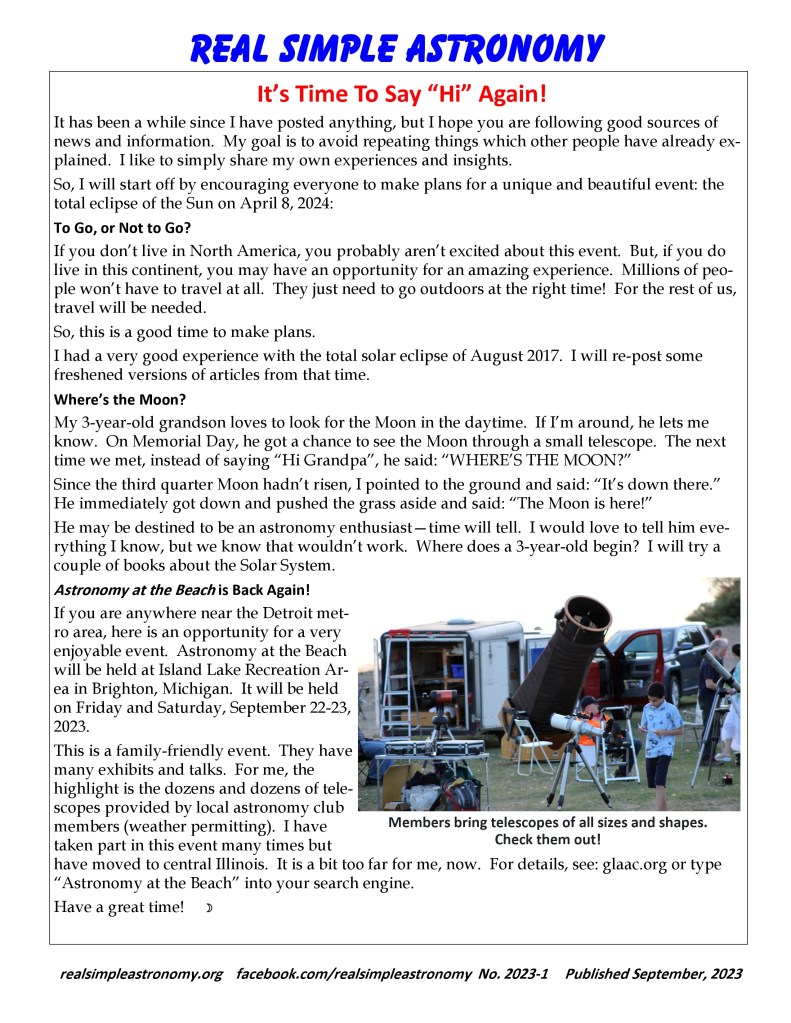
This is a family-friendly event. They have many exhibits and talks. For me, the highlight is the dozens and dozens of telescopes provided by local astronomy club members (weather permitting). I have taken part in this event many times but have moved to central Illinois. It is a bit too far for me, now. For details, see: glaac.org or type “Astronomy at the Beach” into your search engine.
From the earliest ages, the appearance of a new comet was a source of excitement. Bright comets can be awesome to see, and they do not come frequently.
Sometimes, comets were considered a sign that something good was about to happen. More often, however, people feared that something terrible was coming soon.
Today, we know a lot more about comets. But just like the days of old, I have some apprehension when I hear that a major comet is coming. I don’t fear that earthquakes or crop failures will happen. I just wonder if I will be able to get a good look!
Astronomers can tell us where a comet will be, but not what it will look like. So, I get excited when I hear that a bright one is approaching. On the happy side, I look forward to seeing a beautiful and unique sight in the sky. On the downside, I foresee a struggle to see it at all.
Comet Leonard Comes to Town
Comet Leonard came from a region of our solar system called the Oort Cloud, which is about 1,000 times as far away as Pluto. Objects in the Oort cloud are beyond the reach of even our best telescopes.
After traveling for thousands of years, our new object was discovered in January 2021 by Gregory Leonard. It’s official name is C/2021 A1 (Leonard).
As it approached, it was visible in the Northern Hemisphere before sunrise. I’ll make no excuses: I wasn’t motivated to get out of bed to look for it. I waited until it moved into the evening sky.
Unfortunately, the comet was visible for only a short time after sunset and was very low in the sky. I made a couple of trips to the edge of the city but found the sky too hazy to see the comet.
A Happy Ending in the Southern Hemisphere
Thanks to the internet, I was able to remotely operate a telescope in Australia (see iTelescope.net). On my first try, I got a very good, sharp image. I enjoy looking at details of a good image, but I especially enjoy standing outside and looking at a comet “in person.”










 Real Simple Astronomy