My goal is to post enjoyable items about the skies. I don't have a schedule for new posts, so please check in from time to time. If you would like, you can sign up for email notifications about new posts. Enjoy!
A satellite capable of capturing and de-orbiting a derelict object has been launched and will soon begin testing. If successful, it will help prevent collisions which flood the orbital paths with deadly debris.
In my opinion, the owner of the defunct satellite should pay for the expense of a retrieval mission. If this can be enforced, spacefarers would find it economical to include reliable de-orbiting systems into their spacecraft.
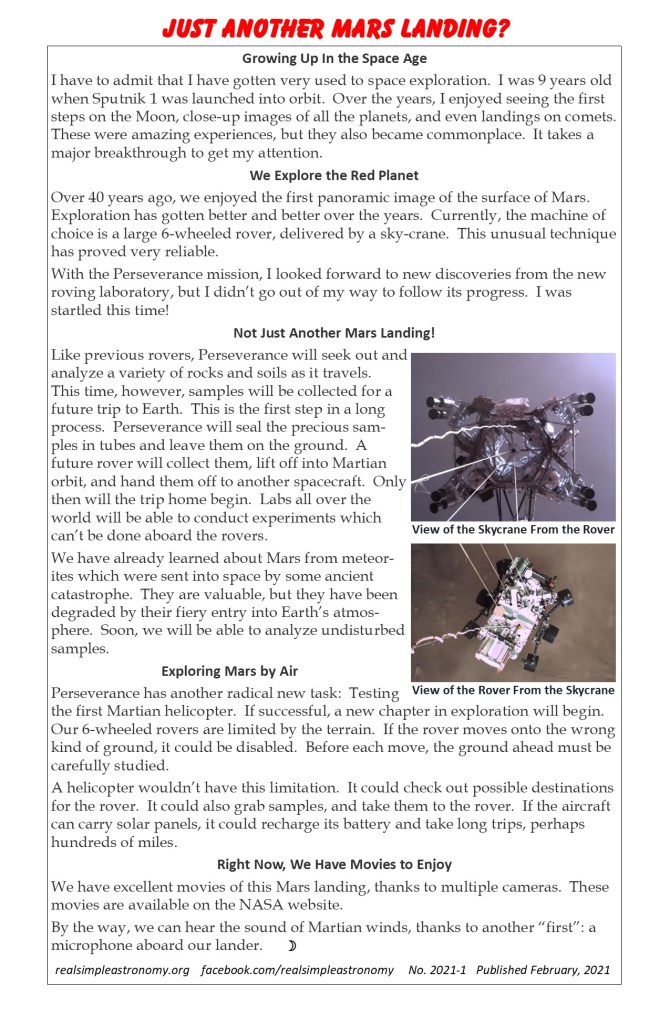
Growing Up In the Space Age I have to admit that I have gotten very used to space exploration. I was 9 years old when Sputnik 1 was launched into orbit. Over the years, I enjoyed seeing the first steps on the Moon, close-up images of all the planets, and even landings on comets. These were amazing experiences, but they also became commonplace. It takes a major breakthrough to get my attention. We Explore the Red Planet Over 40 years ago, we enjoyed the first panoramic image of the surface of Mars. Exploration has gotten better and better over the years. Currently, the machine of choice is a large 6-wheeled rover, delivered by a sky-crane. This unusual technique has proved very reliable. With the Perseverance mission, I looked forward to new discoveries from the new roving laboratory, but I didn’t go out of my way to follow its progress. I was startled this time! Not Just Another Mars Landing! Like previous rovers, Perseverance will seek out and analyze a variety of rocks and soils as it travels. This time, however, samples will be collected for a future trip to Earth. This is the first step in a long process. Perseverance will seal the precious samples in tubes and leave them on the ground. A future rover will collect them, lift off into Martian orbit, and hand them off to another spacecraft. Only then will the trip home begin. Labs all over the world will be able to conduct experiments which can’t be done aboard the rovers. We have already learned about Mars from meteorites which were sent into space by some ancient catastrophe. They are valuable, but they have been degraded by their fiery entry into Earth’s atmosphere. Soon, we will be able to analyze undisturbed samples. Exploring Mars by Air Perseverance has another radical new task: Testing the first Martian helicopter. If successful, a new chapter in exploration will begin. Our 6-wheeled rovers are limited by the terrain. If the rover moves onto the wrong kind of ground, it could be disabled. Before each move, the ground ahead must be carefully studied. A helicopter wouldn’t have this limitation. It could check out possible destinations for the rover. It could also grab samples, and take them to the rover. If the aircraft can carry solar panels, it could recharge its battery and take long trips, perhaps hundreds of miles. Right Now, We Have Movies to Enjoy We have excellent movies of this Mars landing, thanks to multiple cameras. These movies are available on the NASA website. By the way, we can hear the sound of Martian winds, thanks to another “first”: a microphone aboard our lander.
I forgot to mention the Geminid meteor shower, which peaks at 2 AM on the night of December 13/14, 2020. It is predicted to be better than the August Perseids.
I have included some links, but here is the bottom line: 1. Set up a recliner, 2. Set your alarm for 2 AM, 3. Put on everything warm that you have, 4. Watch the sky for at least a half hour. This is my plan.
During the current year, Jupiter and Saturn have been moving closer together in the sky. Now, they are close enough to be covered by one’s thumb held at arm’s length. For the next few weeks, they will continue to close in. Their closest position will occur on December 21. On this evening they can be covered by a toothpick!
Of course, this is just an appearance (called a conjunction). The two giant planets are always millions of miles apart. Conjunctions occur when two or more objects appear close together. Conjunctions are not unusual, but ones this close ones are very rare.
This is a good time to talk about orbital inclinations. Imagine you had a flat piece of paper bigger than the solar system. You could arrange it so that the orbit of Jupiter stays on the paper. To do the same thing for Saturn, you would have to move the paper, but you would lose the orbit of Jupiter. If you add a second piece of paper, you could use one for Jupiter’s orbit and one for Saturn’s orbit.
These sheets of paper are called orbital planes. Because two sheets are needed, we say that the orbital planes of Jupiter and Saturn are inclined at different angles. Before we go, let’s mark the orbits on their sheets.
In the diagram above, the positions of the two planets are shown for four nights. The orbital paths are from the two sheets of paper, as viewed from Earth. Notice that the planets have similar, but not identical paths. This year, Jupiter and Saturn will be close together in two ways. First, on December 21, they come close in their orbital journey around the Sun. Secondly, on this date, their orbital paths are close to each other.
Many centuries can pass between these events. Usually, the planets meet when their orbital paths are further apart. They will be seen in the same area of the sky, but they will be further apart.
Tonight would be a good time to start watching the dance of the giants. No equipment is needed.
If a telescope is available, a unique view will be possible: for a few days before and after December 21, both planets can be seen in the same view.
This link has an animated graphic which may help in visualizing orbital inclinations:
A prominent group of stars is now moving into view for evening observers.
This constellation is Orion, the hunter. Orion is easily recognized by its “belt” of three bright stars. With a little bit of imagination, one finds stars for the head, a shoulder, a club, two feet, and a sword kept beneath the belt.
Some constellations are visible only from northern latitudes, others only from southern latitudes. Orion is one can be seen from any place on Earth. For northerners, Orion stands in the southern part of the sky. For southerners, Orion is in the northern sky. For those on the equator, the hunter passes directly overhead. For the few people who visit the poles, half of Orion is just above the horizon, and the other half is just below the horizon.
In the north, the hunter figure will be “right side up”, with the head higher than the feet. In the south, our hunter is “upside down”.
Betelgeuse
Of Orion’s two brightest stars, Betelgeuse (pronounced “Beetle juice”) is the distinctly orange one. It is the “shoulder” of the hunter. Betelgeuse is classified as a “Red Supergiant” star. Its diameter is about 650 times that of our Sun. If it was at the center of our solar system, it would engulf Mercury, Venus, Earth, and Mars.
Because it is so huge and so close, images of Betelgeuse have been obtained, showing its outline and a glimpse of its surface features.
“Red supergiant” refers to a phase late in the life of many stars. Early in life, Betelgeuse was much smaller. When its supply of hydrogen fuel was used up, the star swelled to its current size.
The next major event would be a supernova explosion. This is expected “soon” in astronomical terms, meaning around a hundred thousand years for now. Since Betelgeuse is only 500 light years from us, a supernova would be quite dramatic. It would rival the Moon for brightness. Unfortunately, it’s remnant would be very dim, and the Hunter may no longer look like a hunter.
A year ago, Betelgeuse had an obvious decrease in brightness. There was speculation that the explosion was imminent. Later, it returned to its normal brightness. The current thinking is that an enormous cloud of dust was expelled, blocking part of our view of the star.
The Orion Nebula
So much for the end of a star’s life cycle. On the other side of the Hunter’s belt, we find the Orion Nebula, which is full of stars at their beginning stages. The Orion Nebula is very close to the Hunter’s belt of three stars. In Northern latitudes, look below the star at the left of the belt. In Southern latitudes, look above the star on the right. The Orion nebula appears as a fuzzy mass. In the city, it may not be visible to the naked eye.
The term nebula means “a cloud of gas or dust in interstellar space”. Virtually all of the gas in a nebula is hydrogen. The hydrogen in a nebula pulls together into a compact mass, through gravity. This process takes millions of years. If enough hydrogen is available, the molecules will be forced together tightly enough to start a nuclear fusion reaction. This is the birth of a star.
The Trapezium is a group of stars in the brightest area of the Orion Nebula. With a small telescope, four of its stars are visible. The stars of the Trapezium are the main sources of the intense visible and ultraviolet energy which lights up the entire nebula.
Explore Orion
Orion has many more nebulae and double stars to enjoy. Orion is a favorite of amateur astronomers, and an important study area for researchers. It is a constellation which “has something for everyone”.
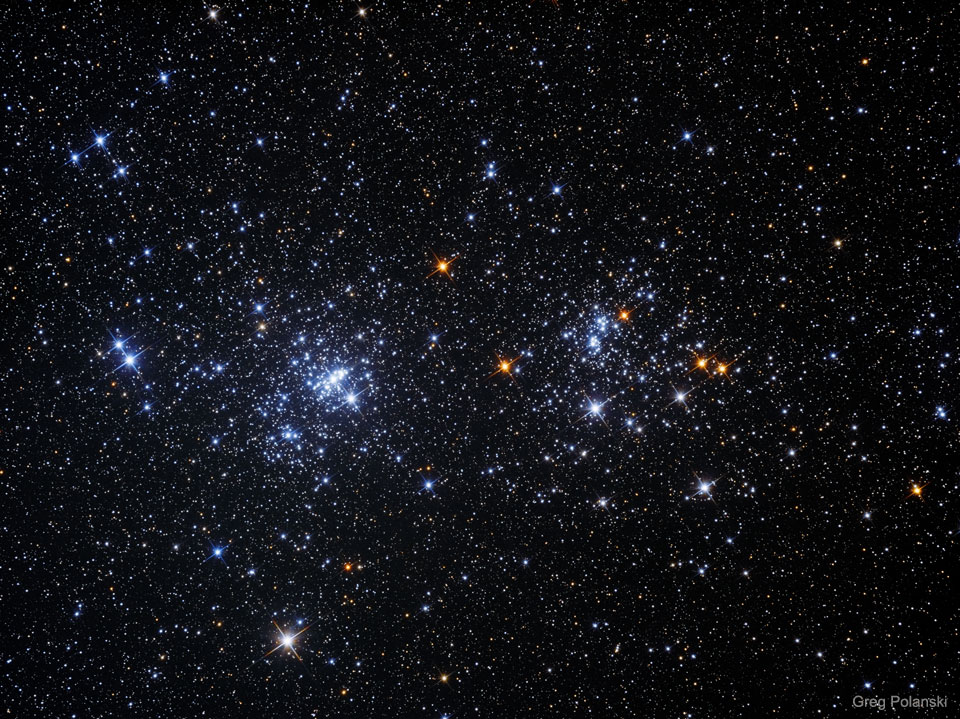
Here is one of my favorite objects. This is one spot in the sky where one can see a large number of stars. With a close look, a variety of star colors can be seen.
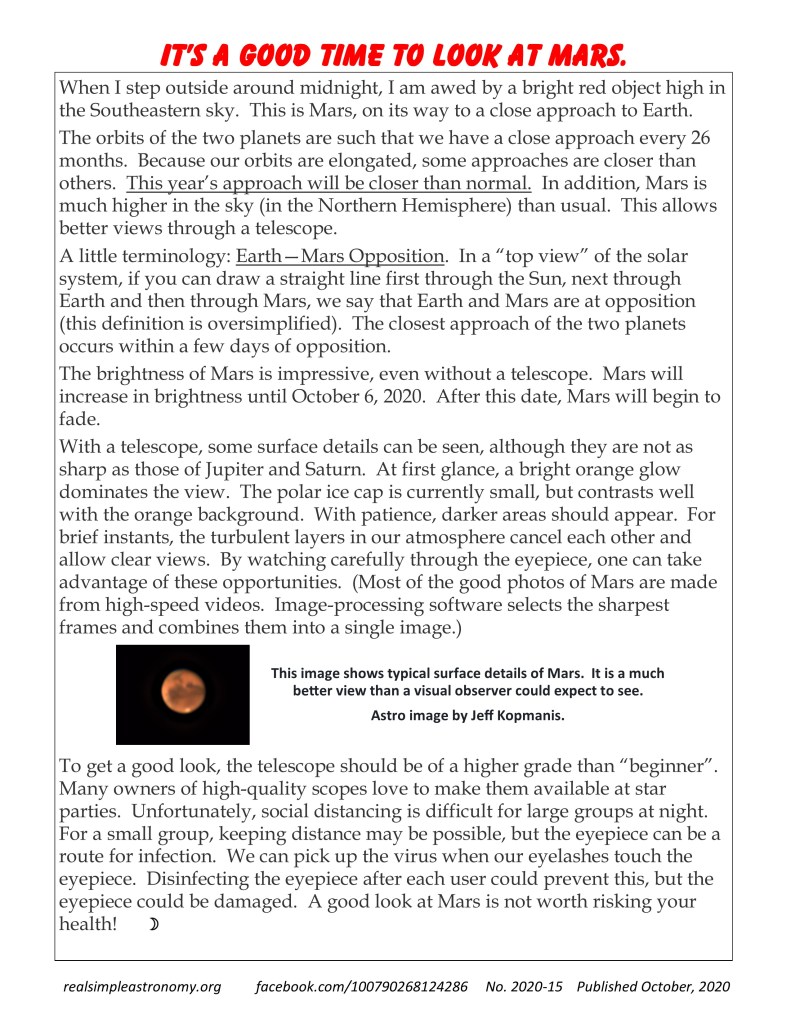
When I step outside around midnight, I am awed by a bright red object high in the Southeastern sky. This is Mars, on its way to a close approach to Earth.
The orbits of the two planets are such that we have a close approach every 26 months. Because our orbits are elongated, some approaches are closer than others. This year’s approach will be closer than normal. In addition, Mars is much higher in the sky (in the Northern Hemisphere) than usual. This allows better views through a telescope.
A little terminology: Earth—Mars Opposition. In a “top view” of the solar system, if you can draw a straight line first through the Sun, next through Earth and then through Mars, we say that Earth and Mars are at opposition (this definition is oversimplified). The closest approach of the two planets occurs within a few days of opposition.
The brightness of Mars is impressive, even without a telescope. Mars will increase in brightness until October 6, 2020. After this date, Mars will begin to fade.
With a telescope, some surface details can be seen, although they are not as sharp as those of Jupiter and Saturn. At first glance, a bright orange glow dominates the view. The polar ice cap is currently small, but contrasts well with the orange background. With patience, darker areas should appear. For brief instants, the turbulent layers in our atmosphere cancel each other and allow clear views. By watching carefully through the eyepiece, one can take advantage of these opportunities. (Most of the good photos of Mars are made from high-speed videos. Image-processing software selects the sharpest frames and combines them into a single image.)
To get a good look, the telescope should be of a higher grade than “beginner”. Many owners of high-quality scopes love to make them available at star parties. Unfortunately, social distancing is difficult for large groups at night. For a small group, keeping distance may be possible, but the eyepiece can be a route for infection. We can pick up the virus when our eyelashes touch the eyepiece. Disinfecting the eyepiece after each user could prevent this, but the eyepiece could be damaged. A good look at Mars is not worth risking your health!
ASTRONOMY AT THE BEACH 2020… WON’T BE AT THE BEACH.
September is the time for a most unique event for those in Southeastern Michigan. A joint effort of 10 astronomy clubs, along with educational institutions and generous sponsors, Astronomy At the Beach offers two evenings of presentations, demonstrations, and observation of the sky.
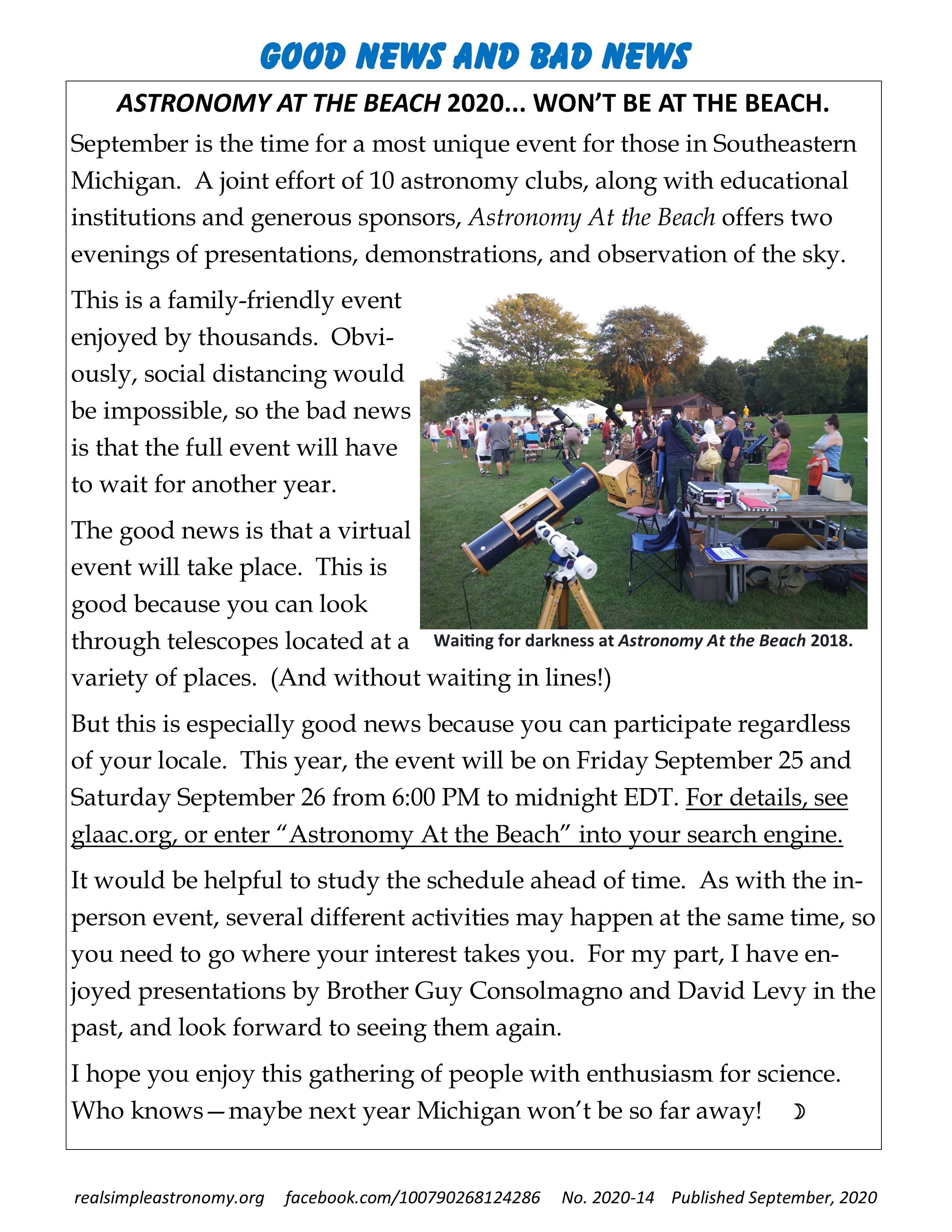
This is a family-friendly event enjoyed by thousands. Obviously, social distancing would be impossible, so the bad news is that the full event will have to wait for another year.
The good news is that a virtual event will take place. This is good because you can look through telescopes located at a variety of places. (And without waiting in lines!)
But this is especially good news because you can participate regardless of your locale. This year, the event will be on Friday September 25 and Saturday September 26 from 6:00 PM to midnight EDT. For details, see glaac.org, or enter “Astronomy At the Beach” into your search engine.
It would be helpful to study the schedule ahead of time. As with the in-person event, several different activities may happen at the same time, so you need to go where your interest takes you. For my part, I have enjoyed presentations by Brother Guy Consolmagno and David Levy in the past, and look forward to seeing them again.
I hope you enjoy this gathering of people with enthusiasm for science. Who knows—maybe next year Michigan won’t be so far away!
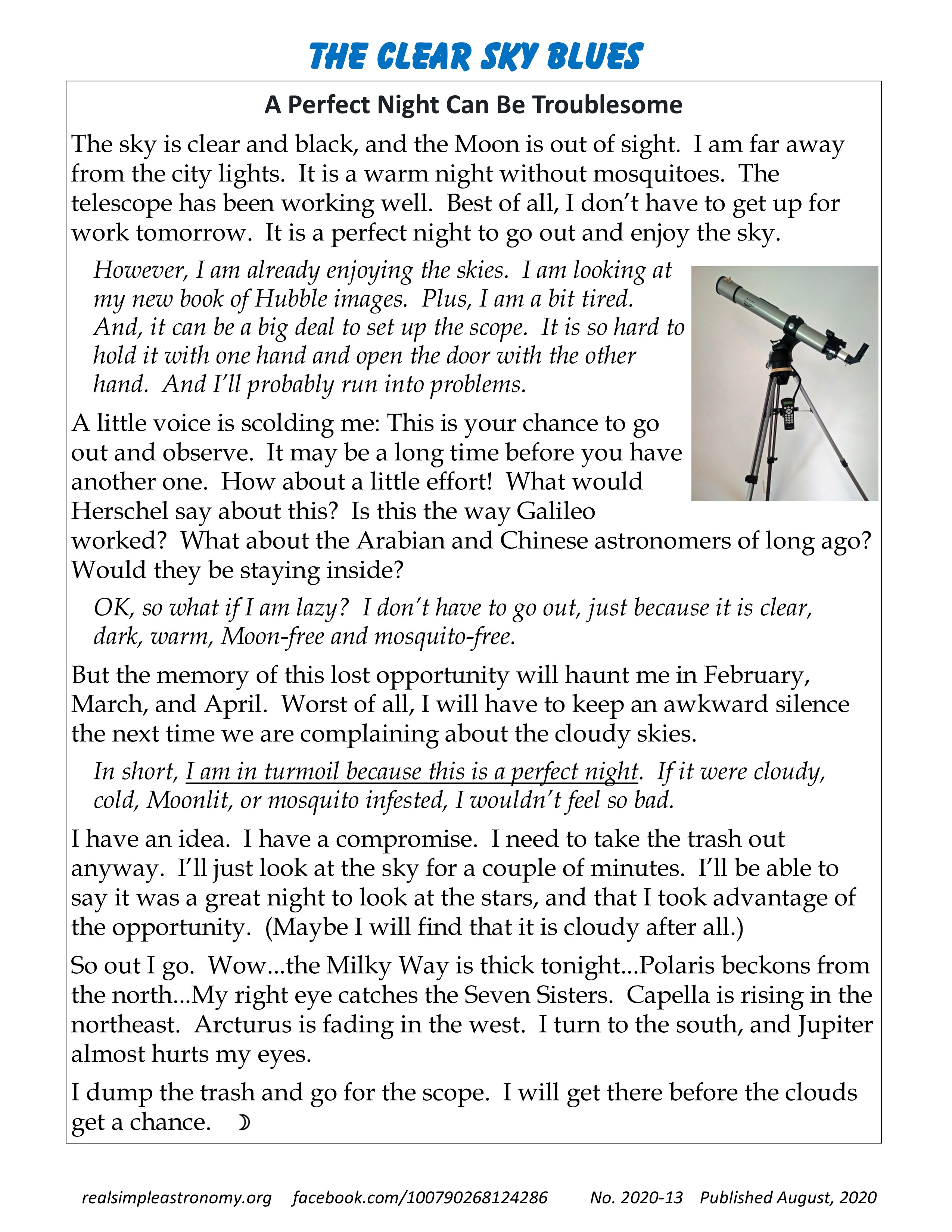
The sky is clear and black, and the Moon is out of sight. I am far away from the city lights. It is a warm night without mosquitoes. The telescope has been working well. Best of all, I don’t have to get up for work tomorrow. It is a perfect night to go out and enjoy the sky.
However, I am already enjoying the skies. I am looking at my new book of Hubble images. Plus, I am a bit tired. And, it can be a big deal to set up the scope. It is so hard to hold it with one hand and open the door with the other hand. And I’ll probably run into problems.
A little voice is scolding me: This is your chance to go out and observe. It may be a long time before you have another one. How about a little effort! What would Herschel say about this? Is this the way Galileo worked? What about the Arabian and Chinese astronomers of long ago? Would they be staying inside?
OK, so what if I am lazy? I don’t have to go out, just because it is clear, dark, warm, Moon-free and mosquito-free.
But the memory of this lost opportunity will haunt me in February, March, and April. Worst of all, I will have to keep an awkward silence the next time we are complaining about the cloudy skies.
In short, I am in turmoil because this is a perfect night. If it were cloudy, cold, Moonlit, or mosquito infested, I wouldn’t feel so bad.
I have an idea. I have a compromise. I need to take the trash out anyway. I’ll just look at the sky for a couple of minutes. I’ll be able to say it was a great night to look at the stars, and that I took advantage of the opportunity. (Maybe I will find that it is cloudy after all.)
So out I go. Wow…the Milky Way is thick tonight…Polaris beckons from the north…My right eye catches the Seven Sisters. Capella is rising in the northeast. Arcturus is fading in the west. I turn to the south, and Jupiter almost hurts my eyes.
I dump the trash and go for the scope. I will get there before the clouds get a chance.
The meteors or “shooting stars” which we see at night are solid objects, usually no bigger than a grain of sand, which burn up when they collide with Earth’s atmosphere. Many comets leave trails of these particles in orbits around the Sun. At a particular time of the year, Earth may pass through one of these swarms, producing a “meteor shower”.
Meteor showers happen at all times of the year, but the Perseid shower is very popular in the Northern Hemisphere because it is seen on the warm nights of August. More importantly, it produces a large number of meteors (roughly 60 per hour). The Perseids reach their maximum on the night of August 11-12, but they are also seen for a couple of weeks before and after that time.
The “right” way to observe a meteor shower is to simply lay back on a lounge chair, and watch a particular section of the sky (see links for details). Before your eyes get dark-adapted, you may think that nothing is happening. After a few minutes, your vision will be improved. It takes about 40 minutes to achieve full dark adaptation. This can be lost very quickly if you look at a white light!
For those who don’t want to go to all of this trouble, the peak night of the Perseids is the time to watch. If one goes outside and watches for 10 minutes, one or two shooting stars will likely be seen.
The brightness of the meteors ranges from extremely dim to that of a bright star. They move very fast. Sometimes, the event will look like a gray thread which very briefly flashes and disappears.
This year, the Perseids share the sky with the waning crescent Moon, which will hide the dimmer meteors. Next year, the Moon will not interfere with the Perseids.
I have included some links with details. One link is for a live webcast from the Lowell Observatory in Arizona. They will use an “all-sky” camera to show the meteors. I have never seen this, but I will check it out if it is cloudy at my home.