Comet Hunting, Success!

Here is a link with instructions for locating comet NEOWISE:
https://skyandtelescope.org/press-releases/new-bright-visitor-comet-neowise/
Time For Comet-Hunting!

Here is the link to the Astronomy magazine article:
https://astronomy.com/news/2020/07/comet-c2020-f3-neowise-springs-a-naked-eye-surprise
(Plain Text Version)
We are finally in the right position to greet a visitor from the dark, icy fringes of the solar system. Comet C/2020 F3 (NEOWISE) has survived its close encounter with the Sun, and is now approaching our planet. We have countless reports that it is great to observe with a telescope, binoculars, or the naked eye.
Rather than retelling the story, I recommend the link to an article from Astronomy magazine.
Morning Comet…Invisible…Evening Comet…Departure
Right now, NEOWISE is visible just above the horizon in the morning twilight. You will need a site with a clear view of the horizon to the Northeast. The bright yellow star, Capella, will be just above the comet. The best time to look is a bit tricky. Since it is near the Sun, it won’t rise until about 2 hours before sunrise. It will get higher with time, but the sky will be getting brighter. So, somewhere in the middle is the best time to catch this object. I would recommend starting about 1-1/2 hours before sunrise, and checking the area every 5 minutes.
After a few more days NEOWISE won’t be visible because it will rise with the Sun. Around July 15, it will begin to be visible in the Northwest after sunset. It’s setting time will be later each day, making observation much more easy. But, there is another catch…the comet will start moving away from us, so it will start losing brightness and detail.
Safety First.
In the morning, one must be careful not to look at the Sun through a telescope or binoculars, even briefly. One way to avoid this would be to set an alarm for 20 minutes before sunrise. This would be the signal to stop observing (the sky would be too bright anyway).
Happy comet hunting!
Your First Telescope – Part 2 – Finding Objects

Here are links to more information on the SSE system:
https://www.celestron.com/pages/starsense-explorer-technology
https://www.celestron.com/collections/starsense-explorer-smartphone-app-enabled-telescopes
(Plain Text Version)
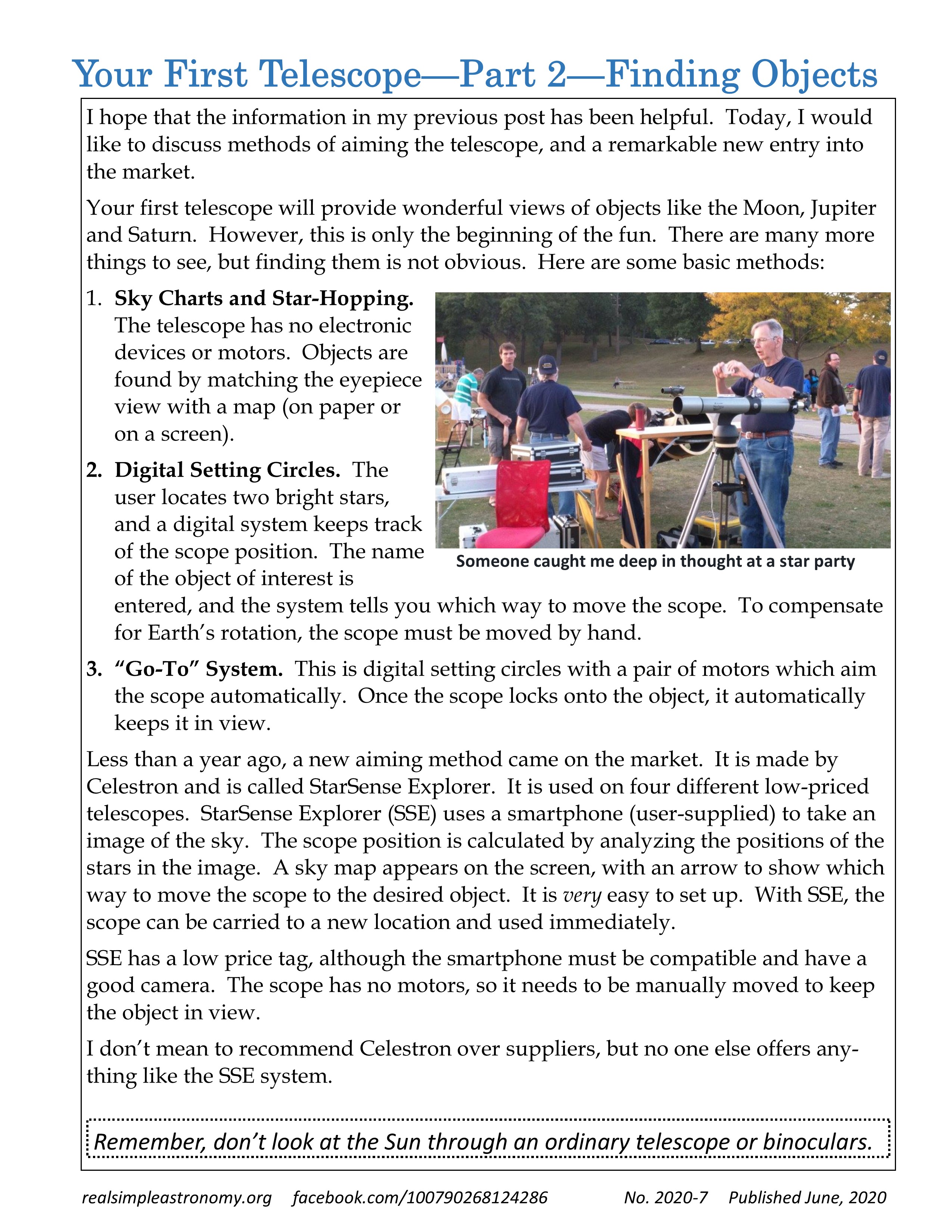
I hope that the information in my previous post has been helpful. Today, I would like to discuss methods of aiming the telescope, and a remarkable new entry into the market.
Your first telescope will provide wonderful views of objects like the Moon, Jupiter and Saturn. However, this is only the beginning of the fun. There are many more things to see, but finding them is not obvious. Here are some basic methods:
1. Sky Charts and Star-Hopping. The telescope has no electronic devices or motors. Objects are found by matching the eyepiece view with a map (on paper or on a screen).
2. Digital Setting Circles. The user locates two bright stars, and a digital system keeps track of the scope position. The name of the object of interest is entered, and the system tells you which way to move the scope. To compensate for Earth’s rotation, the scope must be moved by hand.
3. “Go-To” System. This is digital setting circles with a pair of motors which aim the scope automatically. Once the scope locks onto the object, it automatically keeps it in view.
Less than a year ago, a new aiming method came on the market. It is made by Celestron and is called StarSense Explorer. It is used on four different low-priced telescopes. StarSense Explorer (SSE) uses a smartphone (user-supplied) to take an image of the sky. The scope position is calculated by analyzing the positions of the stars in the image. A sky map appears on the screen, with an arrow to show which way to move the scope to the desired object. It is very easy to set up. With SSE, the scope can be carried to a new location and used immediately.
SSE has a low price tag, although the smartphone must be compatible and have a good camera. The scope has no motors, so it needs to be manually moved to keep the object in view.
I don’t mean to recommend Celestron over suppliers, but no one else offers anything like the SSE system.
Remember, don’t look at the Sun through an ordinary telescope or binoculars.
Choosing a “First Telescope”
Here are some good articles on shopping for a telescope:
https://astronomy.com/-/media/Files/PDF/Buying%20Your%20First%20Telescope.pdf
https://www.space.com/15693-telescopes-beginners-telescope-reviews-buying-guide.html
https://skyandtelescope.org/astronomy-news/types-of-telescopes/
https://skyandtelescope.org/astronomy-equipment/telescope-buying-guide/
(Plain Text Version)
As wonderful as the night sky appears to the naked eye, there is much more to see with the aid of a telescope.
Rather than tell you how to pick out a telescope, I will post links to some very informative articles. I will just add a few ideas of my own:
1. If you can get to a star party, the telescope owners will be glad to show how their telescopes work. They will help you to learn the advantages and disadvantages of the various choices.
2. Your local public library may be lending telescopes. These telescopes are usually in the low price category, but they will help you to learn how to use a telescope.
3. Some manufacturers who offer low priced telescopes of good quality: Celestron, Meade, Orion, Sky Watcher.
4. If you want to do astroimaging, consider doing it with your second telescope. Scopes suitable for imaging are much more expensive than ones for visual use only. For your first telescope, choose one that is easy to set up, and enjoy visual astronomy for a while. Later, you will be able to make a better choice for your new instrument.
5. Think about size, weight and ease of setup when making your selection. When the Sun goes down, your energy level may be declining. If the telescope is hard to set up, you may be tempted to stay indoors!
To be continued …

(Plain Text Version)
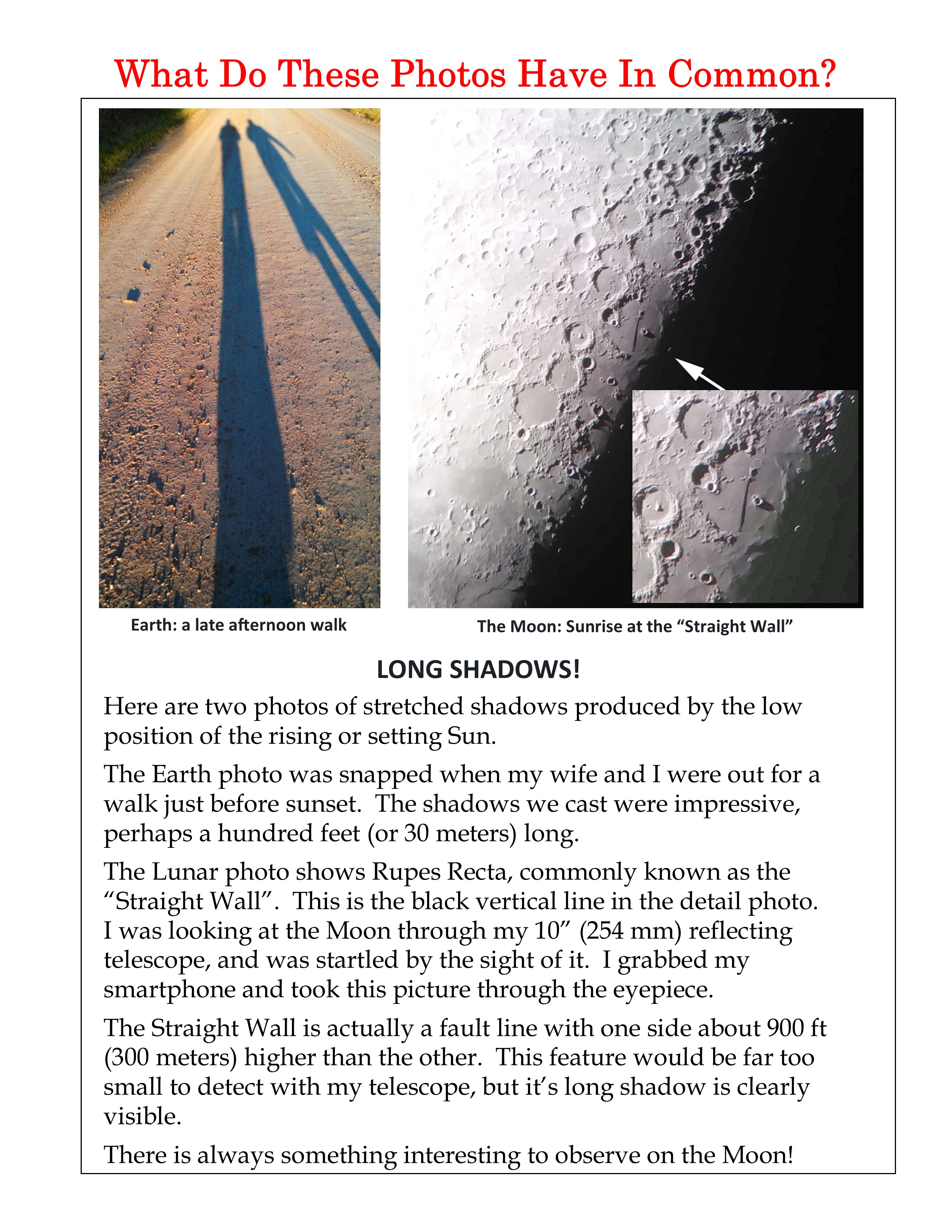
LONG SHADOWS!
Here are two photos of stretched shadows produced by the low position of the rising or setting Sun.
The Earth photo was snapped when my wife and I were out for a walk just before sunset. The shadows we cast were impressive, perhaps a hundred feet (or 30 meters) long.
The Lunar photo shows Rupes Recta, commonly known as the “Straight Wall”. This is the black vertical line in the detail photo. I was looking at the Moon through my 10” (254 mm) reflecting telescope, and was startled by the sight of it. I grabbed my smartphone and took this picture through the eyepiece.
The Straight Wall is actually a fault line with one side about 900 ft (300 meters) higher than the other. This feature would be far too small to detect with my telescope, but it’s long shadow is clearly visible.
There is always something interesting to observe on the Moon!

Links:
https://www.space.com/41494-spacex-crew-dragon-spaceship-inside-look.html (General Description)
NASA.gov. (for NASA TV launch coverage)
Heavens-above.com My favorite satellite tracker (Be sure to enter your exact location and time zone)
(Plain Text Version)
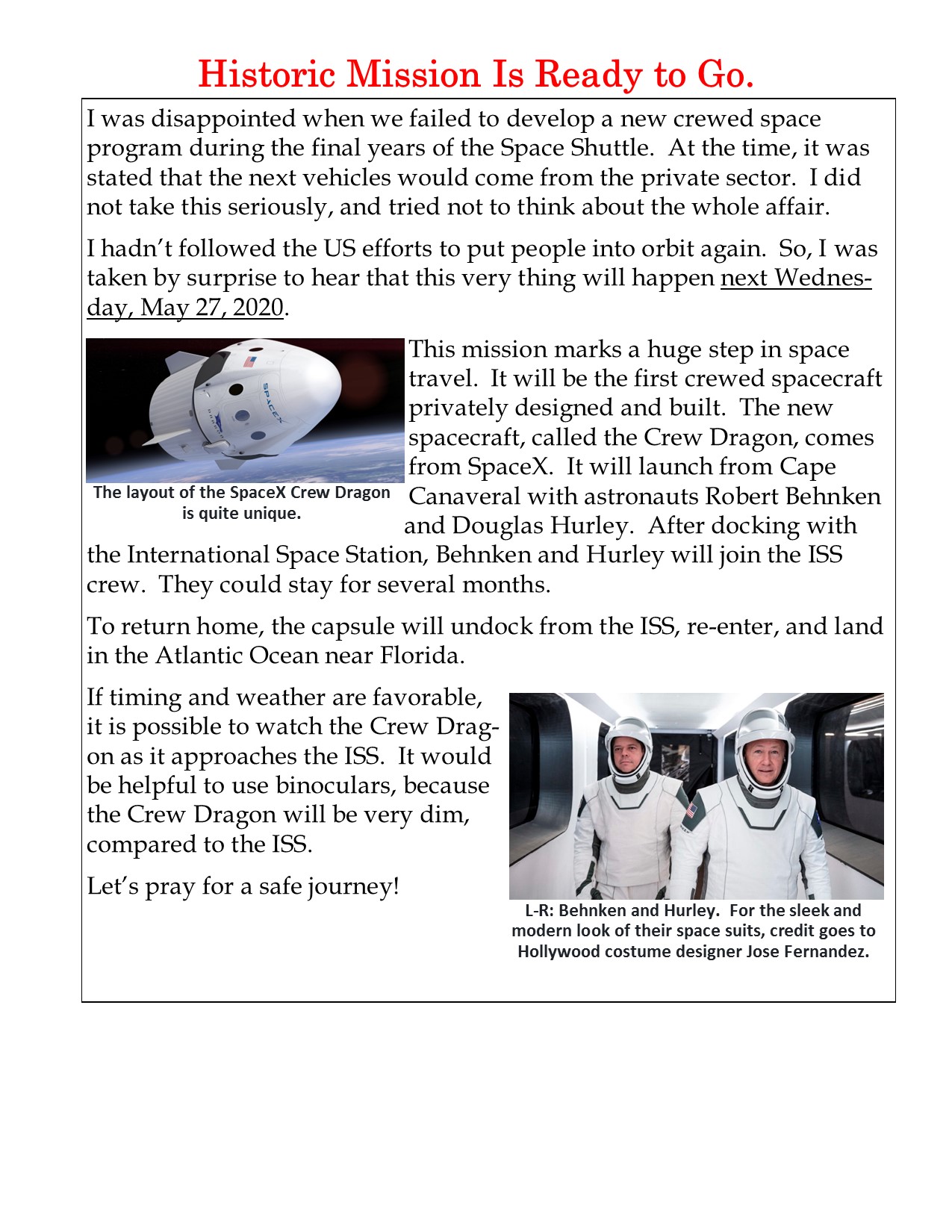
I was disappointed when we failed to develop a new crewed space program during the final years of the Space Shuttle. At the time, it was stated that the next vehicles would come from the private sector. I did not take this seriously, and tried not to think about the whole affair.
I hadn’t followed the US efforts to put people into orbit again. So, I was taken by surprise to hear that this very thing will happen next Wednesday, May 27, 2020.
This mission marks a huge step in space travel. It will be the first crewed spacecraft privately designed and built. The new spacecraft, called the Crew Dragon, comes from SpaceX. It will launch from Cape Canaveral with astronauts Robert Behnken and Douglas Hurley. After docking with the International Space Station, Behnken and Hurley will join the ISS crew. They could stay for several months.
To return home, the capsule will undock from the ISS, re-enter, and land in the Atlantic Ocean near Florida.
If timing and weather are favorable, it is possible to watch the Crew Dragon as it approaches the ISS. It would be helpful to use binoculars, because the Crew Dragon will be very dim, compared to the ISS.
Let’s pray for a safe journey!
Will we Get to See Comet Atlas?
Comets seem to love surprises. Before astronomers began to make sense of their nature, bright comets would appear without warning, and dominate the night (and sometimes daytime) sky. Quite often, they were thought to be precursors to disasters. Some people with a more cheerful outlook would take a comet’s arrival to indicate that a great king was born.
Today, we are not free from fear of these beautiful visitors. They are large enough and fast enough to devastate any planet that sits in their path. According to a plausible theory, the dinosaur extinction resulted from climate changes triggered by a comet impact 65 million years ago.
A more recent example happened in 1994, when the fragmented comet Shoemaker-Levy 9 collided with the planet Jupiter. When large fragments entered Jupiter’s thick atmosphere, they exploded, and created dark spots in the bright clouds. Many of these spots were larger than Earth!
So much for the scary stuff. We have just heard that comet C/2019 Y4 (ATLAS) has had a large, sudden increase in brightness. A comet will warm up as it approaches the Sun, and vapors and dust will escape the surface to form a cloud. Atlas has suddenly formed an extra large cloud, so it appears much brighter than expected.
So, Atlas has graduated from a “telescopic comet” to one which might be visible to the naked eye.
And here we get to the unpredictability of comets. Although their orbits are calculated very precisely, their visibility and appearance are very hard to predict. Based on the brightening of comet Atlas, we may see a very bright comet in May, 2020. It is possible that it will be visible during daylight; it is also possible that it will disintegrate as it makes its closest approach to the Sun.
Here is a very good article with many details:
https://earthsky.org/space/how-to-see-bright-comet-c-2019-y4-atlas
I will try to keep you posted. In the meantime…
Keep looking up!