Mars Opposition – Part 2 – How to Observe the Planets

Of all the planets in our solar system, only three lend themselves to detailed examination with amateur telescopes: Jupiter, Saturn, and Mars.  The other planets are interesting, but don’t reveal much detail.  Mercury is small, and low in the sky at night.  Venus is covered by a permanent cloud deck.  Uranus and Neptune are very far away.

I do enjoy looking at Mercury, Venus, Uranus and Neptune and encourage you to do likewise.  However, Jupiter, Saturn, and Mars have large and small surface details.  Even with the best telescopes, the best sky conditions, and the best observing techniques, there will be details which are just out of reach.  We keep coming back, hoping to do better.

Good News for City-Dwellers!

It is not necessary to flee to the country to view of the bright planets, because they stand out against the bright sky.  Many observers actually prefer a bright background to a black one.

So, try to find out what will be happening in your area.  Some astronomy clubs set up telescopes in downtown locations.  Also, many urban observatories which had fallen into disuse, are now open to the public.

Telescopes

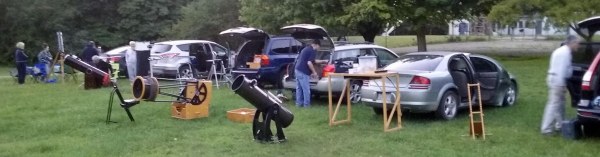
In this tiny article, I won’t try to cover the strengths and weaknesses of the diverse types of telescopes.    Since Jupiter, Saturn, and Mars are bright, a large diameter objective lens or mirror is not necessary.  For planetary observation, pick the telescope with the most precisely crafted optical components.  The better the optics, the less the image details will be distorted.  As with most things, quality costs money, and high quality costs a lot of money.  For this reason, I recommend enjoying the Mars opposition at an observatory or at a star party.

Sky Conditions

Although we are glad to have air to breathe, we wish it wouldn’t distort our view of everything more than a few miles away.  If the air was free of dust and mist, and was uniform in density, our planet-watching would be much better.  In reality, we must cope with the air we have.  The higher the planet is above the horizon, the better the view, since we have less air to look through.  There are on-line resources which predict transparency (freedom from haze) and “seeing” (freedom from distortion caused by variations in air density).

How to Observe

“Patience” is the key word in observing the features of the planets.  Our goal is to see the delicate details as well as we can.  I am not an expert observer, but I will tell what I know.  It helps to study good photos of the planets, to know what to look for.  Astronomical apps are useful for previews of features like the Great Red Spot of Jupiter and the light and dark areas of Mars.  Look at broad features first, and then look for finer ones.
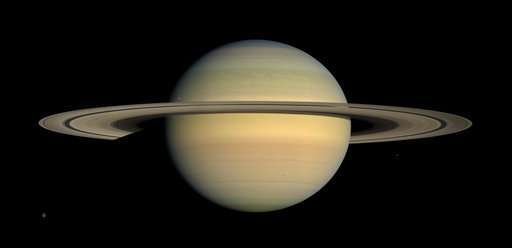
Saturn - NASA - farewellcass
Saturn, From the Cassini Mission


Let’s take Saturn for an example.  Even a very small telescope shows the rings, but perhaps not the Cassini Division (the black gap in the outer portion of the ring system).  If you find the Cassini Division, can you see any other gaps or features of the rings?  At first look, the planet itself seems uniformly white or tan, but can you see bands with subtle color variations?

Your view of a planet will keep changing from bad to good and good to bad.  This is not necessarily a problem with your eyesight.  Here is where the patience comes in.  Because our atmosphere is constantly in motion, the image distortions keep changing.  Sometimes the distortion is extreme, and other times it is not so bad.  To catch the details, we need to concentrate, but also relax and wait for the brief moments of clarity.  These glimpses may last only a fraction of a second, so try to memorize what you see.

“Patience” also applies to the people waiting in line behind you.  You should take as much time as you need to grab the best moments of image clarity.  Fifteen seconds is not long enough.  Two minutes is not unreasonable.  At some point, you will decide that there won’t be a better view, and it is time to move on.  But don’t leave – go to the end of the line for another try!  By the time your turn comes up, the atmosphere will be different – maybe better, maybe worse.
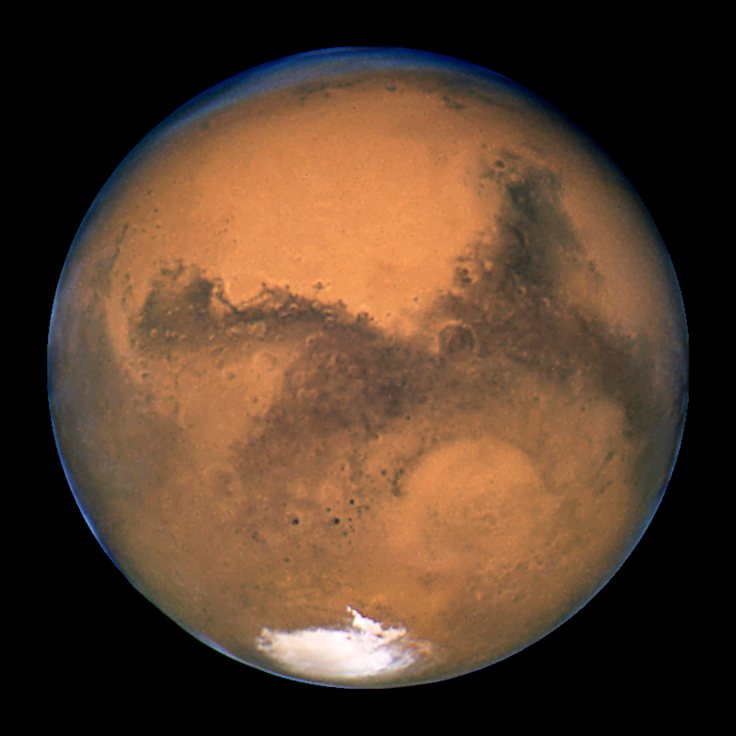
Mars - Hubble hs-2005-34-j-full_jpg
Mars, From the Hubble Space Telescope


The surface details of Mars are very subtle and can be completely missed if one is not patient.  The splendid photos we see on line and in print are usually adjusted for enhanced contrast.  In visual observation, we don’t have this luxury.  In the telescope, Mars can be very bright, and seem devoid of any details.  With patience, fleeting glimpses of the dark areas may occur.  Depending on the Martian seasons, and orbital positions, one of the polar ice caps may be visible.

My “best-ever” view of Mars was near the opposition of 2014.  I was fortunate to look through a very good 24” reflecting telescope.  After waiting a while, an ice cap and some of the dark surface features appeared and promptly disappeared.  Unfortunately, they did not reappear.

Conclusion

There is much more to say about observing the planets, but I hope I have given you motivation to learn more and watch more.  In upcoming articles, I hope to cover best times to observe and how to find resources in your area.

Keep looking up,

John


Resources

Sky conditions, including transparency and seeing for the US and Canada:

http://www.cleardarksky.com/csk/index.html#chart_list


Weather and other data for any location:

http://clearoutside.com/forecast/50.7/-3.52


Articles:

http://www.skyandtelescope.com/observing/interactive-sky-watching-tools/mars-which-side-is-visible/

http://www.astronomy.com/videos/tour-the-solar-system/2010/11/tour-the-solar-system-mars

The Mars Opposition – Part 1 – It is Coming!

Mid-summer of 2018 will be a very good time to observe Mars.  During this period, the Mars-Earth distance will be at its lowest in 15 years.  These opportunities come rarely because of the shape of the orbit of Mars.

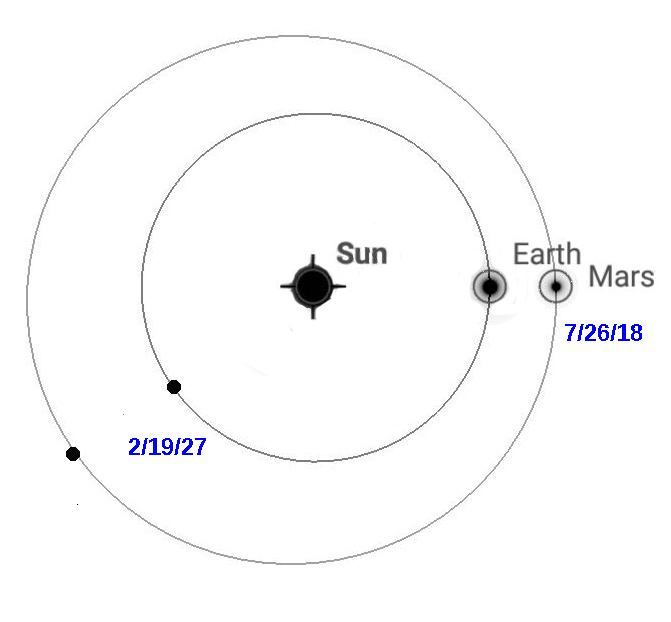
Here is a diagram of Earth’s and Mars’ orbits, drawn to scale (thanks to the SkySafari app):7-26-18.jpg d

As you can see, Earth’s orbit is a lot rounder than Mars’ orbit.  As the two planets progress around the Sun their oppositions (closest alignments) can be close or distant.  Oppositions occur approximately every 26 months.  For clarity, we are showing only two oppositions, a  close one (this July) and a distant one (in 2027).

At the next opposition, which occurs on July 26, 2018, Mars will be at its brightest.  This will also be the best time use a telescope to look at its surface features. Of course, weather and other things get in the way, so it would be good to start looking before opposition and continue to look for opportunities after opposition.

Here is a lengthy article, which I haven’t read:

http://www.alpo-astronomy.org/jbeish/2018_MARS.htm

Figure 4 is the item of interest.  This is an illustration of the relative sizes of Mars as it would appear before and after opposition.  It highlights the importance of viewing during the closest Earth-Mars encounter.  Late July is very good; late October is not good at all.  (The surface detail of these images is much better than we would expect to see, even with a very good telescope.)

For those in the Northern hemisphere, frostbite will not be an issue.  However, the time to view Mars will be a bit inconvenient.  Mars won’t rise until after midnight and won’t reach its highest elevation on the sky for another 2 hours.  Mars will be low in the sky, so our view will be distorted by a lot of turbulent air.  In the Southern hemisphere, Mars will rise early and be very high in the sky by mid-evening.

On and around July 26, 2018, Mars will be impressive naked-eye or with a small telescope.  To make the best use of this opportunity, a large telescope will enable the best look at the surface features.  There are many observatories which have public viewing nights.  There are also many star parties hosted by astronomy clubs.  Or maybe you know someone who has a large telescope, and is waiting for someone to ask…

Upcoming posts will cover this topic in more detail.

lookin’ up,

John


This Week: a Total Eclipse of the Moon

Last August 21, millions of people traveled to view a total eclipse of the Sun.  This Wednesday, January 31, 2018, there will be a total eclipse of the Moon.  While the total solar eclipse was visible only inside a narrow band of land, the total lunar eclipse will be visible to everyone on an entire side of planet Earth!

Here’s the short explanation of a lunar eclipse: On some orbits, the Moon travels through the shadow cast by the Earth.  If the Moon is above our horizon, we can watch our shadow darken the surface of the Moon.  If the Moon is completely darkened by the shadow, this is a total eclipse of the Moon.  Otherwise, it is a partial eclipse of the Moon.

Here are some links to detailed explanations, and information about viewing this eclipse:

https://spaceweatherarchive.com/2018/01/22/blue-moon-lunar-eclipse/

http://www.skyandtelescope.com/observing/january-lunar-eclipse/

For this eclipse, people on the eastern portion of North America can watch the beginning stages of the eclipse.  However, the Moon will set before it is totally covered.  For those to the west (i.e. from North America, across the Pacific Ocean, and through most of Asia), the total eclipse will be visible.  For detailed visibility maps, see:

https://eclipse.gsfc.nasa.gov/LEplot/LEplot2001/LE2018Jan31T.pdf

As with the total solar eclipse, the simplest viewing techniques are often the most enjoyable.  While going about your other activities, you can go outside from time to time, and see the progress.  And, there is no law against staying inside and watching through a window!

When the eclipse is total, the Moon is illuminated by a small amount of sunlight which is “scattered” by Earth’s atmosphere.  If you were standing on the Moon, you would see an orange ring around the Earth.  This ring is a view of all the sunrises and sunsets all around the Earth!   This ring of light casts an orange glow onto the Moon.  This strength of the glow is affected by volcanic activity on Earth.  Dust and aerosols from volcanic eruptions can darken the glow so that the Moon will be almost invisible.

Enjoy the Lunar eclipse and keep looking up!

John

I guess I’ve been away for a while…

You may have thought that I died and went to Heaven, after experiencing a total eclipse of the Sun.  Well, that’s close, but not exactly what happened!

I must be honest and say that I am not the most organized person in the universe.  I got busy with other things, and forgot about blogging.

So, I appreciate your attention while I was doing other things.

Since Eclipse Day, there have been some exciting developments, so I will get busy … soon.

Keep Looking Up,

John


Eclipse Day, August 21, 2017

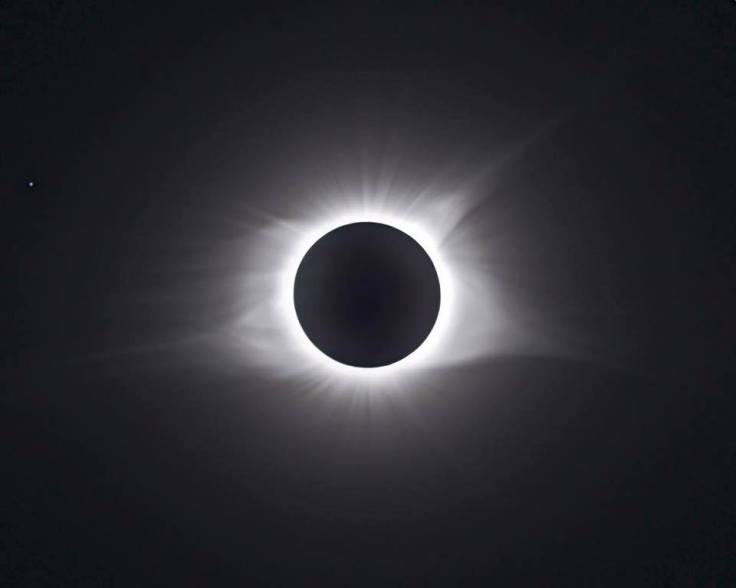
Brian Ottum composite image 21077685_723036411231224_4553820105859167058_n
This photo, by Brian Ottum, matches my memory of what the eclipse looked like.

It has taken a week to catch up on a lot of neglected chores (like sleep), but now I am ready to tell the story!

Summary:  The experience of the eclipse was worth four days of driving!

We had options to go to Missouri, Nebraska, or Tennessee.  Based on the weather forecasts, we chose Lebanon, Tennessee.  We arrived on Sunday, and searched for good places to watch the eclipse.  The Cedars of Lebanon State Park looked good, but I was apprehensive that the viewing area would not be big enough for the expected crowds of people.

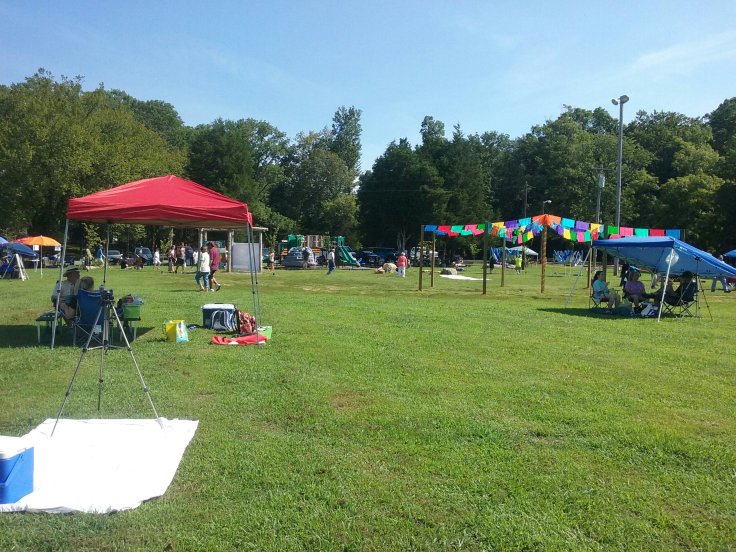
Early in the morning of eclipse day, my daughter and I returned to the park, and claimed a spot in the open field. It turned out that there was plenty of room for everyone.  We were joined by a fellow-member of my astronomy club with some friends.

wp-image-1439999865
The Ball Field at the Cedars of Lebanon State Park was not at all crowded.

We wanted clear skies, and we got them!  The Sun was high in the sky, and the air was hot and humid. Fortunately, we had two extra camera tripods and two umbrellas. We fastened the umbrellas to the tripods with hose clamps and duct tape, and positioned them near our chairs so that we had some relief from the scorching sunshine.

After a full day of clear skies, banks of clouds moved in, and covered the Sun at the start of the partial eclipse.  Thankfully, the clouds left and did not come back.

Camera Bar 20170821_112445
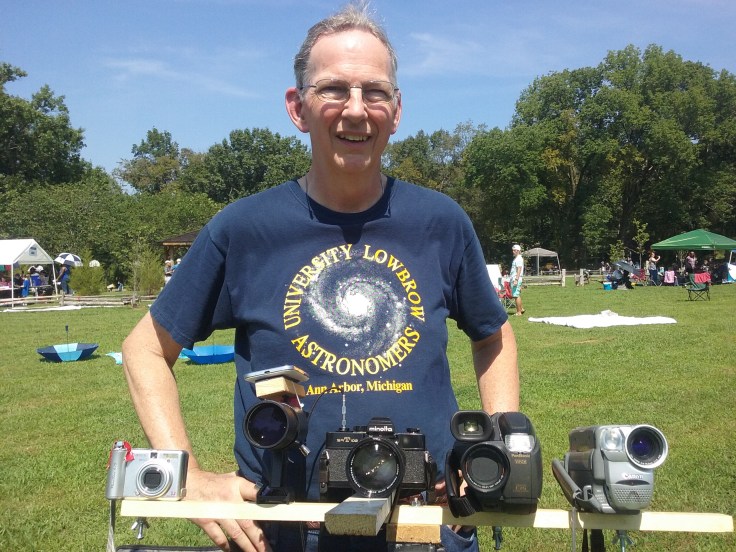
Here I am with my 5-camera monstrosity.  Shortly afterwards, it was abandoned.

I had a grand plan to take videos and still shots of the eclipse, using 5 cameras mounted on a single tripod.  I had tried out this gadget at home, and was successful in managing it. However, on eclipse day, I found that it was impossible to aim it high enough to capture the Sun, and I wasn’t able to keep it balanced.

After trying several fixes, I realized that we were half way into the partial eclipse, and I hadn’t looked at the Sun!  So, I set some priorities by giving up the eclipse photography.

Giving up on the photography was a great relief.  I was also able to be more sociable, and talk to the people around me.  And, I was able to enjoy the eclipse!

Time passed quickly, and I noticed that the heat of the Sun was no longer bothersome.  The remaining sunshine was dim, but didn’t have the orange cast which goes with sunset.  Everything looked a bit gray.

2 minutes before totality, brightened IMG_0505
Two minutes before totality, an unusual kind of darkness covered us.

I had a plan to watch the ground for the shadow bands, which are very subtle ripples which often appear just before and after totality.  However, when the coverage of the Sun was in its last stages, I forgot those plans. My entire focus was on the long awaited total eclipse, which was about to happen.

Through the eclipse glasses, I watched the Sun shrink rapidly.  When there was nothing more to see, it was time to put the glasses aside.  I will try to describe what I saw: The sky was a dark grayish blue, which was brighter gray near the Sun.  The body of the Sun was a round black circle.  The corona was quite a bit larger than the disk of the Sun.  Its width was irregular, and was widest on the lower right.  At first look, a red stream protruded from the bottom of the black disk.  Its length was about 1/16 of a sun diameter, and was visible without magnification.

I came to my senses and remembered that I had brought a pair of 7 x 50 binoculars to use during totality.  Because they didn’t have solar filters, I had hidden them for safety.  I scrambled in the dark, and found them.  The view of the Sun was better with magnification, but the red streamer appeared smaller.

Toward the end of totality, the red stream had changed appearance again.  Someone nearby said that this object was a solar flare.  I need to learn more about this.  I didn’t think that solar features changed so rapidly over a period of 2 – ½ minutes.  It is possible that the changes were in my perception, rather than reality.

Although stars and planets were visible during totality, I was not interested in viewing them on eclipse day.  I have the rest of my life to do that!  Venus, however, forced itself on me.  Because it was so close to the Sun and so high in the sky, it was annoyingly bright.  I had never seen Venus so bright.  Curiously, I remember the position of Venus as directly above the Sun in the sky.  Later, I checked the position of Venus on two different planetarium apps.  They both show Venus to the right, and slightly higher than the Sun.  I think that the apps were right, and the observer was excited.

The 2 minutes and 20 seconds of totality passed quickly, and a tiny sliver of the Sun lit up our area again.  I was amazed at how much light comes from the Sun even when it is 99% covered.  In a few seconds, lighting had changed from a very deep twilight to an early twilight, and we had no trouble seeing ourselves and our surroundings.

Our crowd was very calm, compared to ones I had watched on videos.  We all broke out with a spontaneous cheer at the start of totality, and another applause at the return of the Sun.

I had no regrets that I dropped the idea of photographing the eclipse, because I was planning to take a series of shots with a manual single-lens-reflex camera.  It is unlikely that I would have had enough alertness to make the settings and shoot the pictures.  I did remember to make movies of the crowd reactions.  The quality of the movies is mediocre, but their keepsake value is tremendous.

A few minutes after totality ended, I was thinking about the next total solar eclipse for North America, which will be on April 8, 2024.


It’s Time for the Eclipse, and I Don’t Have Eclipse Glasses. What Can I Do?

No need to worry.  There are several safe, simple ways to view the progress of the eclipse:

  1. A pinhole projector can be as simple as an index card with a tiny hole.  A thumb tack or a push pin can make a good hole of the proper size.  ‘To use, hold the card so that it faces the Sun, and place a second index card in the shadow of the first card.   Adjust the spacing of the cards until a good image of the Sun is visible.
  2. Use a mirror to project Sunlight onto a wall.  I just heard about this technique, and haven’t had a chance to try it out.  Use a circular mirror, or a mirror masked by cardboard with a circular hole.  Hold the mirror so that it casts reflected sunlight onto a smooth white or gray wall, or some similar surface.  If all goes well, the patch of reflected light will have the same shape as the eclipsed Sun.  Caution:  Don’t look directly into the mirror to see the Sun.  This is just as destructive as looking directly at the Sun.  If you fasten the mirror to any kind of fixture, stay with it, so that other people don’t misuse it.
  3. Here’s an easy one: Find a tree or bush with leaves and look at the shadow that it casts.  Wherever the shadow has a small sunny spot, you should be able to see the shape of the eclipsed Sun.  This same effect can be produced by a piece of cardboard with a hole, or even with your hands and fingers.

Enjoy the eclipse, wherever you are!

lookin’ up,

John


Leaving Town for the Eclipse

Today is packing day, and tomorrow we drive to Illinois.  On Saturday morning, we will pick a destination, based on the latest weather forecasts.

It is my desire to make frequent posts during this expedition.  We will see if this works out.  Right now, the last-minute preparations don’t leave much time for writing!

lookin’ up,

John


I Haven’t made Any Plans. Is It Too Late to View the Total Eclipse?

No, it isn’t!

No one knows for sure how many people will travel to the band of land where the Total Solar Eclipse of August 21, 2017 will be visible.  Crowding will very likely be a problem, but here are a few ideas to consider:

  • The “narrow band” for totality is actually a vast area. Even with millions of people visiting, there is plenty of room for everyone.
  • Of course, some places will be very popular, and they will be crowded.
  • Our love of automobiles and our road system is the weak link in handling a large number of people. On August 21, the eclipse traffic will be added to the normal traffic load.  A particular concern would be after the eclipse, where most people will want to go home at the same time.
  • Motel rooms will be available at the last minute, because some people (my self included) have made reservations in multiple cities. The unused reservations will be cancelled a day or two before August 21.

So, I offer this advice:

  • Try to make motel reservations as close to the area of totality as possible.
  • Check for last-minute vacancies at places inside the area of totality.
  • Arrive at your destination as early as you can manage.
  • Keep your gas tank full, and bring food and water.
  • Bring printed road maps, since the cellular networks in some areas may be overloaded.
  • Try to plan a route which avoids the major highways. In particular, be wary of expressways, because U-turns are not allowed.
  • Research good locations to view the eclipse. Many small towns have provided viewing areas, with varying levels of support.
  • While the centerline of the band of totality offers the maximum duration of totality, areas a small number of miles away will be almost as good.

In summary, a total eclipse of the Sun is such a magnificent event that many people want to experience it.  Even with advance planning, inconveniences will occur.  The goal is to keep them to a minimum, and have a memorable day!


Some Links and Apps For the August 21 Total Solar Eclipse

These links will cover virtually every aspect of watching this eclipse:

http://eclipsophile.com/

https://www.greatamericaneclipse.com/eclipse-2017/

http://www.eclipse2017.org/

http://mreclipse.com/

https://eclipse.gsfc.nasa.gov/SEmono/TSE2017/TSE2017.html

http://nationaleclipse.com/

A very interesting analysis of road traffic patterns:

https://www.greatamericaneclipse.com/statistics

The US Weather Service offers this service:

https://www.weather.gov/source/crh/eclipse.html

Here are two Android apps which calculate the local circumstances (timing and degree to which the Sun is covered):

Eclipse Safari

Eclipse 2017.org

Keep looking up!

John


Blog at WordPress.com.

Up ↑