Saturn’s Rings Play “Hide & Seek”

(Plain Text Version)

Saturn’s Rings Play “Hide & Seek”

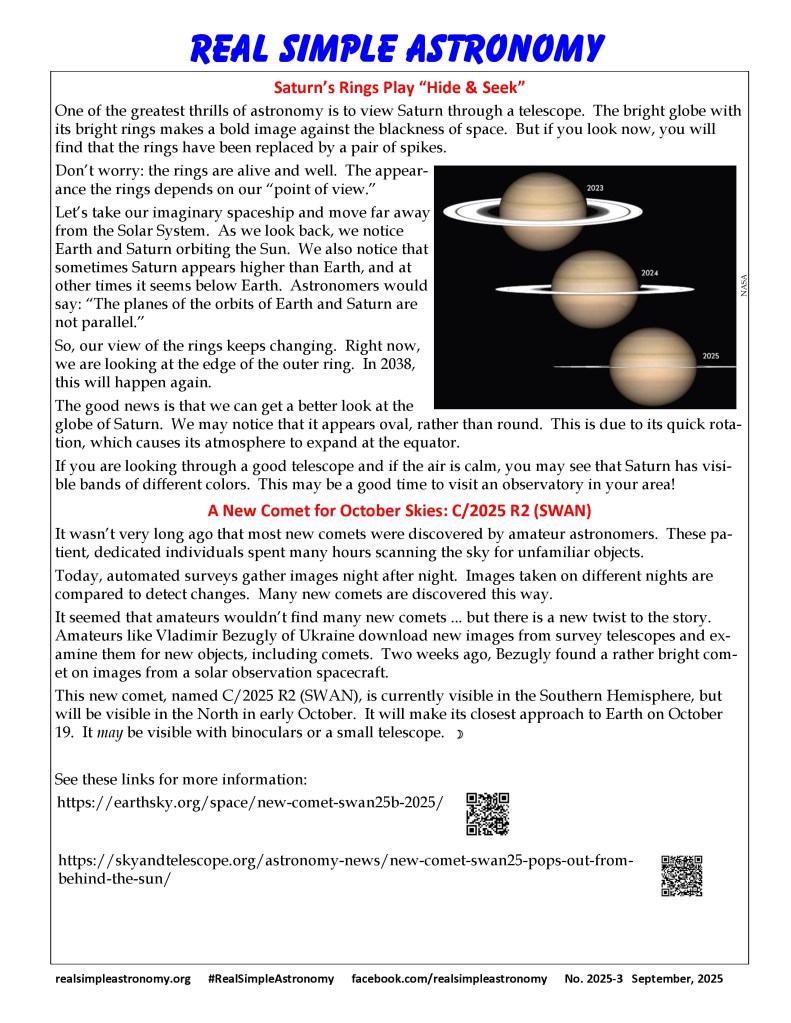
One of the greatest thrills of astronomy is to view Saturn through a telescope.  The bright globe with its bright rings makes a bold image against the blackness of space.  But if you look now, you will find that the rings have been replaced by a pair of spikes.

Don’t worry: the rings are alive and well.  The appearance the rings depends on our “point of view.”  

Let’s take our imaginary spaceship and move far away from the Solar System.  As we look back, we notice Earth and Saturn orbiting the Sun.  We also notice that sometimes Saturn appears higher than Earth, and at other times it seems below Earth.  Astronomers would say: “The planes of the orbits of Earth and Saturn are not parallel.”

So, our view of the rings keeps changing.  Right now, we are looking at the edge of the outer ring.  In 2038, this will happen again.

The good news is that we can get a better look at the globe of Saturn.  We may notice that it appears oval, rather than round.  This is due to its quick rotation, which causes its atmosphere to expand at the equator.

If you are looking through a good telescope and if the air is calm, you may see that Saturn has visible bands of different colors.  This may be a good time to visit an observatory in your area!

A New Comet for October Skies: C/2025 R2 (SWAN)

It wasn’t very long ago that most new comets were discovered by amateur astronomers.  These patient, dedicated individuals spent many hours scanning the sky for unfamiliar objects. 

Today, automated surveys gather images night after night.  Images taken on different nights are compared to detect changes.  Many new comets are discovered this way.

It seemed that amateurs wouldn’t find many new comets … but there is a new twist to the story.  Amateurs like Vladimir Bezugly of Ukraine download new images from survey telescopes and examine them for new objects, including comets.  Two weeks ago, Bezugly found a rather bright comet on images from a solar observation spacecraft. 

This new comet, named C/2025 R2 (SWAN), is currently visible in the Southern Hemisphere, but will be visible in the North in early October.  It will make its closest approach to Earth on October 19.  It may be visible with binoculars or a small telescope.

See these links for more information:

https://earthsky.org/space/new-comet-swan25b-2025/

https://skyandtelescope.org/astronomy-news/new-comet-swan25-pops-out-from-behind-the-sun/

#RealSimpleAstronomy

A Bright New Comet is Coming!

http://Astronomy.com

http://Skyandtelescope.org

http://Spaceweather.com

http://aerith.net/comet/weekly/current.html

http://nasa.gov/centers-and-facilities/marshall/nasa-global-astronomers-await-rare-nova-explosion/

http://skyandtelescope.org/astronomy-news/is-the-blaze-star-about-to-blow-you-may-be-the-first-to-know/

(Plain Text Version)

Comet Tsuchinshan Comes to Our Neighborhood

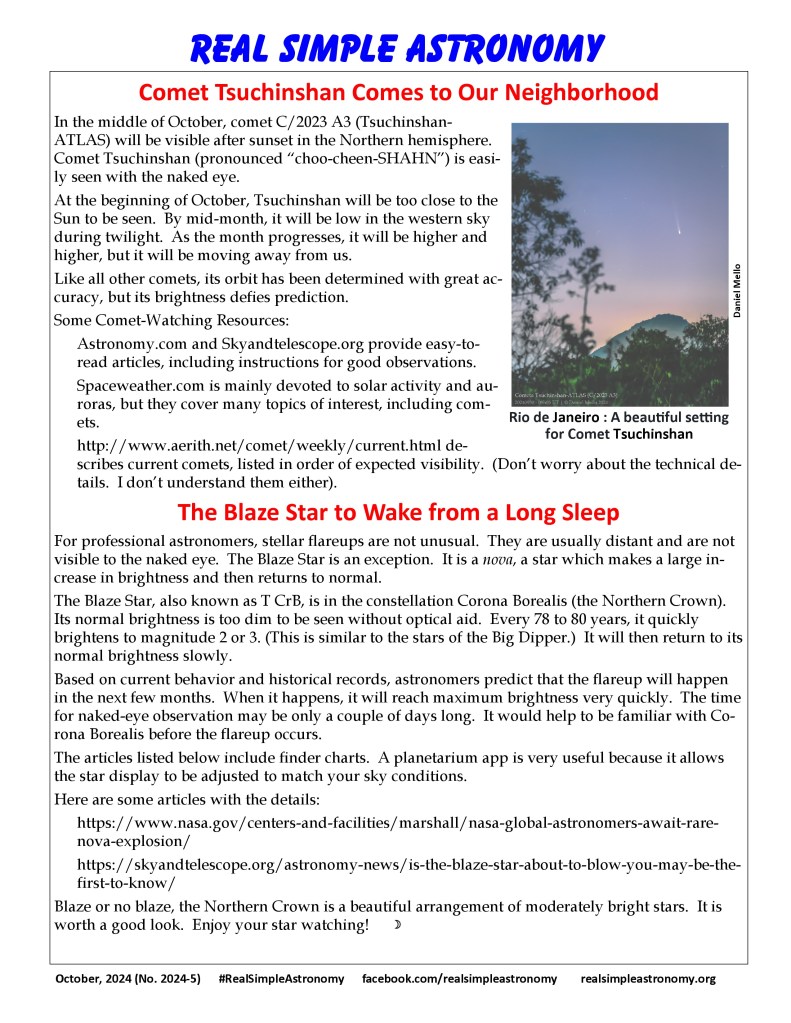
In the middle of October, comet C/2023 A3 (Tsuchinshan-ATLAS) will be visible after sunset in the Northern hemisphere.   Comet Tsuchinshan (pronounced “choo-cheen-SHAHN”) is easily seen with the naked eye.

At the beginning of October, Tsuchinshan will be too close to the Sun to be seen.  By mid-month, it will be low in the western sky during twilight.  As the month progresses, it will be higher and higher, but it will be moving away from us.  

Like all other comets, its orbit has been determined with great accuracy, but its brightness defies prediction. 

Some Comet-Watching Resources:

Astronomy.com and Skyandtelescope.org provide easy-to-read articles, including instructions for good observations.

Spaceweather.com is mainly devoted to solar activity and auroras, but they cover many topics of interest, including comets.

http://www.aerith.net/comet/weekly/current.html describes current comets, listed in order of expected visibility.  (Don’t worry about the technical details.  I don’t understand them either).

The Blaze Star to Wake from a Long Sleep

For professional astronomers, stellar flareups are not unusual.  They are usually distant and are not visible to the naked eye.  The Blaze Star is an exception.  It is a nova, a star which makes a large increase in brightness and then returns to normal.

The Blaze Star, also known as T CrB, is in the constellation Corona Borealis (the Northern Crown). Its normal brightness is too dim to be seen without optical aid.  Every 78 to 80 years, it quickly brightens to magnitude 2 or 3. (This is similar to the stars of the Big Dipper.)  It will then return to its normal brightness slowly.

Based on current behavior and historical records, astronomers predict that the flareup will happen in the next few months.  When it happens, it will reach maximum brightness very quickly.  The time for naked-eye observation may be only a couple of days long.  It would help to be familiar with Corona Borealis before the flareup occurs. 

The articles listed below include finder charts.  A planetarium app is very useful because it allows the star display to be adjusted to match your sky conditions. 

Here are some articles with the details:

https://www.nasa.gov/centers-and-facilities/marshall/nasa-global-astronomers-await-rare-nova-explosion/

https://skyandtelescope.org/astronomy-news/is-the-blaze-star-about-to-blow-you-may-be-the-first-to-know/

Blaze or no blaze, the Northern Crown is a beautiful arrangement of moderately bright stars.  It is worth a good look.  Enjoy your star watching!

#RealSimpleAstronomy

A Second Chance to See Comet Leonard

(Plain Text Version)

A New Comet: Good News or Bad News?

From the earliest ages, the appearance of a new comet was a source of excitement.  Bright comets can be awesome to see, and they do not come frequently. 

Sometimes, comets were considered a sign that something good was about to happen.  More often, however, people feared that something terrible was coming soon.

Today, we know a lot more about comets.  But just like the days of old, I have some apprehension when I hear that a major comet is coming.  I don’t fear that earthquakes or crop failures will happen.  I just wonder if I will be able to get a good look!

Astronomers can tell us where a comet will be, but not what it will look like.  So, I get excited when I hear that a bright one is approaching.  On the happy side, I look forward to seeing a beautiful and unique sight in the sky.  On the downside, I foresee a struggle to see it at all.

Comet Leonard Comes to Town

Comet Leonard came from a region of our solar system called the Oort Cloud, which is about 1,000 times as far away as Pluto.  Objects in the Oort cloud are beyond the reach of even our best telescopes. 

After traveling for thousands of years, our new object was discovered in January 2021 by Gregory Leonard.  It’s official name is C/2021 A1 (Leonard).

As it approached, it was visible in the Northern Hemisphere before sunrise.  I’ll make no excuses: I wasn’t motivated to get out of bed to look for it.  I waited until it moved into the evening sky. 

Unfortunately, the comet was visible for only a short time after sunset and was very low in the sky.  I made a couple of trips to the edge of the city but found the sky too hazy to see the comet.

A Happy Ending in the Southern Hemisphere

Thanks to the internet, I was able to remotely operate a telescope in Australia (see iTelescope.net).  On my first try, I got a very good, sharp image.  I enjoy looking at details of a good image, but I especially enjoy standing outside and looking at a comet “in person.”

Maybe I will set my alarm next time.

Meteor Outburst!

Here are two links with more information:

https://earthsky.org/astronomy-essentials/unexpected-perseid-outburst-wows-viewers/

https://spaceweatherarchive.com/2021/08/18/perseid-meteor-outburst-2/

(Plain Text Version)

The Perseid meteor shower has a reputation for being a reliable event.  It reaches its peak on the night beginning August 12.  Under a dark sky, roughly 60 meteors per hour can be expected.  Unlike many other showers, it produces meteors a few nights before and after the peak night.

Although the Perseid shower is consistent in many ways, no meteor shower is fully predictable.

An Outburst on August 14, 2021

One day after the historical peak, an outburst was seen in the United States and Canada from 1:00-4:00 AM CDT.  Approximately 120 meteors were observed per hour, about five times the usual number for this “off peak” date.

Scientists were not totally surprised by this outburst, because similar but smaller events occurred in 1993, 2018, 2019, and 2020.

Why Do Outbursts Occur?

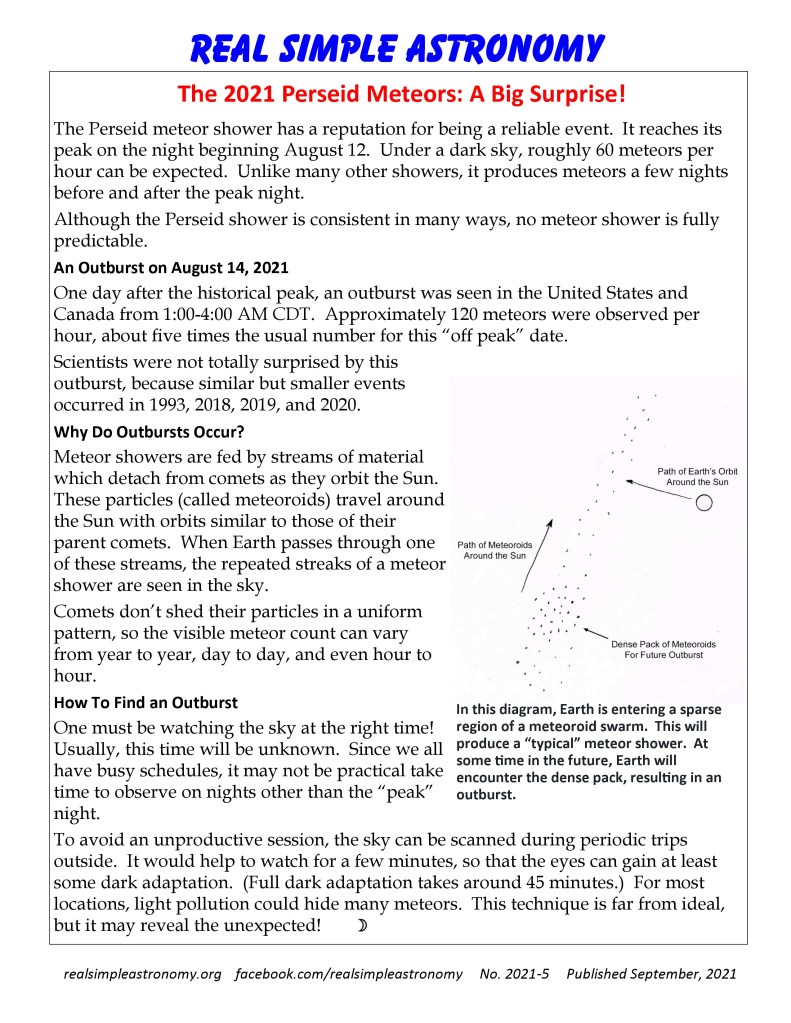
Meteor showers are fed by streams of material which detach from comets as they orbit the Sun.  These particles (called meteoroids) travel around the Sun with orbits similar to those of their parent comets.  When Earth passes through one of these streams, the repeated streaks of a meteor shower are seen in the sky.

Comets don’t shed their particles in a uniform pattern, so the visible meteor count can vary from year to year, day to day, and even hour to hour. 

How To Find an Outburst

One must be watching the sky at the right time!  Usually, this time will be unknown.  Since we all have busy schedules, it may not be practical take time to observe on nights other than the “peak” night.

To avoid an unproductive session, the sky can be scanned during periodic trips outside.  It would help to watch for a few minutes, so that the eyes can gain at least some dark adaptation.  (Full dark adaptation takes around 45 minutes.)  For most locations, light pollution could hide many meteors.  This technique is far from ideal, but it may reveal the unexpected!

Have You Ever Seen a Comet?

The night sky has many treasures in store for us.  Most of these objects are very far away, and don’t appear to change much from year to year. Without precise measurements with telescopes, they seem to be stationary. Others, like the Moon and the planets, are close enough that their motion is obvious.

In addition to the Moon and the planets, comets show visible progress as they move across the sky.  Comets are icy objects which orbit the Sun. Unlike planets, comets have elongated orbits which bring them close to the Sun, and then take them far away from the Sun. For example, Comet Halley comes closer to the Sun than the planet Mercury, and then travels out to the vicinity of Neptune and Pluto.

When a comet approaches the Sun, the ice begins to evaporate.  The water vapor, combined with soil, moves away from the surface, and forms a visible tail.  Energy from the sun can ionize (add or remove electrons from) the water vapor, and cause a second tail to develop.

This month, a comet has made a close (11.6 kilometer) approach to Earth and is now moving away from us.  It is called 46P/ Wirtanen.  It is high in the sky for observers in the Northern Hemisphere.  This week, the Moon is brightening and coming closer to “46P” every night.  This interferes with a good look at the comet.  Beginning December 23, 2018, the sky will be dark before the Moon has a chance to rise.  For the following two weeks, the Moon will not interfere.  (As always, don’t miss an opportunity to see 46P, even when the Moon is out.)

181213 image1 cropped
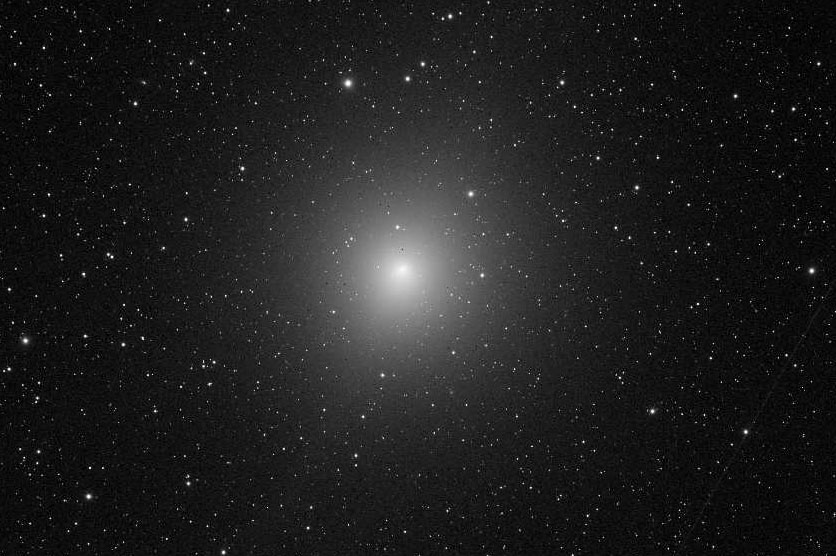
I obtained this image of Comet Wirtanen using a remote rental telescope on December 13, 2018.  This comet has a faint tail, which doesn’t appear in this image.  (itelescope.net T14; Takahashi 106 mm refractor, 5-minute exposure)

Comet Wirtanen is not bright enough to be seen naked-eye (to my best knowledge).  Many people are finding it with binoculars and small telescopes.  I have had an excellent view with my 10” (254mm) reflecting telescope.

Here is a link to a finder chart.

https://www.skyandtelescope.com/astronomy-news/observing-news/comet-46p-wirtanen-and-moon/

I admit that finder charts can be difficult to use.  In this instance, however, the bright star Capella is a very good reference point.  An alternative to paper charts is the free version of the smartphone app “SkySafari”.  Once it is installed, simply tap “Search”, then “Brightest Comets”, then “46P Wirtanen”, then “center”.

Here are more links about Comet Wirtanen:

https://earthsky.org/todays-image/photos-comet-46p-wirtanen-brightest-comet-2018

https://www.space.com/42756-comet-46p-wirtanen-original-rosetta-target.html

https://earthsky.org/space/46p-wirtanen-possibly-visible-to-eye-dec-2018

Keep looking up!

John

Blog at WordPress.com.

Up ↑