Here is a beginner telescope for $US 59.95, with free shipping in the USA. It is by Orion. I have one of their telescopes and it works well for me.
Good Move, NASA!

(Plain Text Version)
NASA Makes a Good Call
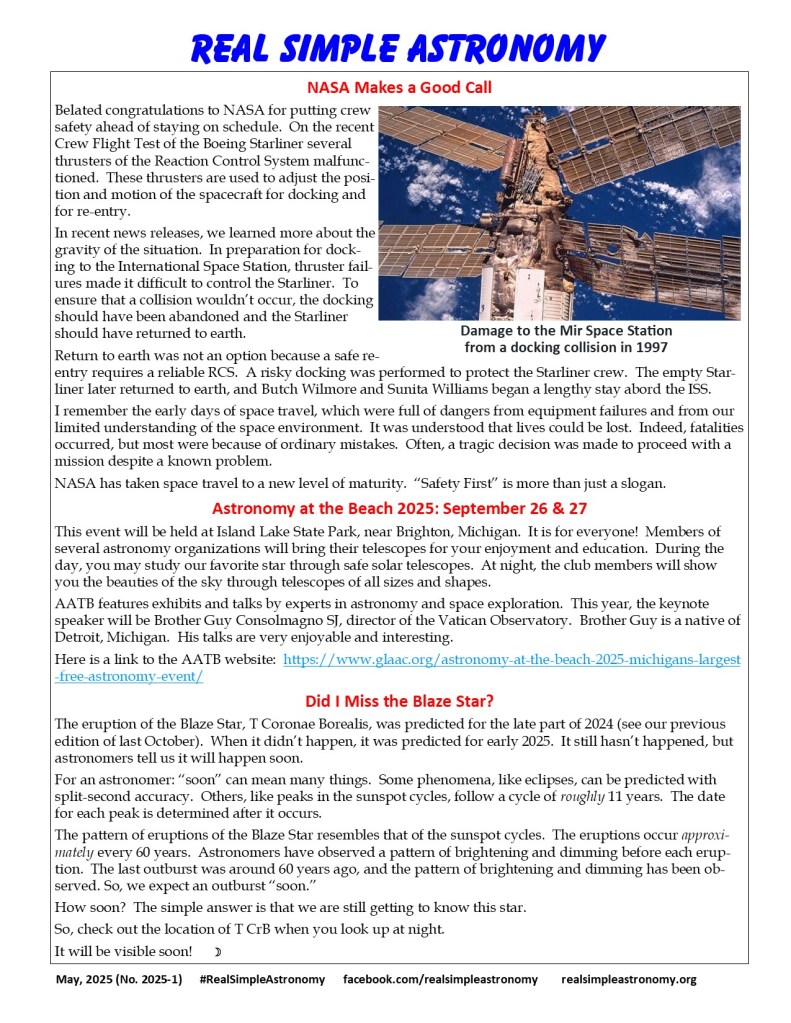
Belated congratulations to NASA for putting crew safety ahead of staying on schedule. On the recent Crew Flight Test of the Boeing Starliner several thrusters of the Reaction Control System malfunctioned. These thrusters are used to adjust the position and motion of the spacecraft for docking and for re-entry.
In recent news releases, we learned more about the gravity of the situation. In preparation for docking to the International Space Station, thruster failures made it difficult to control the Starliner. To ensure that a collision wouldn’t occur, the docking should have been abandoned and the Starliner should have returned to earth.
Return to earth was not an option because a safe re-entry requires a reliable RCS. A risky docking was performed to protect the Starliner crew. The empty Starliner later returned to earth, and Butch Wilmore and Sunita Williams began a lengthy stay abord the ISS.
I remember the early days of space travel, which were full of dangers from equipment failures and from our limited understanding of the space environment. It was understood that lives could be lost. Indeed, fatalities occurred, but most were because of ordinary mistakes. Often, a tragic decision was made to proceed with a mission despite a known problem.
NASA has taken space travel to a new level of maturity. “Safety First” is more than just a slogan.
Astronomy at the Beach 2025: September 26 & 27
This event will be held at Island Lake State Park, near Brighton, Michigan. It is for everyone! Members of several astronomy organizations will bring their telescopes for your enjoyment and education. During the day, you may study our favorite star through safe solar telescopes. At night, the club members will show you the beauties of the sky through telescopes of all sizes and shapes.
AATB features exhibits and talks by experts in astronomy and space exploration. This year, the keynote speaker will be Brother Guy Consolmagno SJ, director of the Vatican Observatory. Brother Guy is a native of Detroit, Michigan. His talks are very enjoyable and interesting.
Here is a link to the AATB website: https://www.glaac.org/astronomy-at-the-beach-2025-michigans-largest-free-astronomy-event/
Did I Miss the Blaze Star?
The eruption of the Blaze Star, T Coronae Borealis, was predicted for the late part of 2024 (see our previous edition of last October). When it didn’t happen, it was predicted for early 2025. It still hasn’t happened, but astronomers tell us it will happen soon.
For an astronomer: “soon” can mean many things. Some phenomena, like eclipses, can be predicted with split-second accuracy. Others, like peaks in the sunspot cycles, follow a cycle of roughly 11 years. The date for each peak is determined after it occurs.
The pattern of eruptions of the Blaze Star resembles that of the sunspot cycles. The eruptions occur approximately every 60 years. Astronomers have observed a pattern of brightening and dimming before each eruption. The last outburst was around 60 years ago, and the pattern of brightening and dimming has been observed. So, we expect an outburst “soon.”
How soon? The simple answer is that we are still getting to know this star.
So, check out the location of T CrB when you look up at night.
It will be visible soon!
#RealSimpleAstronomy
A Bright New Comet is Coming!

http://aerith.net/comet/weekly/current.html
http://nasa.gov/centers-and-facilities/marshall/nasa-global-astronomers-await-rare-nova-explosion/
(Plain Text Version)
Comet Tsuchinshan Comes to Our Neighborhood
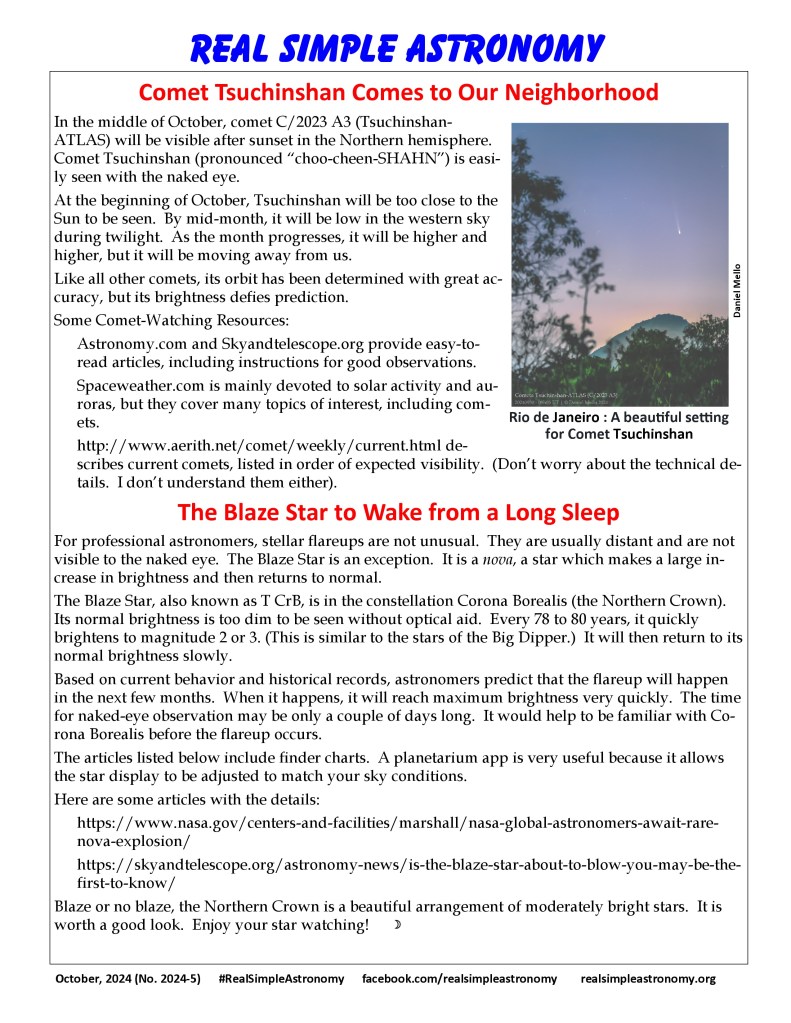
In the middle of October, comet C/2023 A3 (Tsuchinshan-ATLAS) will be visible after sunset in the Northern hemisphere. Comet Tsuchinshan (pronounced “choo-cheen-SHAHN”) is easily seen with the naked eye.
At the beginning of October, Tsuchinshan will be too close to the Sun to be seen. By mid-month, it will be low in the western sky during twilight. As the month progresses, it will be higher and higher, but it will be moving away from us.
Like all other comets, its orbit has been determined with great accuracy, but its brightness defies prediction.
Some Comet-Watching Resources:
Astronomy.com and Skyandtelescope.org provide easy-to-read articles, including instructions for good observations.
Spaceweather.com is mainly devoted to solar activity and auroras, but they cover many topics of interest, including comets.
http://www.aerith.net/comet/weekly/current.html describes current comets, listed in order of expected visibility. (Don’t worry about the technical details. I don’t understand them either).
The Blaze Star to Wake from a Long Sleep
For professional astronomers, stellar flareups are not unusual. They are usually distant and are not visible to the naked eye. The Blaze Star is an exception. It is a nova, a star which makes a large increase in brightness and then returns to normal.
The Blaze Star, also known as T CrB, is in the constellation Corona Borealis (the Northern Crown). Its normal brightness is too dim to be seen without optical aid. Every 78 to 80 years, it quickly brightens to magnitude 2 or 3. (This is similar to the stars of the Big Dipper.) It will then return to its normal brightness slowly.
Based on current behavior and historical records, astronomers predict that the flareup will happen in the next few months. When it happens, it will reach maximum brightness very quickly. The time for naked-eye observation may be only a couple of days long. It would help to be familiar with Corona Borealis before the flareup occurs.
The articles listed below include finder charts. A planetarium app is very useful because it allows the star display to be adjusted to match your sky conditions.
Here are some articles with the details:
Blaze or no blaze, the Northern Crown is a beautiful arrangement of moderately bright stars. It is worth a good look. Enjoy your star watching!
#RealSimpleAstronomy
My Best Astro-Blunders

(Plain Text Version)
Intrusive Lights
For many years, I lived in a rural setting in Southern Michigan. It was a pleasure to have a dark sky and freedom from nearby lights. At the telescope one night, I was bothered by a light from the cornfield behind me. I ignored it for quite a while, but it persisted. At last, I turned around and found that my annoyance was caused by the Northern Lights. A few seconds later, the aurora ended and did not return.
Don’t forget…
When I was a brand-new observer, I heard many stories of people traveling to a dark-sky site, only to find that they had forgotten to pack their eyepieces. I resolved not to make this mistake, so I always triple-checked this item when I packed the car. One night, I arrived at a club event and found that I hadn’t brought the telescope.
The Mystery of the Great Square
Some blunders are obvious, but this one was hard to solve. I was performing a “Two Star Alignment” which requires careful aim of the telescope at two known stars. This enables a digital system to locate numerous objects easily.
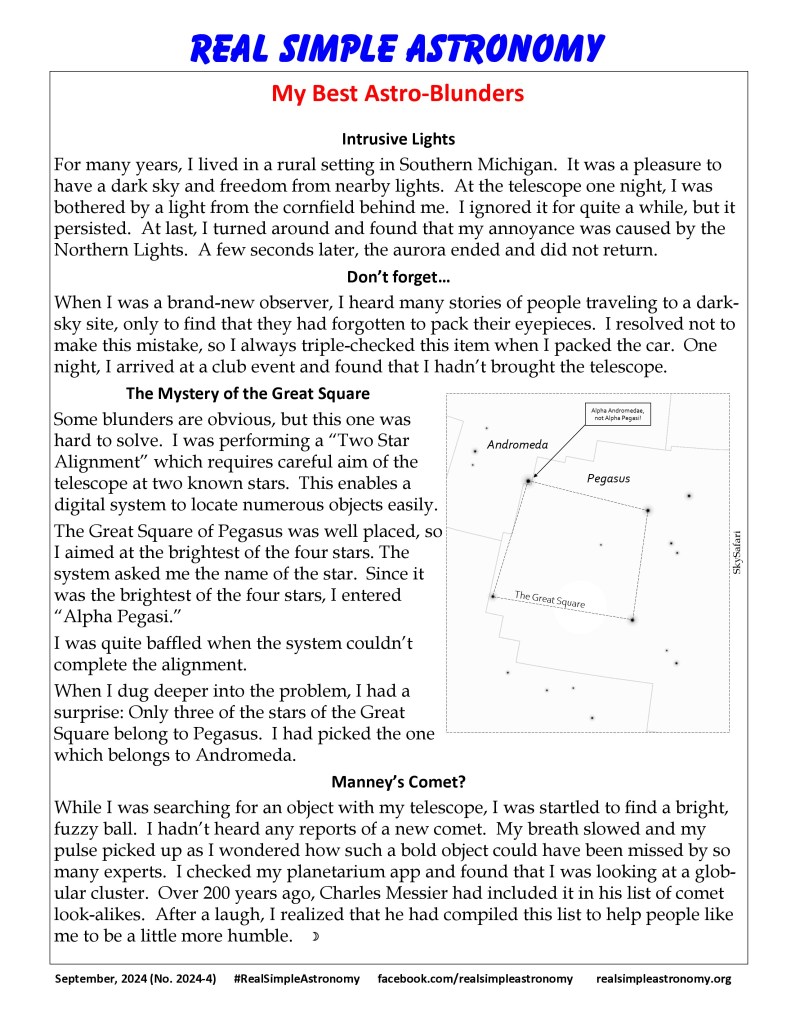
The Great Square of Pegasus was well placed, so I aimed at the brightest of the four stars. The system asked me the name of the star. Since it was the brightest of the four stars, I entered “Alpha Pegasi.”
I was quite baffled when the system couldn’t complete the alignment.
When I dug deeper into the problem, I had a surprise: Only three of the stars of the Great Square belong to Pegasus. I had picked the one which belongs to Andromeda.
Manney’s Comet?
While I was searching for an object with my telescope, I was startled to find a bright, fuzzy ball. I hadn’t heard any reports of a new comet. My breath slowed and my pulse picked up as I wondered how such a bold object could have been missed by so many experts. I checked my planetarium app and found that I was looking at a globular cluster. Over 200 years ago, Charles Messier had included it in his list of comet look-alikes. After a laugh, I realized that he had compiled this list to help people like me to be a little more humble.
#RealSimpleAstronomy
Bright and Beautiful Summer Stars

(Plain Text Version)
The Summer Triangle
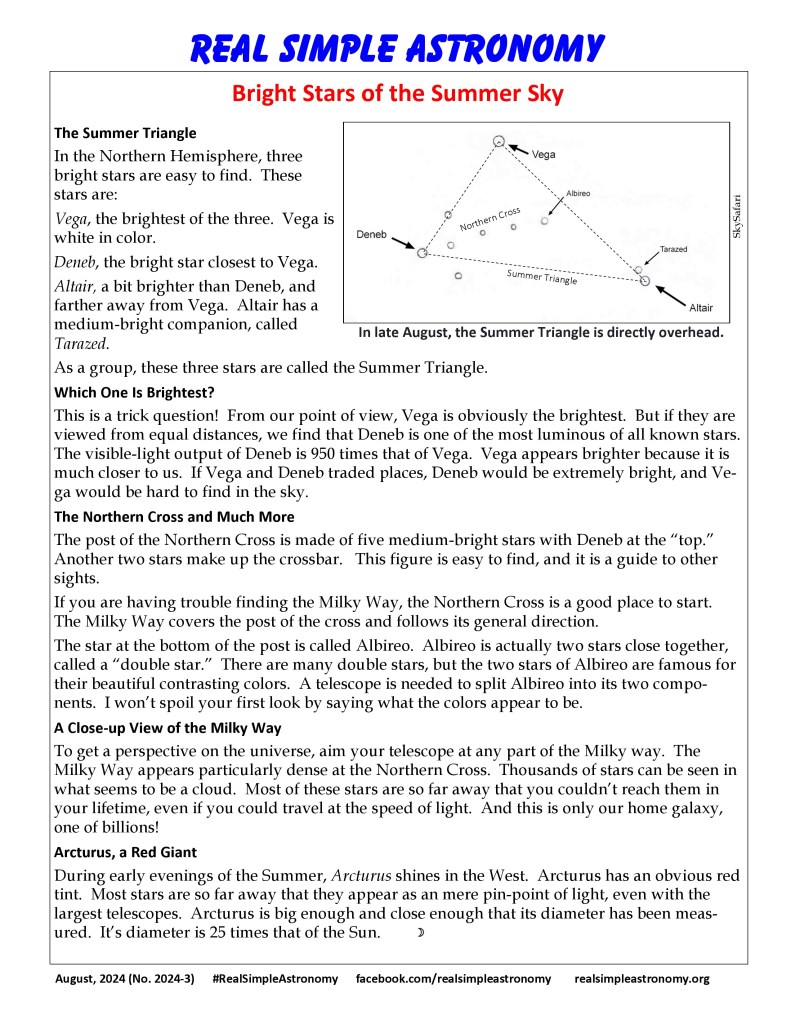
In the Northern Hemisphere, three bright stars are easy to find. These stars are:
Vega, the brightest of the three. Vega is white in color.
Deneb, the bright star closest to Vega.
Altair, a bit brighter than Deneb, and farther away from Vega. Altair has a medium-bright companion, called Tarazed.
As a group, these three stars are called the Summer Triangle.
Which One Is Brightest?
This is a trick question! From our point of view, Vega is obviously the brightest. But if they are viewed from equal distances, we find that Deneb is one of the most luminous of all known stars. The visible-light output of Deneb is 950 times that of Vega. Vega appears brighter because it is much closer to us. If Vega and Deneb traded places, Deneb would be extremely bright, and Vega would be hard to find in the sky.
The Northern Cross and Much More
The post of the Northern Cross is made of five medium-bright stars with Deneb at the “top.” Another two stars make up the crossbar. This figure is easy to find, and it is a guide to other sights.
If you are having trouble finding the Milky Way, the Northern Cross is a good place to start. The Milky Way covers the post of the cross and follows its general direction.
The star at the bottom of the post is called Albireo. Albireo is actually two stars close together, called a “double star.” There are many double stars, but the two stars of Albireo are famous for their beautiful contrasting colors. A telescope is needed to split Albireo into its two components. I won’t spoil your first look by saying what the colors appear to be.
A Close-up View of the Milky Way
To get a perspective on the universe, aim your telescope at any part of the Milky way. The Milky Way appears particularly dense at the Northern Cross. Thousands of stars can be seen in what seems to be a cloud. Most of these stars are so far away that you couldn’t reach them in your lifetime, even if you could travel at the speed of light. And this is only our home galaxy, one of billions!
Arcturus, a Red Giant
During early evenings of the Summer, Arcturus shines in the West. Arcturus has an obvious red tint. Most stars are so far away that they appear as an mere pin-point of light, even with the largest telescopes. Arcturus is big enough and close enough that its diameter has been measured. It’s diameter is 25 times that of the Sun.
#RealSimpleAstronomy
It is Time to Say “Hi” Again!

(Plain Text Version)
It has been a while since I have posted anything, but I hope you are following good sources of news and information. My goal is to avoid repeating things which other people have already explained. I like to simply share my own experiences and insights.
So, I will start off by encouraging everyone to make plans for a unique and beautiful event: the total eclipse of the Sun on April 8, 2024:
To Go, or Not to Go?
If you don’t live in North America, you probably aren’t excited about this event. But, if you do live in this continent, you may have an opportunity for an amazing experience. Millions of people won’t have to travel at all. They just need to go outdoors at the right time! For the rest of us, travel will be needed.
So, this is a good time to make plans.
I had a very good experience with the total solar eclipse of August 2017. I will re-post some freshened versions of articles from that time.
Where’s the Moon?
My 3-year-old grandson loves to look for the Moon in the daytime. If I’m around, he lets me know. On Memorial Day, he got a chance to see the Moon through a small telescope. The next time we met, instead of saying “Hi Grandpa”, he said: “WHERE’S THE MOON?”
Since the third quarter Moon hadn’t risen, I pointed to the ground and said: “It’s down there.” He immediately got down and pushed the grass aside and said: “The Moon is here!”
He may be destined to be an astronomy enthusiast—time will tell. I would love to tell him everything I know, but we know that wouldn’t work. Where does a 3-year-old begin? I will try a couple of books about the Solar System.
Astronomy at the Beach is Back Again!
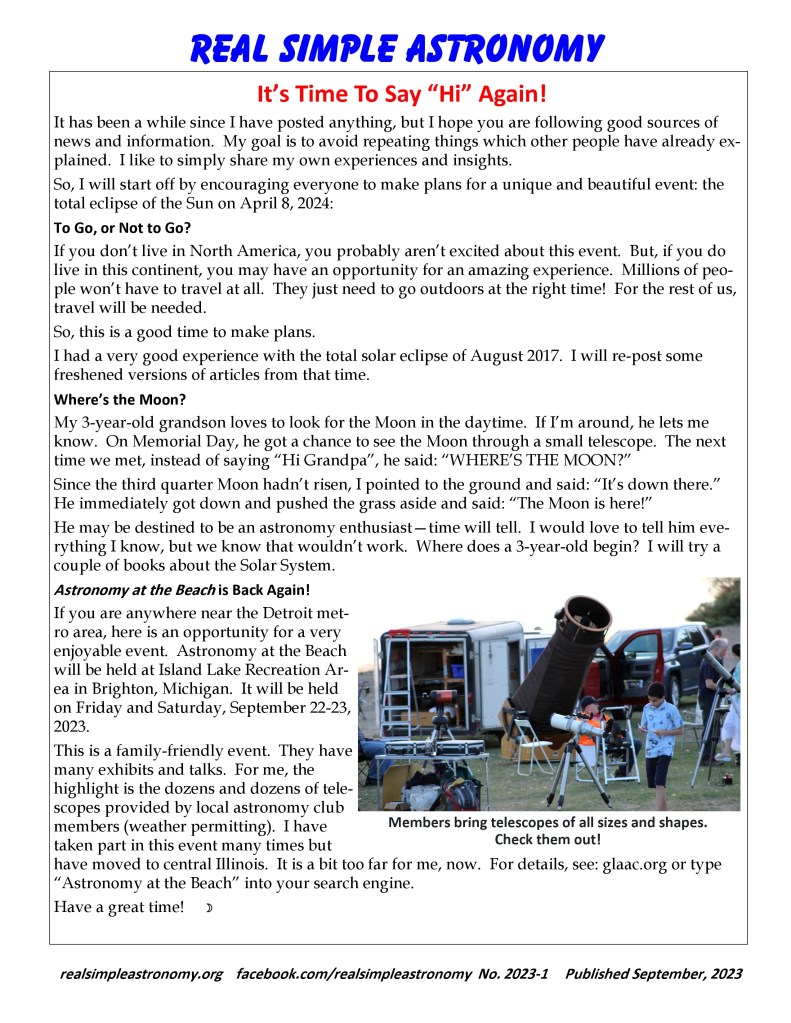
If you are anywhere near the Detroit metro area, here is an opportunity for a very enjoyable event. Astronomy at the Beach will be held at Island Lake Recreation Area in Brighton, Michigan. It will be held on Friday and Saturday, September 22-23, 2023.
This is a family-friendly event. They have many exhibits and talks. For me, the highlight is the dozens and dozens of telescopes provided by local astronomy club members (weather permitting). I have taken part in this event many times but have moved to central Illinois. It is a bit too far for me, now. For details, see: glaac.org or type “Astronomy at the Beach” into your search engine.
Have a great time!
A “Near-Total” Lunar Eclipse

Here is a “clickable” link:
https://www.timeanddate.com/eclipse/lunar/2021-november-19
(Plain Text Version)
As our friend the Moon journeys around our planet it passes through our shadow on a regular basis. The Moon will be partially or completely covered, depending on the alignment of the Sun, Earth, and Moon.
Unlike a solar eclipse, it is not necessary to travel to see a Lunar eclipse. One needs only to be on the side of Earth facing the Moon. Bad news: if you are on the “wrong” side, or it is cloudy, you will miss it. Good news: Lunar eclipses are frequent, and another opportunity will come soon.
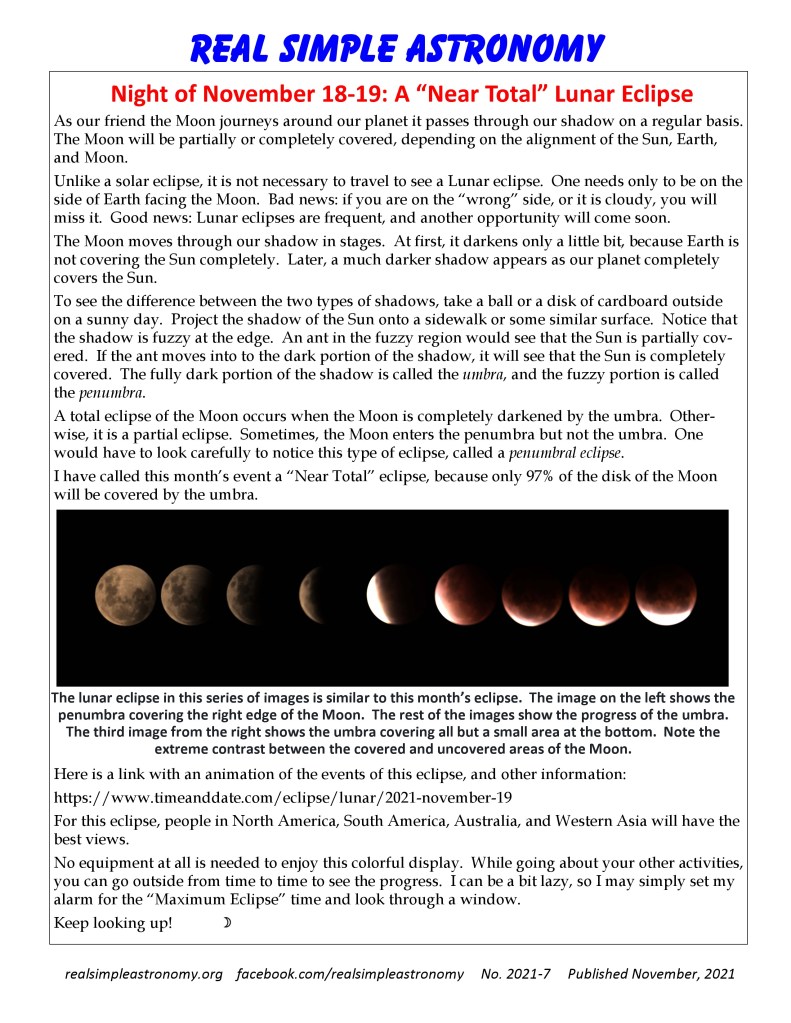
The Moon moves through our shadow in stages. At first, it darkens only a little bit, because Earth is not covering the Sun completely. Later, a much darker shadow appears as our planet completely covers the Sun.
To see the difference between the two types of shadows, take a ball or a disk of cardboard outside on a sunny day. Project the shadow of the Sun onto a sidewalk or some similar surface. Notice that the shadow is fuzzy at the edge. An ant in the fuzzy region would see that the Sun is partially covered. If the ant moves into to the dark portion of the shadow, it will see that the Sun is completely covered. The fully dark portion of the shadow is called the umbra, and the fuzzy portion is called the penumbra.
A total eclipse of the Moon occurs when the Moon is completely darkened by the umbra. Otherwise, it is a partial eclipse. Sometimes, the Moon enters the penumbra but not the umbra. One would have to look carefully to notice this type of eclipse, called a penumbral eclipse.
I have called this month’s event a “Near Total” eclipse, because only 97% of the disk of the Moon will be covered by the umbra.
Here is a link with an animation of the events of this eclipse, and other information:
https://www.timeanddate.com/eclipse/lunar/2021-november-19
For this eclipse, people in North America, South America, Australia, and Western Asia will have the best views.
No equipment at all is needed to enjoy this colorful display. While going about your other activities, you can go outside from time to time to see the progress. I can be a bit lazy, so I may simply set my alarm for the “Maximum Eclipse” time and look through a window.
Keep looking up!
Astronomy At The Beach Is Back!
Pardon me for not mentioning this sooner, but Astronomy At The Beach returns tomorrow!
Again, it will be an online event, with all-new presentations and online telescope views. Since we are online, we can visit the Southern Hemisphere: Maxi Falieres from Argentina will take us on a live a tour of the Southern Hemisphere skies! This will be from 10PM to Midnight EDT.
There are many events, so please see the link:
Three For One!
SPECIAL – THIS WEEK – THREE FOR ONE!
A lot of people would say that the Moon, Jupiter, and Saturn are the three most beautiful objects for small telescopes. For the next month, Jupiter and Saturn are well positioned over the southern horizon in the early evening. They are high enough to be free from disturbance by the atmosphere. For the next few days, the Moon will join them to make a celestial trio.
So, this is a great time to bring out the telescope and enjoy these three beauties.
Happy observing!
Meteor Outburst!

Here are two links with more information:
https://earthsky.org/astronomy-essentials/unexpected-perseid-outburst-wows-viewers/
https://spaceweatherarchive.com/2021/08/18/perseid-meteor-outburst-2/
(Plain Text Version)
The Perseid meteor shower has a reputation for being a reliable event. It reaches its peak on the night beginning August 12. Under a dark sky, roughly 60 meteors per hour can be expected. Unlike many other showers, it produces meteors a few nights before and after the peak night.
Although the Perseid shower is consistent in many ways, no meteor shower is fully predictable.
An Outburst on August 14, 2021
One day after the historical peak, an outburst was seen in the United States and Canada from 1:00-4:00 AM CDT. Approximately 120 meteors were observed per hour, about five times the usual number for this “off peak” date.
Scientists were not totally surprised by this outburst, because similar but smaller events occurred in 1993, 2018, 2019, and 2020.
Why Do Outbursts Occur?
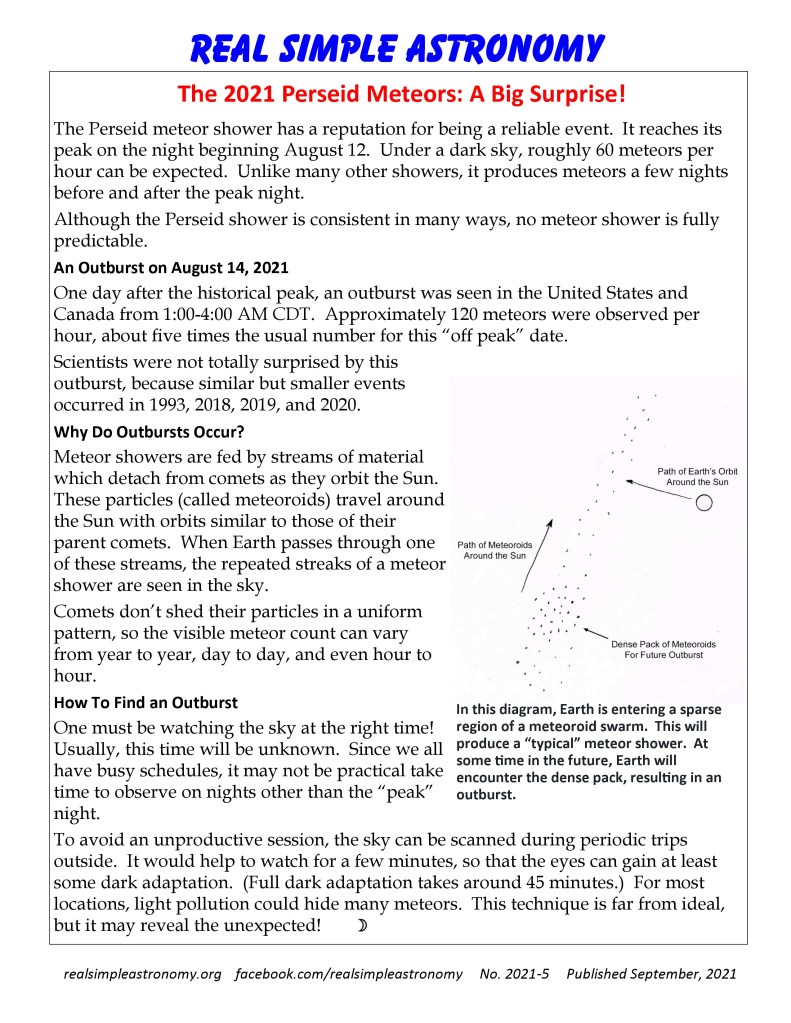
Meteor showers are fed by streams of material which detach from comets as they orbit the Sun. These particles (called meteoroids) travel around the Sun with orbits similar to those of their parent comets. When Earth passes through one of these streams, the repeated streaks of a meteor shower are seen in the sky.
Comets don’t shed their particles in a uniform pattern, so the visible meteor count can vary from year to year, day to day, and even hour to hour.
How To Find an Outburst
One must be watching the sky at the right time! Usually, this time will be unknown. Since we all have busy schedules, it may not be practical take time to observe on nights other than the “peak” night.
To avoid an unproductive session, the sky can be scanned during periodic trips outside. It would help to watch for a few minutes, so that the eyes can gain at least some dark adaptation. (Full dark adaptation takes around 45 minutes.) For most locations, light pollution could hide many meteors. This technique is far from ideal, but it may reveal the unexpected!
 Real Simple Astronomy