Here is a beginner telescope for $US 59.95, with free shipping in the USA. It is by Orion. I have one of their telescopes and it works well for me.
Good Move, NASA!

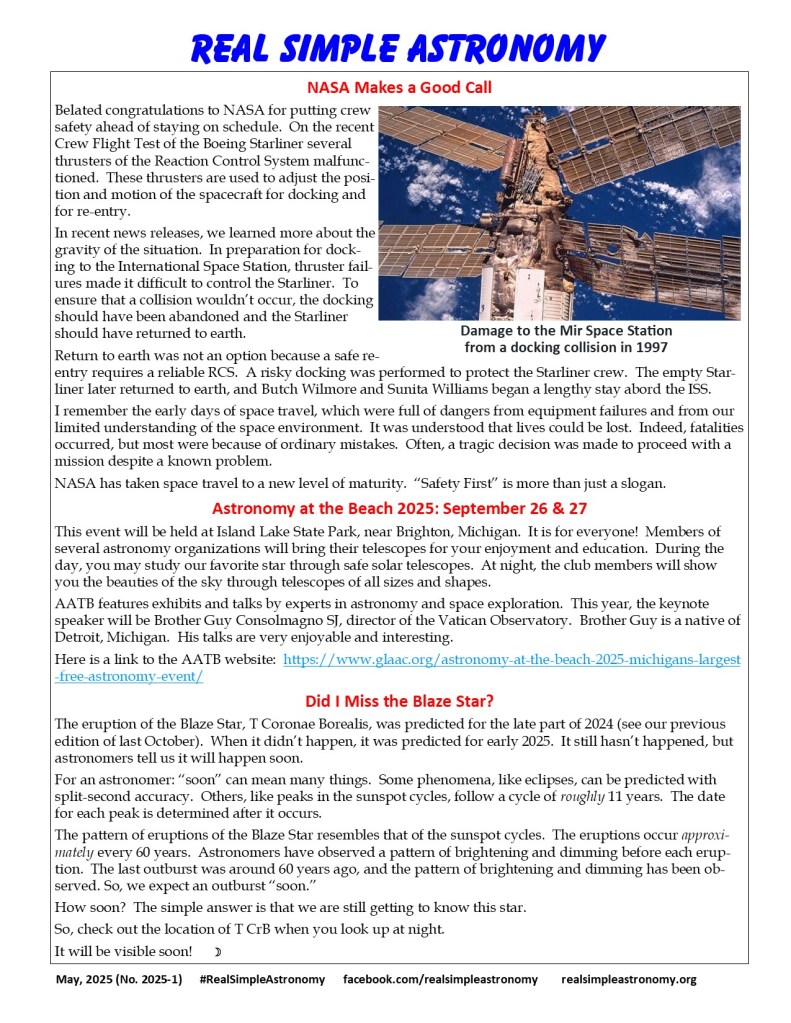
(Plain Text Version)
NASA Makes a Good Call
Belated congratulations to NASA for putting crew safety ahead of staying on schedule. On the recent Crew Flight Test of the Boeing Starliner several thrusters of the Reaction Control System malfunctioned. These thrusters are used to adjust the position and motion of the spacecraft for docking and for re-entry.
In recent news releases, we learned more about the gravity of the situation. In preparation for docking to the International Space Station, thruster failures made it difficult to control the Starliner. To ensure that a collision wouldn’t occur, the docking should have been abandoned and the Starliner should have returned to earth.
Return to earth was not an option because a safe re-entry requires a reliable RCS. A risky docking was performed to protect the Starliner crew. The empty Starliner later returned to earth, and Butch Wilmore and Sunita Williams began a lengthy stay abord the ISS.
I remember the early days of space travel, which were full of dangers from equipment failures and from our limited understanding of the space environment. It was understood that lives could be lost. Indeed, fatalities occurred, but most were because of ordinary mistakes. Often, a tragic decision was made to proceed with a mission despite a known problem.
NASA has taken space travel to a new level of maturity. “Safety First” is more than just a slogan.
Astronomy at the Beach 2025: September 26 & 27
This event will be held at Island Lake State Park, near Brighton, Michigan. It is for everyone! Members of several astronomy organizations will bring their telescopes for your enjoyment and education. During the day, you may study our favorite star through safe solar telescopes. At night, the club members will show you the beauties of the sky through telescopes of all sizes and shapes.
AATB features exhibits and talks by experts in astronomy and space exploration. This year, the keynote speaker will be Brother Guy Consolmagno SJ, director of the Vatican Observatory. Brother Guy is a native of Detroit, Michigan. His talks are very enjoyable and interesting.
Here is a link to the AATB website: https://www.glaac.org/astronomy-at-the-beach-2025-michigans-largest-free-astronomy-event/
Did I Miss the Blaze Star?
The eruption of the Blaze Star, T Coronae Borealis, was predicted for the late part of 2024 (see our previous edition of last October). When it didn’t happen, it was predicted for early 2025. It still hasn’t happened, but astronomers tell us it will happen soon.
For an astronomer: “soon” can mean many things. Some phenomena, like eclipses, can be predicted with split-second accuracy. Others, like peaks in the sunspot cycles, follow a cycle of roughly 11 years. The date for each peak is determined after it occurs.
The pattern of eruptions of the Blaze Star resembles that of the sunspot cycles. The eruptions occur approximately every 60 years. Astronomers have observed a pattern of brightening and dimming before each eruption. The last outburst was around 60 years ago, and the pattern of brightening and dimming has been observed. So, we expect an outburst “soon.”
How soon? The simple answer is that we are still getting to know this star.
So, check out the location of T CrB when you look up at night.
It will be visible soon!
#RealSimpleAstronomy
A Bright New Comet is Coming!

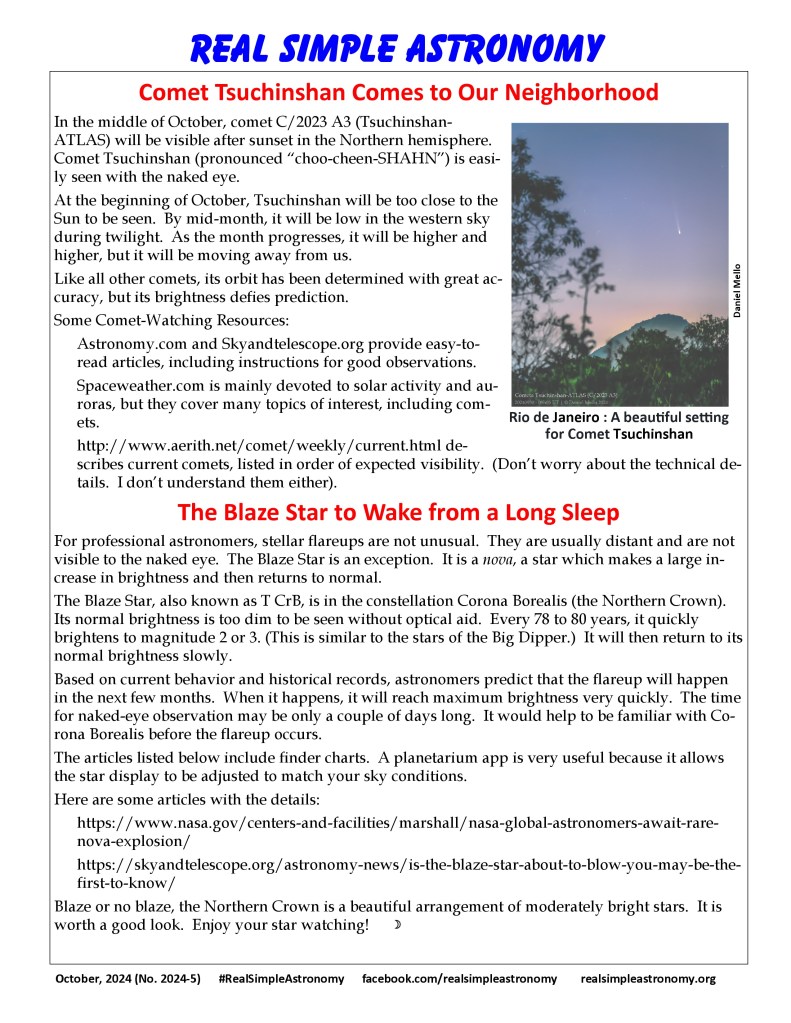
http://aerith.net/comet/weekly/current.html
http://nasa.gov/centers-and-facilities/marshall/nasa-global-astronomers-await-rare-nova-explosion/
(Plain Text Version)
Comet Tsuchinshan Comes to Our Neighborhood
In the middle of October, comet C/2023 A3 (Tsuchinshan-ATLAS) will be visible after sunset in the Northern hemisphere. Comet Tsuchinshan (pronounced “choo-cheen-SHAHN”) is easily seen with the naked eye.
At the beginning of October, Tsuchinshan will be too close to the Sun to be seen. By mid-month, it will be low in the western sky during twilight. As the month progresses, it will be higher and higher, but it will be moving away from us.
Like all other comets, its orbit has been determined with great accuracy, but its brightness defies prediction.
Some Comet-Watching Resources:
Astronomy.com and Skyandtelescope.org provide easy-to-read articles, including instructions for good observations.
Spaceweather.com is mainly devoted to solar activity and auroras, but they cover many topics of interest, including comets.
http://www.aerith.net/comet/weekly/current.html describes current comets, listed in order of expected visibility. (Don’t worry about the technical details. I don’t understand them either).
The Blaze Star to Wake from a Long Sleep
For professional astronomers, stellar flareups are not unusual. They are usually distant and are not visible to the naked eye. The Blaze Star is an exception. It is a nova, a star which makes a large increase in brightness and then returns to normal.
The Blaze Star, also known as T CrB, is in the constellation Corona Borealis (the Northern Crown). Its normal brightness is too dim to be seen without optical aid. Every 78 to 80 years, it quickly brightens to magnitude 2 or 3. (This is similar to the stars of the Big Dipper.) It will then return to its normal brightness slowly.
Based on current behavior and historical records, astronomers predict that the flareup will happen in the next few months. When it happens, it will reach maximum brightness very quickly. The time for naked-eye observation may be only a couple of days long. It would help to be familiar with Corona Borealis before the flareup occurs.
The articles listed below include finder charts. A planetarium app is very useful because it allows the star display to be adjusted to match your sky conditions.
Here are some articles with the details:
Blaze or no blaze, the Northern Crown is a beautiful arrangement of moderately bright stars. It is worth a good look. Enjoy your star watching!
#RealSimpleAstronomy
High Resolution Cloud Images
For all you eclipse chasers, it looks like cloud cover is going to be a major challenge. I have recently discovered yet another resource.
This is a high resolution satellite view of cloud cover. It gives much more detail than the GOES image from the US Weather Service.
The page is set up for a large screen. It is a bit hard to navigate on a smartphone.
There are lots of options. I like “Sub-Regional Sectors”, and “Natural Color”.
Remember, take off your shades during totality!
Keep smiling!
John
Planning for the April Eclipse

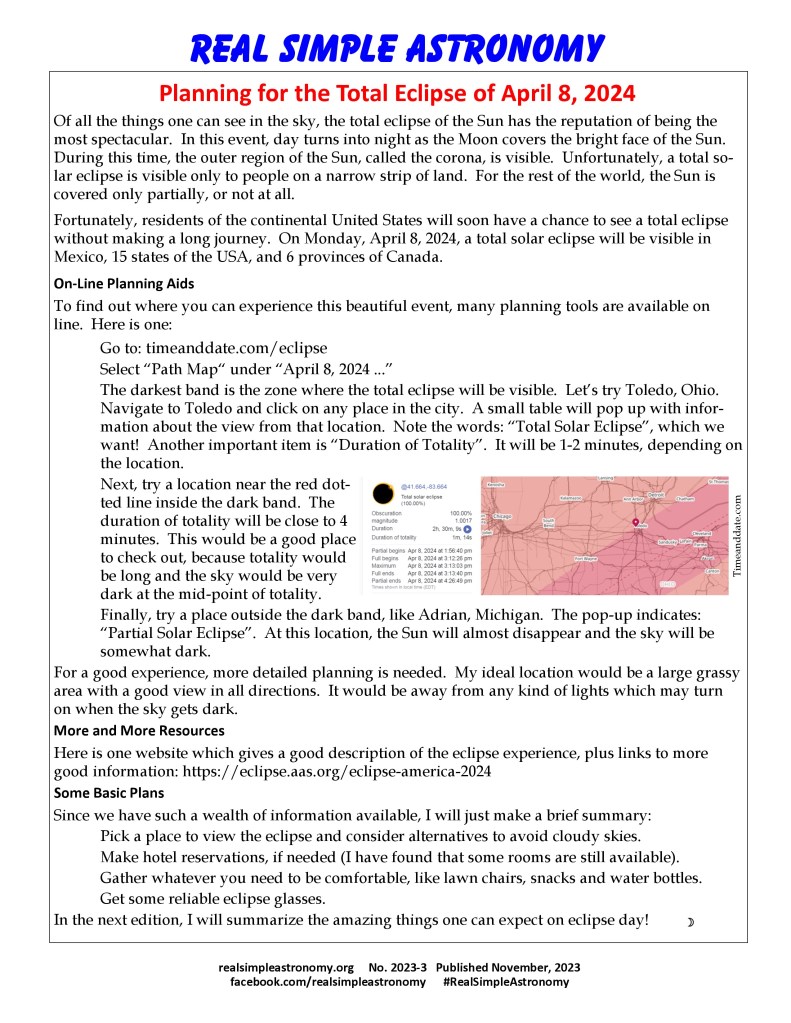
(Plain Text Version)
Of all the things one can see in the sky, the total eclipse of the Sun has the reputation of being the most spectacular. In this event, day turns into night as the Moon covers the bright face of the Sun. During this time, the outer region of the Sun, called the corona, is visible. Unfortunately, a total solar eclipse is visible only to people on a narrow strip of land. For the rest of the world, the Sun is covered only partially, or not at all.
Fortunately, residents of the continental United States will soon have a chance to see a total eclipse without making a long journey. On Monday, April 8, 2024, a total solar eclipse will be visible in Mexico, 15 states of the USA, and 6 provinces of Canada.
On-Line Planning Aids
To find out where you can experience this beautiful event, many planning tools are available on line. Here is one:
Go to: timeanddate.com/eclipse
Select “Path Map“ under “April 8, 2024 …”
The darkest band is the zone where the total eclipse will be visible. Let’s try Toledo, Ohio. Navigate to Toledo and click on any place in the city. A small table will pop up with information about the view from that location. Note the words: “Total Solar Eclipse”, which we want! Another important item is “Duration of Totality”. It will be 1-2 minutes, depending on the location.
Next, try a location near the red dotted line inside the dark band. The duration of totality will be close to 4 minutes. This would be a good place to check out, because totality would be long and the sky would be very dark at the mid-point of totality.
Finally, try a place outside the dark band, like Adrian, Michigan. The pop-up indicates: “Partial Solar Eclipse”. At this location, the Sun will almost disappear and the sky will be somewhat dark.
For a good experience, more detailed planning is needed. My ideal location would be a large grassy area with a good view in all directions. It would be away from any kind of lights which may turn on when the sky gets dark.
More and More Resources
Here is one website which gives a good description of the eclipse experience, plus links to more good information: https://eclipse.aas.org/eclipse-america-2024
Some Basic Plans
Since we have such a wealth of information available, I will just make a brief summary:
Pick a place to view the eclipse and consider alternatives to avoid cloudy skies.
Make hotel reservations, if needed (I have found that some rooms are still available).
Gather whatever you need to be comfortable, like lawn chairs, snacks and water bottles.
Get some reliable eclipse glasses.
In the next edition, I will summarize the amazing things one can expect on eclipse day!
#RealSimpleAstronomy
Solar Eclipse this Saturday!

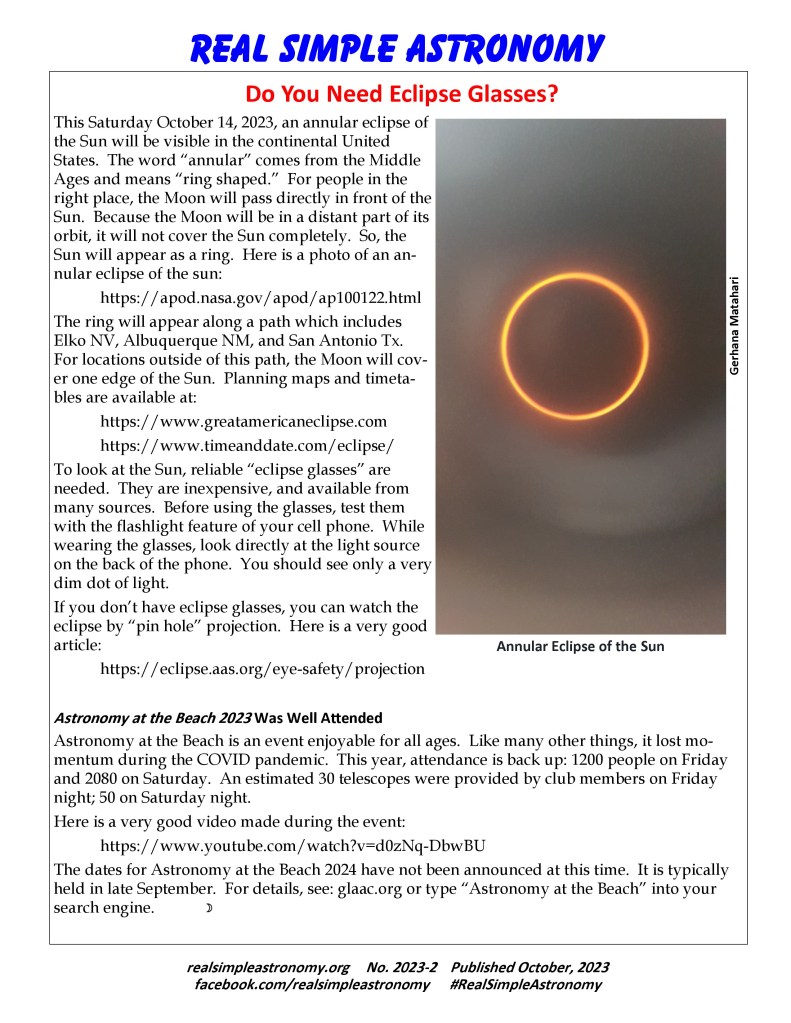
(Plain Text Version)
This Saturday October 14, 2023, an annular eclipse of the Sun will be visible in the continental United States. The word “annular” comes from the Middle Ages and means “ring shaped.” For people in the right place, the Moon will pass directly in front of the Sun. Because the Moon will be in a distant part of its orbit, it will not cover the Sun completely. So, the Sun will appear as a ring. Here is a photo of an annular eclipse of the sun:
https://apod.nasa.gov/apod/ap100122.html
The ring will appear along a path which includes Elko NV, Albuquerque NM, and San Antonio Tx. For locations outside of this path, the Moon will cover one edge of the Sun. Planning maps and timetables are available at:
https://www.greatamericaneclipse.com
https://www.timeanddate.com/eclipse/
To look at the Sun, reliable “eclipse glasses” are needed. They are inexpensive, and available from many sources. Before using the glasses, test them with the flashlight feature of your cell phone. While wearing the glasses, look directly at the light source on the back of the phone. You should see only a very dim dot of light.
If you don’t have eclipse glasses, you can watch the eclipse by “pin hole” projection. Here is a very good article:
https://eclipse.aas.org/eye-safety/projection
Astronomy at the Beach 2023 Was Well Attended
Astronomy at the Beach is an event enjoyable for all ages. Like many other things, it lost momentum during the COVID pandemic. This year, attendance is back up: 1200 people on Friday and 2080 on Saturday. An estimated 30 telescopes were provided by club members on Friday night; 50 on Saturday night.
Here is a very good video made during the event:
The dates for Astronomy at the Beach 2024 have not been announced at this time. It is typically held in late September. For details, see: glaac.org or type “Astronomy at the Beach” into your search engine.
#RealSimpleAstronomy
It is Time to Say “Hi” Again!

(Plain Text Version)
It has been a while since I have posted anything, but I hope you are following good sources of news and information. My goal is to avoid repeating things which other people have already explained. I like to simply share my own experiences and insights.
So, I will start off by encouraging everyone to make plans for a unique and beautiful event: the total eclipse of the Sun on April 8, 2024:
To Go, or Not to Go?
If you don’t live in North America, you probably aren’t excited about this event. But, if you do live in this continent, you may have an opportunity for an amazing experience. Millions of people won’t have to travel at all. They just need to go outdoors at the right time! For the rest of us, travel will be needed.
So, this is a good time to make plans.
I had a very good experience with the total solar eclipse of August 2017. I will re-post some freshened versions of articles from that time.
Where’s the Moon?
My 3-year-old grandson loves to look for the Moon in the daytime. If I’m around, he lets me know. On Memorial Day, he got a chance to see the Moon through a small telescope. The next time we met, instead of saying “Hi Grandpa”, he said: “WHERE’S THE MOON?”
Since the third quarter Moon hadn’t risen, I pointed to the ground and said: “It’s down there.” He immediately got down and pushed the grass aside and said: “The Moon is here!”
He may be destined to be an astronomy enthusiast—time will tell. I would love to tell him everything I know, but we know that wouldn’t work. Where does a 3-year-old begin? I will try a couple of books about the Solar System.
Astronomy at the Beach is Back Again!
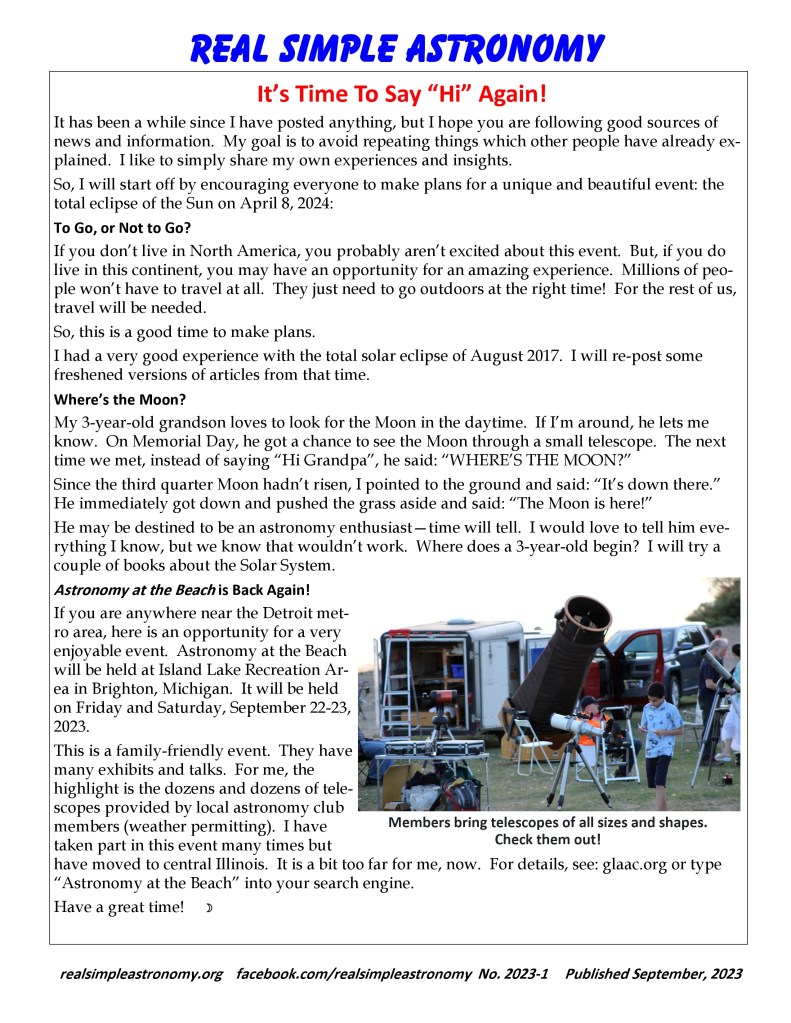
If you are anywhere near the Detroit metro area, here is an opportunity for a very enjoyable event. Astronomy at the Beach will be held at Island Lake Recreation Area in Brighton, Michigan. It will be held on Friday and Saturday, September 22-23, 2023.
This is a family-friendly event. They have many exhibits and talks. For me, the highlight is the dozens and dozens of telescopes provided by local astronomy club members (weather permitting). I have taken part in this event many times but have moved to central Illinois. It is a bit too far for me, now. For details, see: glaac.org or type “Astronomy at the Beach” into your search engine.
Have a great time!
A “Near-Total” Lunar Eclipse

Here is a “clickable” link:
https://www.timeanddate.com/eclipse/lunar/2021-november-19
(Plain Text Version)
As our friend the Moon journeys around our planet it passes through our shadow on a regular basis. The Moon will be partially or completely covered, depending on the alignment of the Sun, Earth, and Moon.
Unlike a solar eclipse, it is not necessary to travel to see a Lunar eclipse. One needs only to be on the side of Earth facing the Moon. Bad news: if you are on the “wrong” side, or it is cloudy, you will miss it. Good news: Lunar eclipses are frequent, and another opportunity will come soon.
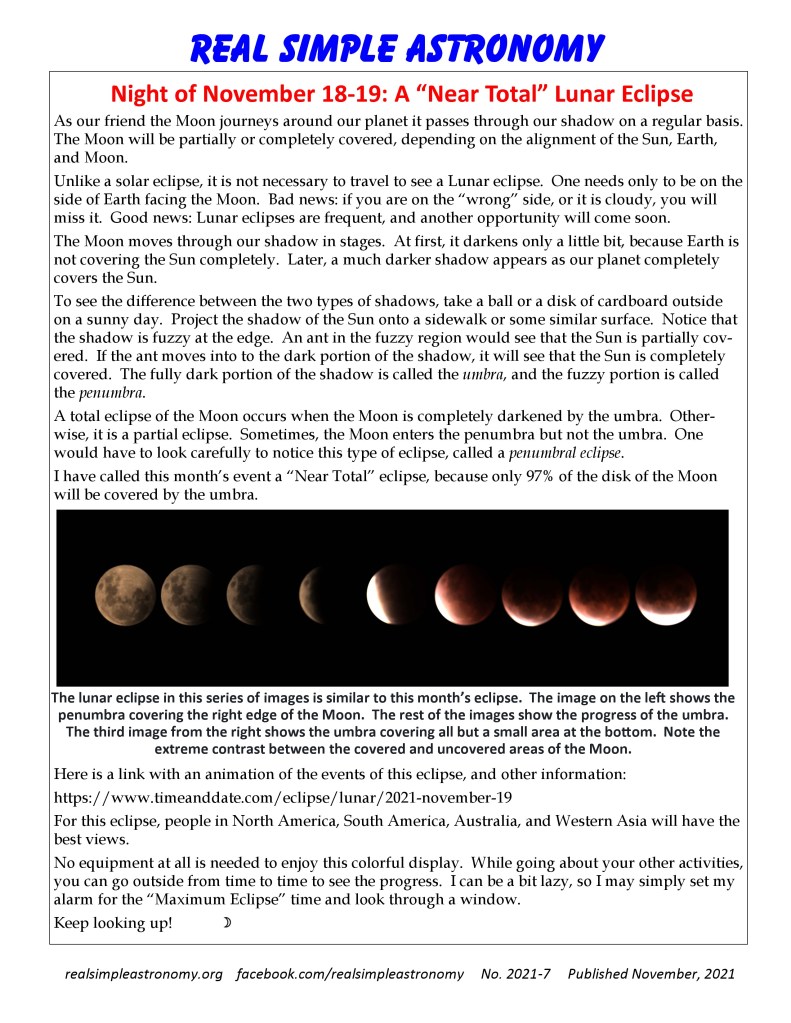
The Moon moves through our shadow in stages. At first, it darkens only a little bit, because Earth is not covering the Sun completely. Later, a much darker shadow appears as our planet completely covers the Sun.
To see the difference between the two types of shadows, take a ball or a disk of cardboard outside on a sunny day. Project the shadow of the Sun onto a sidewalk or some similar surface. Notice that the shadow is fuzzy at the edge. An ant in the fuzzy region would see that the Sun is partially covered. If the ant moves into to the dark portion of the shadow, it will see that the Sun is completely covered. The fully dark portion of the shadow is called the umbra, and the fuzzy portion is called the penumbra.
A total eclipse of the Moon occurs when the Moon is completely darkened by the umbra. Otherwise, it is a partial eclipse. Sometimes, the Moon enters the penumbra but not the umbra. One would have to look carefully to notice this type of eclipse, called a penumbral eclipse.
I have called this month’s event a “Near Total” eclipse, because only 97% of the disk of the Moon will be covered by the umbra.
Here is a link with an animation of the events of this eclipse, and other information:
https://www.timeanddate.com/eclipse/lunar/2021-november-19
For this eclipse, people in North America, South America, Australia, and Western Asia will have the best views.
No equipment at all is needed to enjoy this colorful display. While going about your other activities, you can go outside from time to time to see the progress. I can be a bit lazy, so I may simply set my alarm for the “Maximum Eclipse” time and look through a window.
Keep looking up!
Northern Lights – Not This Time…

For those who tried to see the predicted display of the Northern Lights, we hope you enjoyed the chance to go outside and take a look at the night sky.
I visited a semi-dark site near my home in Peoria, IL, but saw only stars and clouds.
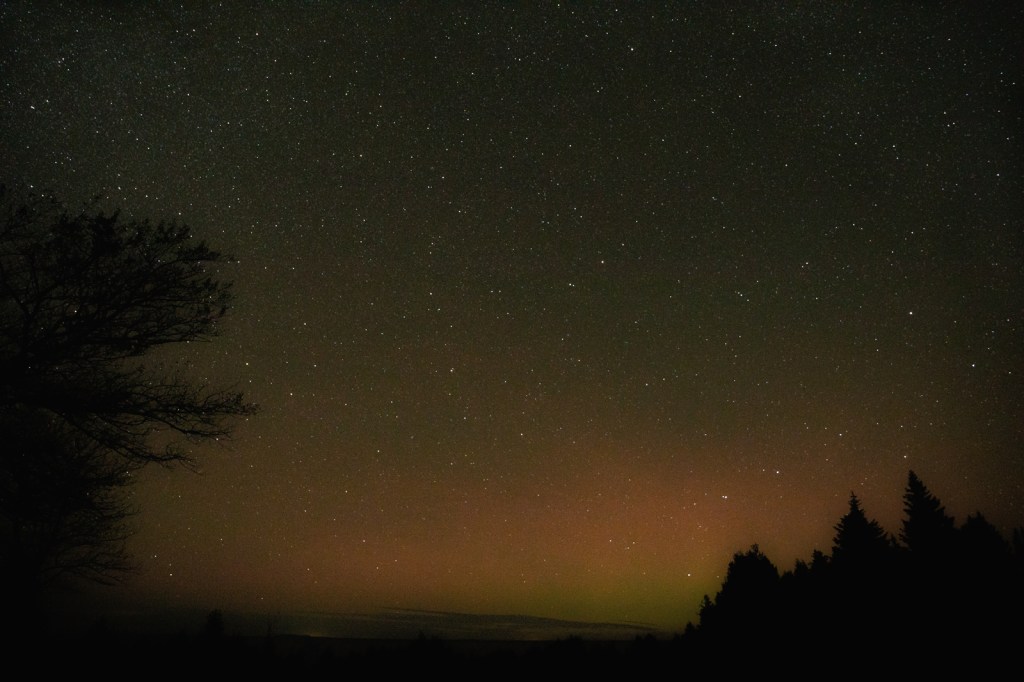
We know that the Coronal Mass Ejection happened, but the bulk of it seems to have missed Earth. I received one report of a low, somewhat weak Auroral display in Northern Michigan (latitude 45 degrees North). See photo:
So, what will I do the next time an exciting prediction is made? I think you know.
Keep looking up, and you will see something!
John
Northern Lights Tonight?
Two days ago (10/28/21), the Sun released a large quantity of protons and electrons. This event is called a Coronal Mass Ejection (CME). This particular CME was stronger than usual, and is directed toward Earth. It is expected to reach Earth today (10/30/21).
CME’s can trigger vivid Aurora displays. This event is expected to strike our Northern Hemisphere, beginning with Europe and continuing to North America. Although Auroras are rare at Latitudes below 45 degrees, this event may be visible in places like Kansas, Illinois, and Virginia.
So, tonight would be a good time to look for the Northern Lights. It helps greatly to be away from city lights. Look to the North when the sky is fully dark.
Auroras are only moderately predictable, so we may not see anything…or we may see a huge display! Once in the 1970’s I was awakened in the middle of the night by my roommates to go outside and take a look. There were gray-white displays covering the entire sky. The city lights (in Ann Arbor, MI) couldn’t take anything away from the view.
Have a great night!
Here is a link with more information: https://www.accuweather.com/en/space-news/northern-lights-to-glow-over-us-halloween-aurora-borealis/1040379
 Real Simple Astronomy