Pardon me for not mentioning this sooner, but Astronomy At The Beach returns tomorrow!
Again, it will be an online event, with all-new presentations and online telescope views. Since we are online, we can visit the Southern Hemisphere: Maxi Falieres from Argentina will take us on a live a tour of the Southern Hemisphere skies! This will be from 10PM to Midnight EDT.
A lot of people would say that the Moon, Jupiter, and Saturn are the three most beautiful objects for small telescopes. For the next month, Jupiter and Saturn are well positioned over the southern horizon in the early evening. They are high enough to be free from disturbance by the atmosphere. For the next few days, the Moon will join them to make a celestial trio.
So, this is a great time to bring out the telescope and enjoy these three beauties.
The Perseid meteor shower has a reputation for being a reliable event. It reaches its peak on the night beginning August 12. Under a dark sky, roughly 60 meteors per hour can be expected. Unlike many other showers, it produces meteors a few nights before and after the peak night.
Although the Perseid shower is consistent in many ways, no meteor shower is fully predictable.
An Outburst on August 14, 2021
One day after the historical peak, an outburst was seen in the United States and Canada from 1:00-4:00 AM CDT. Approximately 120 meteors were observed per hour, about five times the usual number for this “off peak” date.
Scientists were not totally surprised by this outburst, because similar but smaller events occurred in 1993, 2018, 2019, and 2020.
Why Do Outbursts Occur?
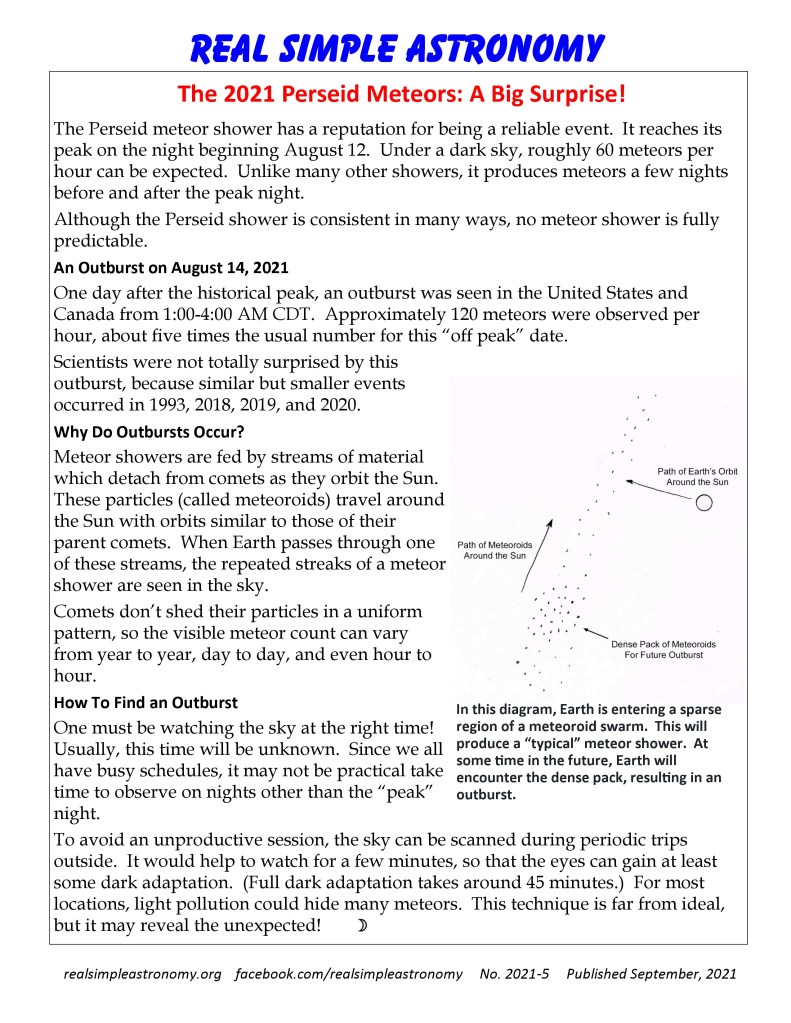
Meteor showers are fed by streams of material which detach from comets as they orbit the Sun. These particles (called meteoroids) travel around the Sun with orbits similar to those of their parent comets. When Earth passes through one of these streams, the repeated streaks of a meteor shower are seen in the sky.
Comets don’t shed their particles in a uniform pattern, so the visible meteor count can vary from year to year, day to day, and even hour to hour.
How To Find an Outburst
One must be watching the sky at the right time! Usually, this time will be unknown. Since we all have busy schedules, it may not be practical take time to observe on nights other than the “peak” night.
To avoid an unproductive session, the sky can be scanned during periodic trips outside. It would help to watch for a few minutes, so that the eyes can gain at least some dark adaptation. (Full dark adaptation takes around 45 minutes.) For most locations, light pollution could hide many meteors. This technique is far from ideal, but it may reveal the unexpected!
Today, the standard method of exploring the surface of the Moon or a planet is to land a robotic crawler loaded with cameras and scientific instruments. In my review of space missions, I was surprised to learn that these vehicles were very rare before the 21st century.
A Bit of History
In the beginning of the Space Age, missions were quite simple by today’s standards. The first lunar missions used a rather obvious procedure: transmission of data before collision with the Moon.
The first few years of space exploration were plagued by all sorts of problems. For every success, there were several failures.
Here is a timeline of the milestones:
1957: Sputnik 1, the first artificial satellite was launched.
1959: Luna 2 returned data before lunar impact.
1966: Luna 9 made first soft landing on the Moon, and returned photos and radiation data.
1969: Astronauts aboard Apollo 11 landed on the Moon.
1970: First of two Lunokhod missions landed on the Moon, and deployed the first robotic crawler to operate away from Earth.
1997: The Mars Pathfinder crawler was deployed on Mars and functioned for more than two months.
2004: Two vehicles were deployed on Mars, and functioned for a long time: Spirit (6 years) and Opportunity (15 years).
In summary, 4 decades elapsed from Sputnik 1 before remote crawlers became commonplace.
2021: Will It Fly?
We are on the verge of another major step in exploring our neighboring bodies: within a few days, Ingenuity, the first Martian helicopter will be flight-tested.
For a successful flight, many challenges need to be overcome, such as generating enough lift in the ultra-thin Martian atmosphere, and controlling the craft with limited human interaction.
Ingenuity has tested its rotating blades at low speed, and is scheduled to fly on Sunday, April 11. For details, see:
A couple of weeks ago, I noticed that one of my favorite stars was a lot dimmer than usual. I soon found out that countless people have noticed the same thing. This star is Betelgeuse, in the constellation Orion the hunter.
Orion is a very prominent constellation in the winter sky of the Northern Hemisphere (summer in the Southern Hemisphere). Many features make Orion easy to find, especially the three bright stars which make up the hunter’s belt. Other striking features include two very bright stars: Rigel and Betelgeuse. Rigel is white, and Betelgeuse has a vivid orange color.
Betelgeuse and Rigel have been nearly equal in brightness, but now the dimming of Betelgeuse is easy to see. Unless you live in the North Polar or South Polar regions, you can step outside and see for yourself. Plus, no telescope is needed.
Betelgeuse is in its last, unstable, phase and will “soon” explode as a supernova. When this happens, you will certainly hear about it without the help of any on-line bulletins! Astronomers predict that it will be bright enough to see in the daytime for many days. It is far enough away that no harm to us Earthlings is expected.
Unfortunately, the word “soon” has a special meaning when spoken by an astronomer. It means: “In the next several hundred thousand years”. So, it could happen tonight, or it could be long after our lifetimes. So, we can look forward to watching the orange star continue to dim, brighten up or … whatever.
The night sky has many treasures in store for us. Most of these objects are very far away, and don’t appear to change much from year to year. Without precise measurements with telescopes, they seem to be stationary. Others, like the Moon and the planets, are close enough that their motion is obvious.
In addition to the Moon and the planets, comets show visible progress as they move across the sky. Comets are icy objects which orbit the Sun. Unlike planets, comets have elongated orbits which bring them close to the Sun, and then take them far away from the Sun. For example, Comet Halley comes closer to the Sun than the planet Mercury, and then travels out to the vicinity of Neptune and Pluto.
When a comet approaches the Sun, the ice begins to evaporate. The water vapor, combined with soil, moves away from the surface, and forms a visible tail. Energy from the sun can ionize (add or remove electrons from) the water vapor, and cause a second tail to develop.
This month, a comet has made a close (11.6 kilometer) approach to Earth and is now moving away from us. It is called 46P/ Wirtanen. It is high in the sky for observers in the Northern Hemisphere. This week, the Moon is brightening and coming closer to “46P” every night. This interferes with a good look at the comet. Beginning December 23, 2018, the sky will be dark before the Moon has a chance to rise. For the following two weeks, the Moon will not interfere. (As always, don’t miss an opportunity to see 46P, even when the Moon is out.)
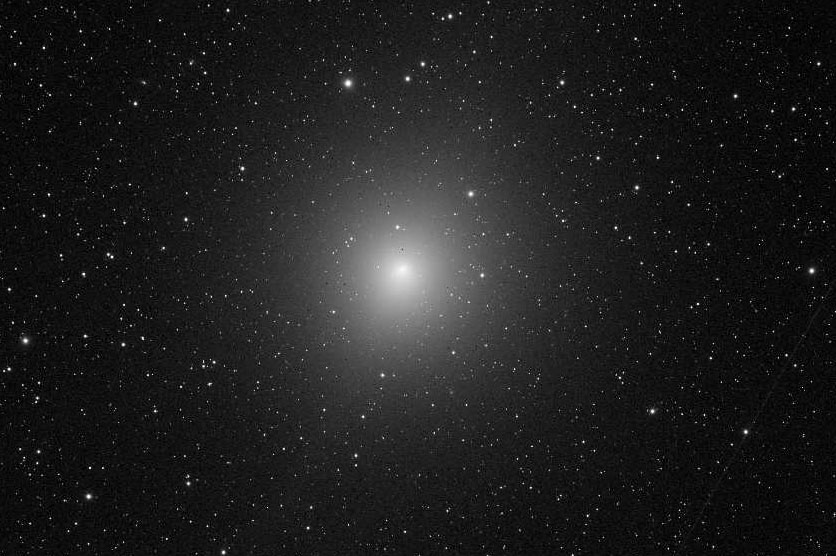
I obtained this image of Comet Wirtanen using a remote rental telescope on December 13, 2018. This comet has a faint tail, which doesn’t appear in this image. (itelescope.net T14; Takahashi 106 mm refractor, 5-minute exposure)
Comet Wirtanen is not bright enough to be seen naked-eye (to my best knowledge). Many people are finding it with binoculars and small telescopes. I have had an excellent view with my 10” (254mm) reflecting telescope.
I admit that finder charts can be difficult to use. In this instance, however, the bright star Capella is a very good reference point. An alternative to paper charts is the free version of the smartphone app “SkySafari”. Once it is installed, simply tap “Search”, then “Brightest Comets”, then “46P Wirtanen”, then “center”.
Last August 21, millions of people traveled to view a total eclipse of the Sun. This Wednesday, January 31, 2018, there will be a total eclipse of the Moon. While the total solar eclipse was visible only inside a narrow band of land, the total lunar eclipse will be visible to everyone on an entire side of planet Earth!
Here’s the short explanation of a lunar eclipse: On some orbits, the Moon travels through the shadow cast by the Earth. If the Moon is above our horizon, we can watch our shadow darken the surface of the Moon. If the Moon is completely darkened by the shadow, this is a total eclipse of the Moon. Otherwise, it is a partial eclipse of the Moon.
Here are some links to detailed explanations, and information about viewing this eclipse:
For this eclipse, people on the eastern portion of North America can watch the beginning stages of the eclipse. However, the Moon will set before it is totally covered. For those to the west (i.e. from North America, across the Pacific Ocean, and through most of Asia), the total eclipse will be visible. For detailed visibility maps, see:
As with the total solar eclipse, the simplest viewing techniques are often the most enjoyable. While going about your other activities, you can go outside from time to time, and see the progress. And, there is no law against staying inside and watching through a window!
When the eclipse is total, the Moon is illuminated by a small amount of sunlight which is “scattered” by Earth’s atmosphere. If you were standing on the Moon, you would see an orange ring around the Earth. This ring is a view of all the sunrises and sunsets all around the Earth! This ring of light casts an orange glow onto the Moon. This strength of the glow is affected by volcanic activity on Earth. Dust and aerosols from volcanic eruptions can darken the glow so that the Moon will be almost invisible.
No one knows for sure how many people will travel to the band of land where the Total Solar Eclipse of August 21, 2017 will be visible. Crowding will very likely be a problem, but here are a few ideas to consider:
The “narrow band” for totality is actually a vast area. Even with millions of people visiting, there is plenty of room for everyone.
Of course, some places will be very popular, and they will be crowded.
Our love of automobiles and our road system is the weak link in handling a large number of people. On August 21, the eclipse traffic will be added to the normal traffic load. A particular concern would be after the eclipse, where most people will want to go home at the same time.
Motel rooms will be available at the last minute, because some people (my self included) have made reservations in multiple cities. The unused reservations will be cancelled a day or two before August 21.
So, I offer this advice:
Try to make motel reservations as close to the area of totality as possible.
Check for last-minute vacancies at places inside the area of totality.
Arrive at your destination as early as you can manage.
Keep your gas tank full, and bring food and water.
Bring printed road maps, since the cellular networks in some areas may be overloaded.
Try to plan a route which avoids the major highways. In particular, be wary of expressways, because U-turns are not allowed.
Research good locations to view the eclipse. Many small towns have provided viewing areas, with varying levels of support.
While the centerline of the band of totality offers the maximum duration of totality, areas a small number of miles away will be almost as good.
In summary, a total eclipse of the Sun is such a magnificent event that many people want to experience it. Even with advance planning, inconveniences will occur. The goal is to keep them to a minimum, and have a memorable day!
On April 19, it will be possible to see the motion of an asteroid as it passes close to Earth. Asteroid 2014 JO25 will be close enough that it will be visible with a small telescope. See this article for details:



 Real Simple Astronomy