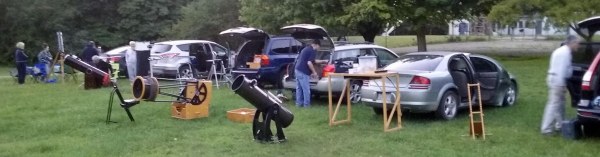
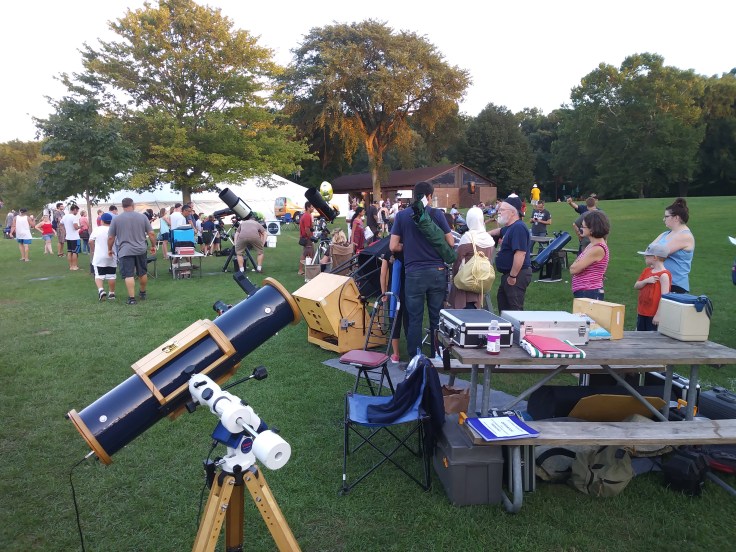
Early guests at our annual 9-club star party. An hour later, it was dark, and very crowded.
I thought I was finished writing about this year’s close encounter with Mars. In fact, I thought I was finished looking at the red planet for a while. For about two months, cloudy skies and Earth-bound activities (things other than astronomy) kept me from using my telescope.
About 3 weeks ago, our astronomy club, together with 8 other clubs, had a giant star party with about 5000 guests. Very early in the evening, I turned the telescope to Mars, and was surprised to see that it still appeared large enough for a good look. I must have said, at least 50 times, “It will be 15 years until we get this good a look at Mars.”
The views early in the evening were very fuzzy, due to the instability of the atmosphere. Regardless, our guests were glad to have a look. Much later, I found that the air was much steadier, and I was able to see the polar ice cap and some dark areas on the disk of the planet. Even though this happened well past our closest encounter with Mars, these were among my best observations for a long time.
The planet-wide dust storm, which had interfered with viewing, has settled down quite a bit. So, we still have a few more weeks to look at our neighboring planet through a telescope. And, that 15-year wait hasn’t started yet!
Although Opposition does not occur until July 26, we can enjoy good observations right now. Today, Mars has attained 89% of its maximum apparent size. If you live in a cloudy region, as I do, taking an early look can prevent anxiety later on.
Speaking of weather, Mars is in a planet-wide dust storm. Unlike dust storms on Earth, Martian dust storms cover vast areas, and can last a long time. So, with a telescope, very few ground features are visible. It is possible that the storm will still be in progress when this year’s observation period ends.
Rather than wish things were different, let’s consider this a unique opportunity to observe the progress of the storm! Observations of the dusty Mars can be compared to past or future observations of the clear Mars.
Here are links to some articles on the dust storm:
The best time to observe Mars is when it is well above the horizon, so that disturbances in our atmosphere are lessened. For this time of the year, the tilt of our planet gives the best views of Mars to residents of the Southern Hemisphere. To use Buenos Aires as an example, on July 26, Mars will be well positioned at 9 PM. It will continue to climb until it is overhead around 1 AM. So, good views can be had for almost the entire night.
For northerners, Mars doesn’t climb very high, and the best viewing occurs during a brief time slot. For New York on July 26, the best viewing time is from approximately 11 PM to 3 AM. Mars reaches its highest position at 1:09 AM. It will then be 24 degrees above the horizon (roughly ¼ of the way to directly overhead). At this elevation, observations can be good, although not the best.
Finding Mars in the sky, is quite easy. Except for the Sun, the Moon, and Venus, it will be the brightest object in the sky!
Here is a link to an online planetarium app, which will help you in your planning:
Of all the planets in our solar system, only three lend themselves to detailed examination with amateur telescopes: Jupiter, Saturn, and Mars. The other planets are interesting, but don’t reveal much detail. Mercury is small, and low in the sky at night. Venus is covered by a permanent cloud deck. Uranus and Neptune are very far away.
I do enjoy looking at Mercury, Venus, Uranus and Neptune and encourage you to do likewise. However, Jupiter, Saturn, and Mars have large and small surface details. Even with the best telescopes, the best sky conditions, and the best observing techniques, there will be details which are just out of reach. We keep coming back, hoping to do better.
Good News for City-Dwellers!
It is not necessary to flee to the country to view of the bright planets, because they stand out against the bright sky. Many observers actually prefer a bright background to a black one.
So, try to find out what will be happening in your area. Some astronomy clubs set up telescopes in downtown locations. Also, many urban observatories which had fallen into disuse, are now open to the public.
Telescopes
In this tiny article, I won’t try to cover the strengths and weaknesses of the diverse types of telescopes. Since Jupiter, Saturn, and Mars are bright, a large diameter objective lens or mirror is not necessary. For planetary observation, pick the telescope with the most precisely crafted optical components. The better the optics, the less the image details will be distorted. As with most things, quality costs money, and high quality costs a lot of money. For this reason, I recommend enjoying the Mars opposition at an observatory or at a star party.
Sky Conditions
Although we are glad to have air to breathe, we wish it wouldn’t distort our view of everything more than a few miles away. If the air was free of dust and mist, and was uniform in density, our planet-watching would be much better. In reality, we must cope with the air we have. The higher the planet is above the horizon, the better the view, since we have less air to look through. There are on-line resources which predict transparency (freedom from haze) and “seeing” (freedom from distortion caused by variations in air density).
How to Observe
“Patience” is the key word in observing the features of the planets. Our goal is to see the delicate details as well as we can. I am not an expert observer, but I will tell what I know. It helps to study good photos of the planets, to know what to look for. Astronomical apps are useful for previews of features like the Great Red Spot of Jupiter and the light and dark areas of Mars. Look at broad features first, and then look for finer ones.
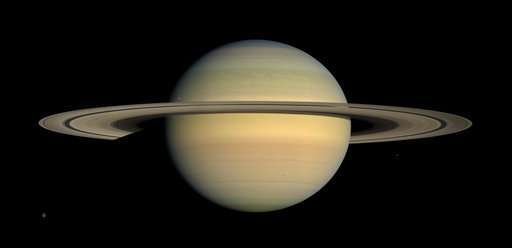
Saturn, From the Cassini Mission
Let’s take Saturn for an example. Even a very small telescope shows the rings, but perhaps not the Cassini Division (the black gap in the outer portion of the ring system). If you find the Cassini Division, can you see any other gaps or features of the rings? At first look, the planet itself seems uniformly white or tan, but can you see bands with subtle color variations?
Your view of a planet will keep changing from bad to good and good to bad. This is not necessarily a problem with your eyesight. Here is where the patience comes in. Because our atmosphere is constantly in motion, the image distortions keep changing. Sometimes the distortion is extreme, and other times it is not so bad. To catch the details, we need to concentrate, but also relax and wait for the brief moments of clarity. These glimpses may last only a fraction of a second, so try to memorize what you see.
“Patience” also applies to the people waiting in line behind you. You should take as much time as you need to grab the best moments of image clarity. Fifteen seconds is not long enough. Two minutes is not unreasonable. At some point, you will decide that there won’t be a better view, and it is time to move on. But don’t leave – go to the end of the line for another try! By the time your turn comes up, the atmosphere will be different – maybe better, maybe worse.
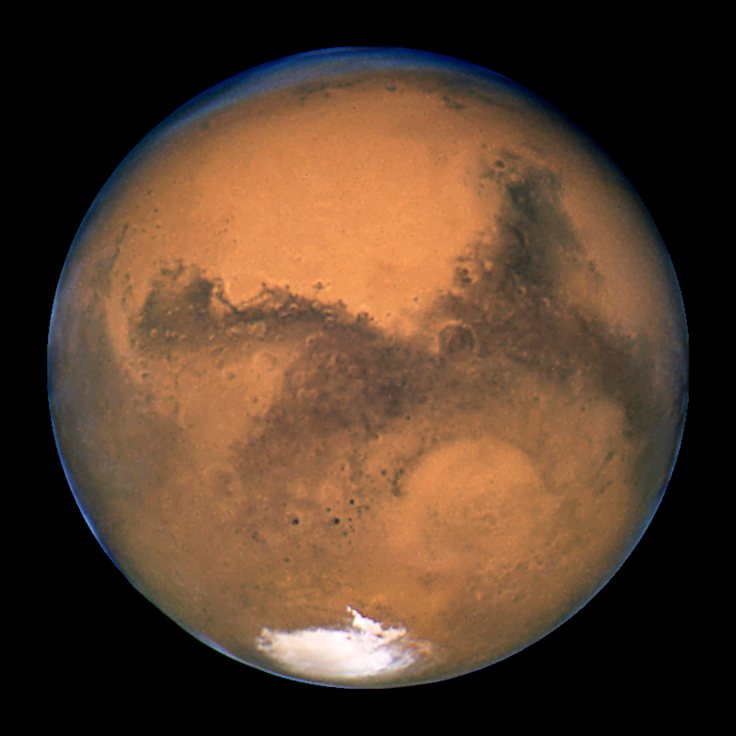
Mars, From the Hubble Space Telescope
The surface details of Mars are very subtle and can be completely missed if one is not patient. The splendid photos we see on line and in print are usually adjusted for enhanced contrast. In visual observation, we don’t have this luxury. In the telescope, Mars can be very bright, and seem devoid of any details. With patience, fleeting glimpses of the dark areas may occur. Depending on the Martian seasons, and orbital positions, one of the polar ice caps may be visible.
My “best-ever” view of Mars was near the opposition of 2014. I was fortunate to look through a very good 24” reflecting telescope. After waiting a while, an ice cap and some of the dark surface features appeared and promptly disappeared. Unfortunately, they did not reappear.
Conclusion
There is much more to say about observing the planets, but I hope I have given you motivation to learn more and watch more. In upcoming articles, I hope to cover best times to observe and how to find resources in your area.
Keep looking up,
John
Resources
Sky conditions, including transparency and seeing for the US and Canada:
Mid-summer of 2018 will be a very good time to observe Mars. During this period, the Mars-Earth distance will be at its lowest in 15 years. These opportunities come rarely because of the shape of the orbit of Mars.
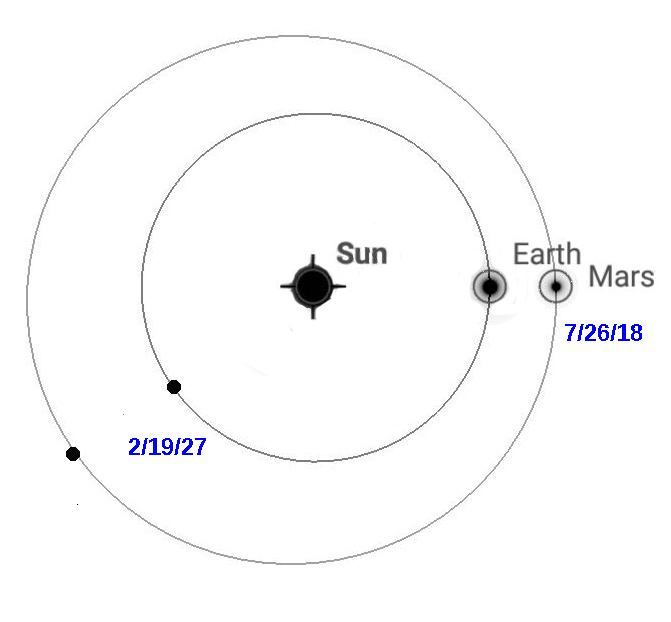
Here is a diagram of Earth’s and Mars’ orbits, drawn to scale (thanks to the SkySafari app):
As you can see, Earth’s orbit is a lot rounder than Mars’ orbit. As the two planets progress around the Sun their oppositions (closest alignments) can be close or distant. Oppositions occur approximately every 26 months. For clarity, we are showing only two oppositions, a close one (this July) and a distant one (in 2027).
At the next opposition, which occurs on July 26, 2018, Mars will be at its brightest. This will also be the best time use a telescope to look at its surface features. Of course, weather and other things get in the way, so it would be good to start looking before opposition and continue to look for opportunities after opposition.
Figure 4 is the item of interest. This is an illustration of the relative sizes of Mars as it would appear before and after opposition. It highlights the importance of viewing during the closest Earth-Mars encounter. Late July is very good; late October is not good at all. (The surface detail of these images is much better than we would expect to see, even with a very good telescope.)
For those in the Northern hemisphere, frostbite will not be an issue. However, the time to view Mars will be a bit inconvenient. Mars won’t rise until after midnight and won’t reach its highest elevation on the sky for another 2 hours. Mars will be low in the sky, so our view will be distorted by a lot of turbulent air. In the Southern hemisphere, Mars will rise early and be very high in the sky by mid-evening.
On and around July 26, 2018, Mars will be impressive naked-eye or with a small telescope. To make the best use of this opportunity, a large telescope will enable the best look at the surface features. There are many observatories which have public viewing nights. There are also many star parties hosted by astronomy clubs. Or maybe you know someone who has a large telescope, and is waiting for someone to ask…
Upcoming posts will cover this topic in more detail.

 Real Simple Astronomy