Saturn has a most unusual hexagonal storm system at its North Pole. Image by Cassini.
A very successful space probe is nearing the end of its life. This is the Cassini mission, a joint US and European effort. It left Earth in 1997, spent 7 years traveling to Saturn, and has been collecting images and data ever since.
In 2005, the Huygens lander detached from Cassini, and landed on Titan, Saturn’s largest Moon.
Study of the rings of Saturn has been a high priority for this mission. However, it has been important for Cassini not to get too close. The rings appear to be smooth bands of ribbon, but are streams of solid objects of various sizes, orbiting the planet at very high speeds. A collision with one of these particles could destroy the spacecraft.
Cassini has used up most of its fuel, and won’t be able to perform many more maneuvers. To avoid trouble in the future, the probe will purposely crash on Saturn.
The good news is that the probe is now moving into some hazardous areas. We will be able to get some images which were too risky earlier in Cassini’s mission. Cassini will venture closer to the rings, but still won’t try to enter them.
This is a summary of the Cassini mission. Here are some links to the bigger story:
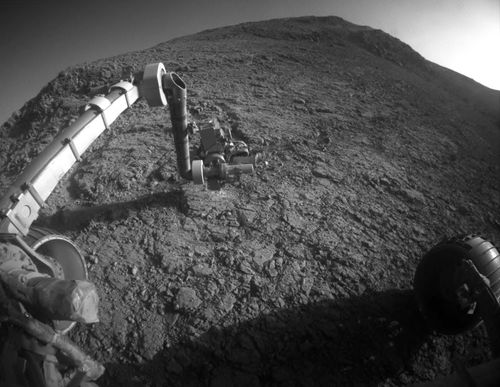
The Opportunity rover has been examining the Martian surface for over 12 years. In this view, a rock is being studied photographically and by chemical analysis.
Cost
To estimate the cost to travel to Mars, it is necessary to identify what needs to be shipped to Mars, what kinds of spacecraft need be built, and what kind of difficulties may arise. Since we cannot easily answer these questions, we can only make a vague guess as to the cost of the program.
Some high-expense items to consider would be:
The spacecraft may need to be large and complex, to provide the ability to recover from a major malfunction.
Because of the distance to Mars and the infrequency of launch windows, critical items will need to be stockpiled there. This will be expensive, and many items will never be used. This is part of the cost of taking safety seriously.
Extra launches may be needed to deal with emergencies. The hardware for these missions would need to be built and ready ahead of time.
To raise the funds for a venture this big, the governments of several countries will need to work together. Each of these participating nations well need to make a firm commitment to staying with the program for many years. Unfortunately, the politics of many countries works against long term participation.
In a democratic country, the voting public would need to be willing to pay high taxes for a long time. They would need to keep paying, even with the inevitable cost overruns. It is doubtful that this would happen.
Currently, in the USA, funding for robotic missions does not come automatically. Each mission must be justified to obtain funding. Given this difficulty, it is difficult to expect that human travel to Mars would be approved.
All of this leads to the third topic:
Value
I won’t dispute the fact that human explorers would be able to do things which robots cannot do. People have intuition, which will enable discoveries which are not anticipated. People can make repairs to equipment, which would be awkward or impossible to do otherwise. People observe on a deeper level than mere instruments. When something new or unusual is found, the human observer wants to understand it, and immediately examines it in detail.
In discussing value, we try to predict what we will accomplish, and decide if it worth the cost. Currently, robotic missions are steadily building up our understanding of Mars. No doubt, more will be launched during the next decade. Eventually, they will bring samples of Martian soil back to Earth.
For the cost of a single human mission, many robotic missions could be launched. These devices would not need to be identical, but could incorporate the lessons from previous successes and failures.
After Mars has been well examined by robots, human exploration could begin. Then human beings could begin to do what machines can’t do. Today, we don’t know what that necessarily human contribution would be.
So, the good news is that we are already exploring Mars in a logical, progressive, and affordable manner!
Next week, I will ask you how your plans for 8/21/17 are coming along!
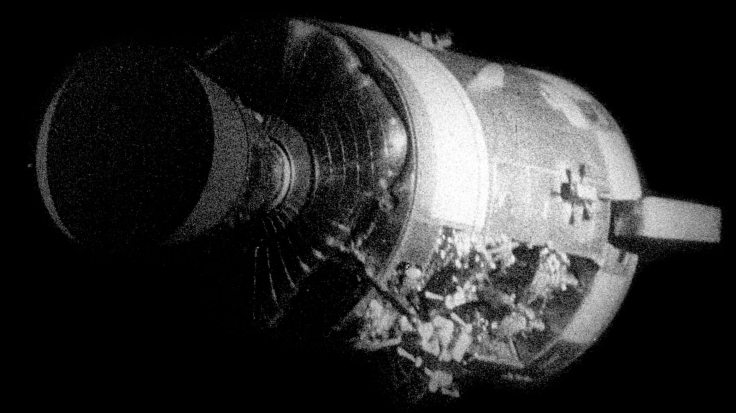
The Service Module of the Apollo 13 mission was damaged by a burst oxygen tank.
Part 1 – Safety
Honestly, I am not having a bad day, and I love space exploration. I am very enthusiastic about exploring Mars. I am amazed at how well some of the robotic craft have performed.
I would like to see larger numbers of roving vehicles traveling the rocky red paths of Mars. I do not think, however, that we are ready to think seriously about human travel to Mars. Also, I don’t take it as a certainty that it will happen “someday in the future”. Here are my reasons: safety, cost, and value.
Safety
I have seen sketches of proposed missions for travel to Mars, and I think that they would have some chance of getting our people to Mars and back home safely. The problem is that they assume that everything will go reasonably well. We have learned a lot about building reliability into our spacecraft, but we have had the option of returning quickly to Earth if malfunctions became too great to handle.
A craft en route to Mars will need the capability of managing and recovering from a major problem. What kind of problem? Since the flight of Yuri Gagarin, we have had fires, a burst oxygen tank, rocket motors which failed to run when needed, attitude thrusters not shutting off, a loss of hull pressure from a docking mishap, failures of modules to undock, release of toxic gas into a crew compartment, and several types of space suit malfunctions.
The Mars spacecraft will need to have extensive countermeasures and backup systems. Even so, to have a high level of safety, it may be necessary to travel in tandem with a complete redundant spacecraft, with a means of getting from one to the other quickly.
Although there may be astronauts willing to take a great risk, I would not wish to put them in danger by paying for a mission which doesn’t have an excellent prospect for success.
In addition to the difficulty of building a robust spacecraft, the problem of radiation must be addressed. When a vehicle moves outside of low-Earth orbit, radiation becomes a serious concern. There is a constant stream of high-energy particles in space. During a solar flare, it becomes much more intense. We have only begun to learn how to provide effective shielding to protect the crew.
Thank you for bearing with my somber treatment of such an exciting topic as space exploration. I promise to wrap up this series with some very encouraging ideas!



 Real Simple Astronomy