A Bright New Comet is Coming!

http://Astronomy.com

http://Skyandtelescope.org

http://Spaceweather.com

http://aerith.net/comet/weekly/current.html

http://nasa.gov/centers-and-facilities/marshall/nasa-global-astronomers-await-rare-nova-explosion/

http://skyandtelescope.org/astronomy-news/is-the-blaze-star-about-to-blow-you-may-be-the-first-to-know/

(Plain Text Version)

Comet Tsuchinshan Comes to Our Neighborhood

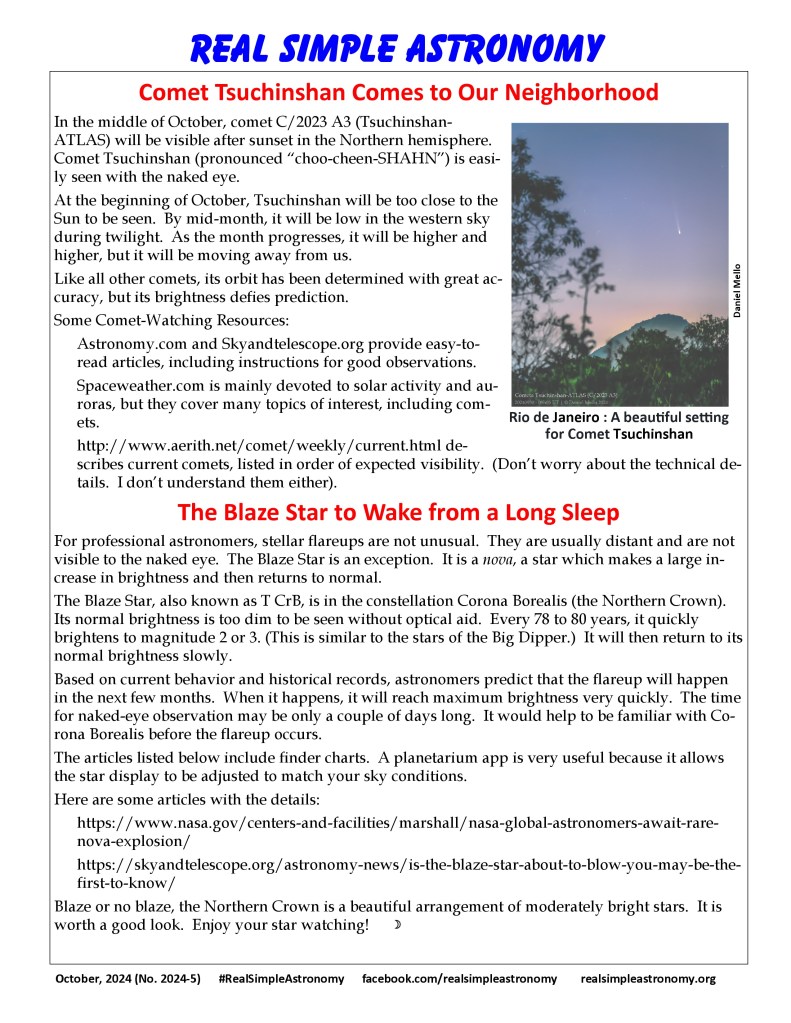
In the middle of October, comet C/2023 A3 (Tsuchinshan-ATLAS) will be visible after sunset in the Northern hemisphere.   Comet Tsuchinshan (pronounced “choo-cheen-SHAHN”) is easily seen with the naked eye.

At the beginning of October, Tsuchinshan will be too close to the Sun to be seen.  By mid-month, it will be low in the western sky during twilight.  As the month progresses, it will be higher and higher, but it will be moving away from us.  

Like all other comets, its orbit has been determined with great accuracy, but its brightness defies prediction. 

Some Comet-Watching Resources:

Astronomy.com and Skyandtelescope.org provide easy-to-read articles, including instructions for good observations.

Spaceweather.com is mainly devoted to solar activity and auroras, but they cover many topics of interest, including comets.

http://www.aerith.net/comet/weekly/current.html describes current comets, listed in order of expected visibility.  (Don’t worry about the technical details.  I don’t understand them either).

The Blaze Star to Wake from a Long Sleep

For professional astronomers, stellar flareups are not unusual.  They are usually distant and are not visible to the naked eye.  The Blaze Star is an exception.  It is a nova, a star which makes a large increase in brightness and then returns to normal.

The Blaze Star, also known as T CrB, is in the constellation Corona Borealis (the Northern Crown). Its normal brightness is too dim to be seen without optical aid.  Every 78 to 80 years, it quickly brightens to magnitude 2 or 3. (This is similar to the stars of the Big Dipper.)  It will then return to its normal brightness slowly.

Based on current behavior and historical records, astronomers predict that the flareup will happen in the next few months.  When it happens, it will reach maximum brightness very quickly.  The time for naked-eye observation may be only a couple of days long.  It would help to be familiar with Corona Borealis before the flareup occurs. 

The articles listed below include finder charts.  A planetarium app is very useful because it allows the star display to be adjusted to match your sky conditions. 

Here are some articles with the details:

https://www.nasa.gov/centers-and-facilities/marshall/nasa-global-astronomers-await-rare-nova-explosion/

https://skyandtelescope.org/astronomy-news/is-the-blaze-star-about-to-blow-you-may-be-the-first-to-know/

Blaze or no blaze, the Northern Crown is a beautiful arrangement of moderately bright stars.  It is worth a good look.  Enjoy your star watching!

#RealSimpleAstronomy

Bright and Beautiful Summer Stars

(Plain Text Version)

The Summer Triangle

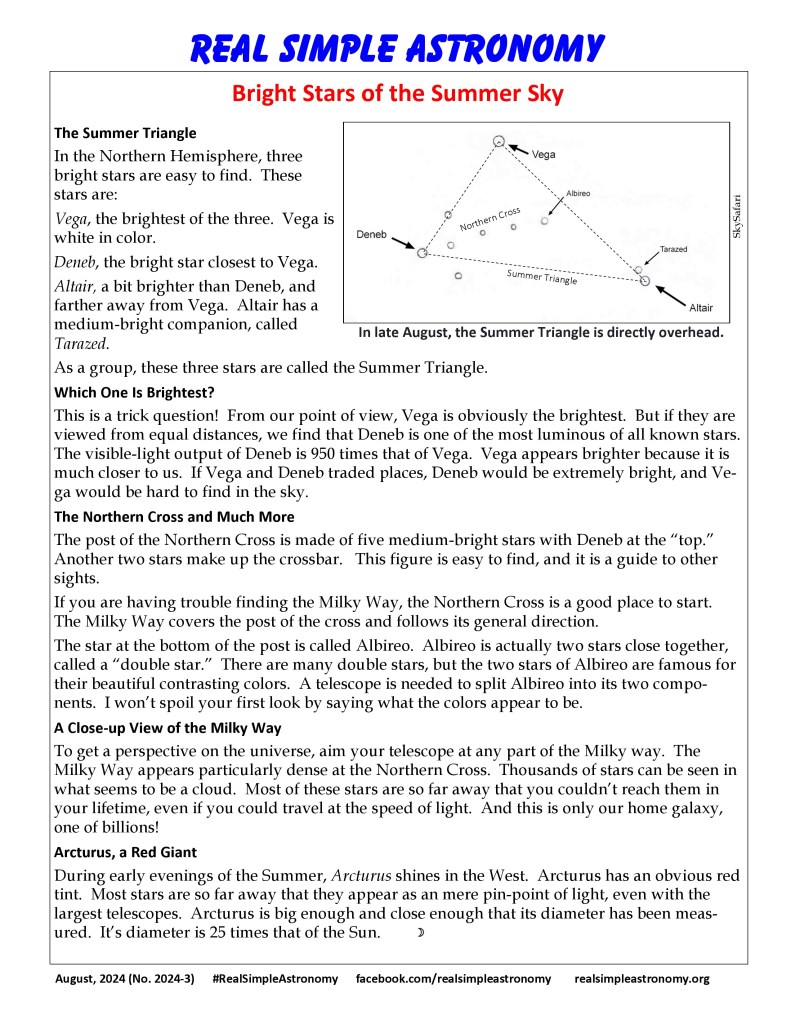
In the Northern Hemisphere, three bright stars are easy to find.  These stars are:

Vega, the brightest of the three.  Vega is white in color.

Deneb, the bright star closest to Vega.

Altair, a bit brighter than Deneb, and farther away from Vega.  Altair has a medium-bright companion, called Tarazed.

As a group, these three stars are called the Summer Triangle.

Which One Is Brightest?

This is a trick question!  From our point of view, Vega is obviously the brightest.  But if they are viewed from equal distances, we find that Deneb is one of the most luminous of all known stars.  The visible-light output of Deneb is 950 times that of Vega.  Vega appears brighter because it is much closer to us.  If Vega and Deneb traded places, Deneb would be extremely bright, and Vega would be hard to find in the sky.

The Northern Cross and Much More

The post of the Northern Cross is made of five medium-bright stars with Deneb at the “top.”  Another two stars make up the crossbar.   This figure is easy to find, and it is a guide to other sights. 

If you are having trouble finding the Milky Way, the Northern Cross is a good place to start.  The Milky Way covers the post of the cross and follows its general direction. 

The star at the bottom of the post is called Albireo.  Albireo is actually two stars close together, called a “double star.”  There are many double stars, but the two stars of Albireo are famous for their beautiful contrasting colors.  A telescope is needed to split Albireo into its two components.  I won’t spoil your first look by saying what the colors appear to be.

A Close-up View of the Milky Way

To get a perspective on the universe, aim your telescope at any part of the Milky way.  The Milky Way appears particularly dense at the Northern Cross.  Thousands of stars can be seen in what seems to be a cloud.  Most of these stars are so far away that you couldn’t reach them in your lifetime, even if you could travel at the speed of light.  And this is only our home galaxy, one of billions!

Arcturus, a Red Giant

During early evenings of the Summer, Arcturus shines in the West.  Arcturus has an obvious red tint.  Most stars are so far away that they appear as an mere pin-point of light, even with the largest telescopes.  Arcturus is big enough and close enough that its diameter has been measured.  It’s diameter is 25 times that of the Sun. 

#RealSimpleAstronomy

Summer Favorites, Part 2

(Plain Text Version)

Let’s continue our tour of summer showpieces with three objects close to the bright white star Vega:

The Ring Nebula

For most of its life, a star produces energy by combining hydrogen atoms in a fusion reaction.  When the hydrogen is consumed, some sort of transition will take place.  In this case, the outer layers of the star’s atmosphere have expanded and escaped.  From our point of view, this gas appears as a ring.  The core of the star shrank into a bright, super dense form called a white dwarf.  Intense radiation from the white dwarf illuminates the gaseous ring.

Although the Ring Nebula is visible with a small telescope, bigger scopes reveal many colorful details. 

The Double Double

Through a small telescope, the Double Double appears as two rather brilliant stars.  These “stars” orbit each other.  When viewed with a medium-sized telescope, the two “stars” are found to be two pairs of stars.  The stars in each pair orbit each other.  Hence the name “Double Double”: a pair of double stars.

T Lyrae

T Lyrae is a carbon star, a red giant star with an atmosphere rich in carbon.  It has a vivid red-orange color due to the carbon compounds in its atmosphere.  The red giant phase occurs after a star’s hydrogen has fused into helium.  This happens late in the life cycle of the star. 

Carbon stars are beautiful because their color contrasts with the neighboring stars.  More importantly, the carbon is eventually expelled from the star and travels to other places.  Much of the life-sustaining carbon on Earth came from ancient Carbon Stars.

The Hercules Cluster

Not too far from Vega and the Summer Triangle we find the Hercules Cluster.  This is a globular cluster, a group of several hundred thousand stars which orbit a common point.  These orbital paths are stable and continue for a long time.

If one lived on a planet inside a globular cluster, the night sky would always be bright.  The view would be dominated by the stars of the cluster.  When viewing through a telescope, it would not be obvious which objects are members of the cluster and which ones are farther away.

With a small telescope, the Hercules Cluster appears to be a small fuzzy blob.  With bigger instruments, many individual stars can be seen.

Some of My Summer Favorites

(Plain Text Version)

In some places, the risk of COVID-19 is low enough that public star parties can resume.  I enjoy observing on my own, but I really enjoy observing with a group of like-minded people.   

Observe Now or Observe Later?

Star parties present a couple of hazards not found elsewhere.  First, social distancing is difficult in the dark.  A dark sky is great for observing, but it makes it hard to see your neighbors.  Secondly, our eyelashes usually touch the eyepiece of the telescope.  This could be a route for a COVID-19 infection. 

Since the guidance of public agencies cannot cover every situation, it is best for the individual to evaluate the situation and decide whether to participate or not.

The Summer Triangle

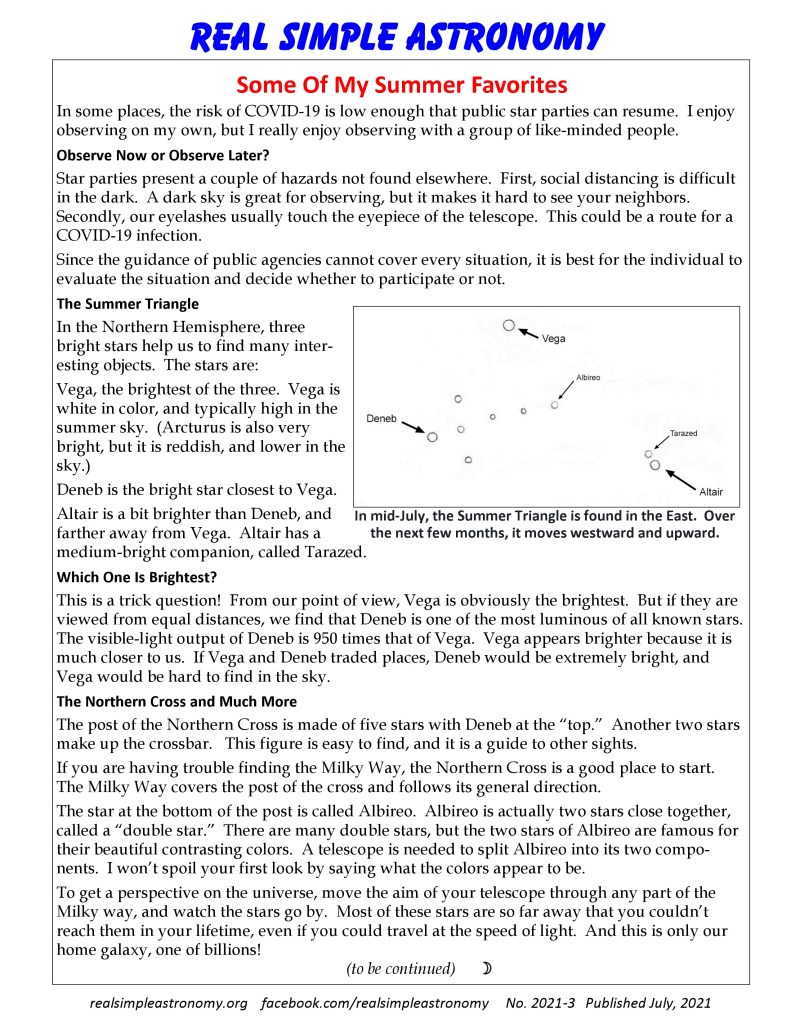
In the Northern Hemisphere, three bright stars help us to find many interesting objects.  The stars are:

Vega, the brightest of the three.  Vega is white in color, and typically high in the summer sky.  (Arcturus is also very bright, but it is reddish, and lower in the sky.)

Deneb is the bright star closest to Vega.

Altair is a bit brighter than Deneb, and farther away from Vega.  Altair has a medium-bright companion, called Tarazed.

Which One Is Brightest?

This is a trick question!  From our point of view, Vega is obviously the brightest.  But if they are viewed from equal distances, we find that Deneb is one of the most luminous of all known stars.  The visible-light output of Deneb is 950 times that of Vega.  Vega appears brighter because it is much closer to us.  If Vega and Deneb traded places, Deneb would be extremely bright, and Vega would be hard to find in the sky.

The Northern Cross and Much More

The post of the Northern Cross is made of five stars with Deneb at the “top.”  Another two stars make up the crossbar.   This figure is easy to find, and it is a guide to other sights. 

If you are having trouble finding the Milky Way, the Northern Cross is a good place to start.  The Milky Way covers the post of the cross and follows its general direction. 

The star at the bottom of the post is called Albireo.  Albireo is actually two stars close together, called a “double star.”  There are many double stars, but the two stars of Albireo are famous for their beautiful contrasting colors.  A telescope is needed to split Albireo into its two components.  I won’t spoil your first look by saying what the colors appear to be.

To get a perspective on the universe, move the aim of your telescope through any part of the Milky way, and watch the stars go by.  Most of these stars are so far away that you couldn’t reach them in your lifetime, even if you could travel at the speed of light.  And this is only our home galaxy, one of billions!

(to be continued)

What is Happening to Betelgeuse?

A couple of weeks ago, I noticed that one of my favorite stars was a lot dimmer than usual.  I soon found out that countless people have noticed the same thing.  This star is Betelgeuse, in the constellation Orion the hunter.

Orion is a very prominent constellation in the winter sky of the Northern Hemisphere (summer in the Southern Hemisphere).  Many features make Orion easy to find, especially the three bright stars which make up the hunter’s belt.  Other striking features include two very bright stars: Rigel and Betelgeuse.  Rigel is white, and Betelgeuse has a vivid orange color.

Betelgeuse and Rigel have been nearly equal in brightness, but now the dimming of Betelgeuse is easy to see.  Unless you live in the North Polar or South Polar regions, you can step outside and see for yourself.  Plus, no telescope is needed.

Betelgeuse is in its last, unstable, phase and will “soon” explode as a supernova.  When this happens, you will certainly hear about it without the help of any on-line bulletins!  Astronomers predict that it will be bright enough to see in the daytime for many days.  It is far enough away that no harm to us Earthlings is expected.

Unfortunately, the word “soon” has a special meaning when spoken by an astronomer.  It means: “In the next several hundred thousand years”.  So, it could happen tonight, or it could be long after our lifetimes.  So, we can look forward to watching the orange star continue to dim, brighten up or … whatever.

Keep lookin’ up!

John

Here is a detailed article, with a current picture of Orion.

Article by Space.com

Older article: Orion the Hunter – Part 1 – Easy to Find

Older article:  Orion the Hunter – Part 2, Two Prominent Objects

Blog at WordPress.com.

Up ↑