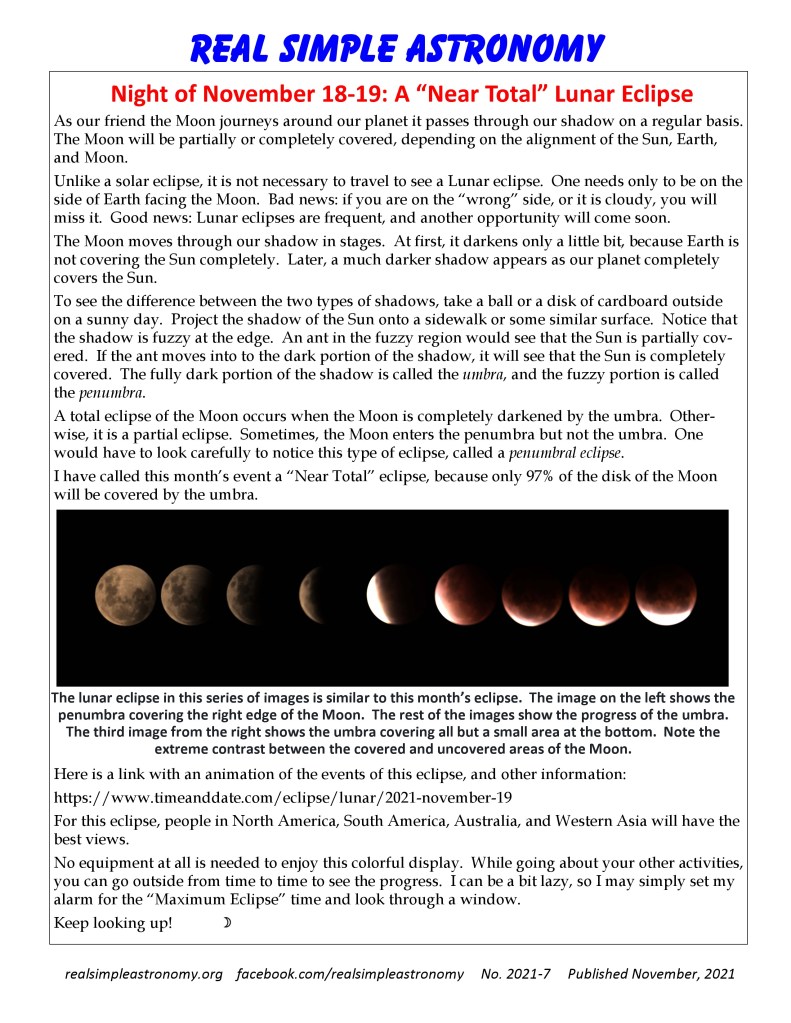
A “Near-Total” Lunar Eclipse

Here is a “clickable” link:

https://www.timeanddate.com/eclipse/lunar/2021-november-19

(Plain Text Version)

As our friend the Moon journeys around our planet it passes through our shadow on a regular basis.  The Moon will be partially or completely covered, depending on the alignment of the Sun, Earth, and Moon.

Unlike a solar eclipse, it is not necessary to travel to see a Lunar eclipse.  One needs only to be on the side of Earth facing the Moon.  Bad news: if you are on the “wrong” side, or it is cloudy, you will miss it.  Good news: Lunar eclipses are frequent, and another opportunity will come soon.

The Moon moves through our shadow in stages.  At first, it darkens only a little bit, because Earth is not covering the Sun completely.  Later, a much darker shadow appears as our planet completely covers the Sun. 

To see the difference between the two types of shadows, take a ball or a disk of cardboard outside on a sunny day.  Project the shadow of the Sun onto a sidewalk or some similar surface.  Notice that the shadow is fuzzy at the edge.  An ant in the fuzzy region would see that the Sun is partially covered.  If the ant moves into to the dark portion of the shadow, it will see that the Sun is completely covered.  The fully dark portion of the shadow is called the umbra, and the fuzzy portion is called the penumbra.

A total eclipse of the Moon occurs when the Moon is completely darkened by the umbra.  Otherwise, it is a partial eclipse.  Sometimes, the Moon enters the penumbra but not the umbra.  One would have to look carefully to notice this type of eclipse, called a penumbral eclipse.

I have called this month’s event a “Near Total” eclipse, because only 97% of the disk of the Moon will be covered by the umbra. 

Here is a link with an animation of the events of this eclipse, and other information:

https://www.timeanddate.com/eclipse/lunar/2021-november-19

For this eclipse, people in North America, South America, Australia, and Western Asia will have the best views. 

No equipment at all is needed to enjoy this colorful display.  While going about your other activities, you can go outside from time to time to see the progress.  I can be a bit lazy, so I may simply set my alarm for the “Maximum Eclipse” time and look through a window. 

Keep looking up!

Three For One!

SPECIAL – THIS WEEK – THREE FOR ONE!

A lot of people would say that the Moon, Jupiter, and Saturn are the three most beautiful objects for small telescopes. For the next month, Jupiter and Saturn are well positioned over the southern horizon in the early evening. They are high enough to be free from disturbance by the atmosphere. For the next few days, the Moon will join them to make a celestial trio.

So, this is a great time to bring out the telescope and enjoy these three beauties.

Happy observing!

This Week: a Total Eclipse of the Moon

Last August 21, millions of people traveled to view a total eclipse of the Sun.  This Wednesday, January 31, 2018, there will be a total eclipse of the Moon.  While the total solar eclipse was visible only inside a narrow band of land, the total lunar eclipse will be visible to everyone on an entire side of planet Earth!

Here’s the short explanation of a lunar eclipse: On some orbits, the Moon travels through the shadow cast by the Earth.  If the Moon is above our horizon, we can watch our shadow darken the surface of the Moon.  If the Moon is completely darkened by the shadow, this is a total eclipse of the Moon.  Otherwise, it is a partial eclipse of the Moon.

Here are some links to detailed explanations, and information about viewing this eclipse:

https://spaceweatherarchive.com/2018/01/22/blue-moon-lunar-eclipse/

http://www.skyandtelescope.com/observing/january-lunar-eclipse/

For this eclipse, people on the eastern portion of North America can watch the beginning stages of the eclipse.  However, the Moon will set before it is totally covered.  For those to the west (i.e. from North America, across the Pacific Ocean, and through most of Asia), the total eclipse will be visible.  For detailed visibility maps, see:

https://eclipse.gsfc.nasa.gov/LEplot/LEplot2001/LE2018Jan31T.pdf

As with the total solar eclipse, the simplest viewing techniques are often the most enjoyable.  While going about your other activities, you can go outside from time to time, and see the progress.  And, there is no law against staying inside and watching through a window!

When the eclipse is total, the Moon is illuminated by a small amount of sunlight which is “scattered” by Earth’s atmosphere.  If you were standing on the Moon, you would see an orange ring around the Earth.  This ring is a view of all the sunrises and sunsets all around the Earth!   This ring of light casts an orange glow onto the Moon.  This strength of the glow is affected by volcanic activity on Earth.  Dust and aerosols from volcanic eruptions can darken the glow so that the Moon will be almost invisible.

Enjoy the Lunar eclipse and keep looking up!

John

Are You Ready for the Supermoon?

10262089_10204054476254662_5906242655802160962_n
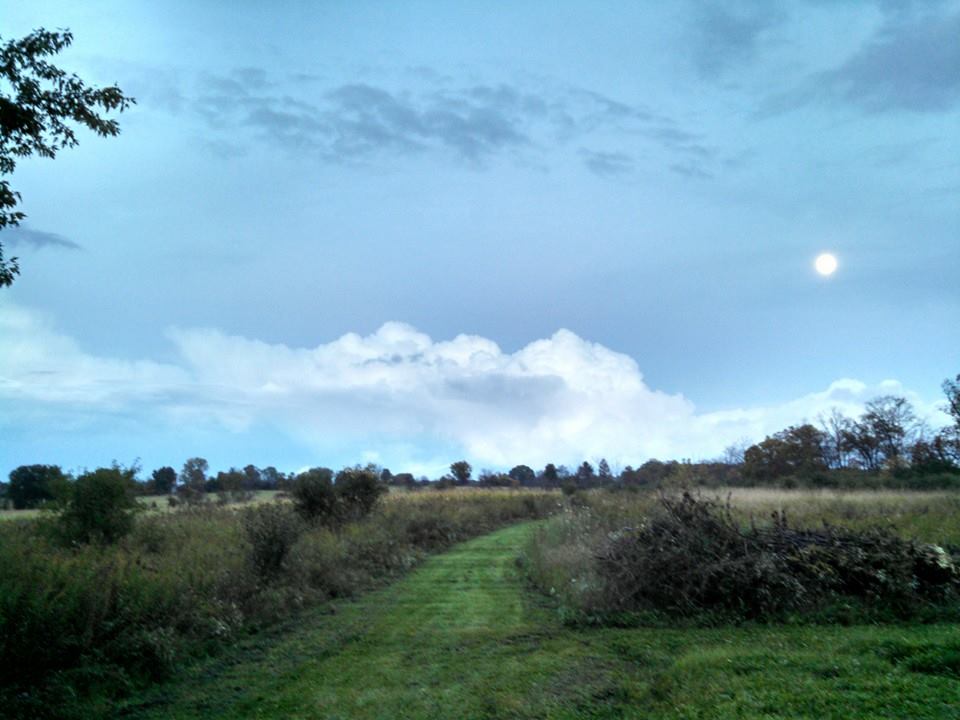
I can take little credit for the composition of this picture.  I was working in the yard, and I was stunned by this Moonlit landscape.

Because of the elliptical shape of the Moon’s orbit, its distance from the Earth is constantly changing.  This week – Monday, November 14, 2016 – we will have a Full Moon which will be at its closest since 1948.  Since it is closer than usual, it will appear larger than usual.  Hence, the name, supermoon.

The supermoon has gotten a lot of publicity, although the event will not be very exciting.  The visual size difference between the Moon at its closest and the Moon at its farthest is about 14%.  If we could view both the “large” Moon and the “small” Moon at the same time, a 14% difference would be obvious.  Unfortunately, the Moon doesn’t present itself that way.  So, we need some way to measure the Moon’s apparent diameter, so we can compare it with a future sighting.  I have added some links to articles on this topic.

In my humble opinion, the easy ways of measuring the Moon’s apparent diameter are not very accurate.  However, if you have a camera which can make a large, sharp image of the Moon, try taking pictures this Monday and compare them to future pictures.  Of course, you would need to use the same settings for all the images.  This would be fairly easy, and fairly accurate.

Another technique would be to take a good look at the supermoon, and examine the finest possible details of it’s surface.  Make a sketch or make a mental note of what you could see.  Repeat this exercise next month.

My plan is to simply go out and take a good look at the supermoon, and call it a night.


Here are some links to more information:

http://www.skyandtelescope.com/observing/see-the-biggest-supermoon-in-68-years/

http://www.astronomy.com/observing/news/2016/11/theres-super-hype-for-this-months-super-moon

http://www.skyandtelescope.com/observing/supermoons-a-unique-observing-challenge/?utm_source=newsletter&utm_campaign=sky-mya-nl-161111&utm_content=896725_SKY_HP_eNL_161111&utm_medium=email

Blog at WordPress.com.

Up ↑