The Great Eclipse – Part 3 – Viewing the Eclipse Safely


eclipse-july-20-1963-b
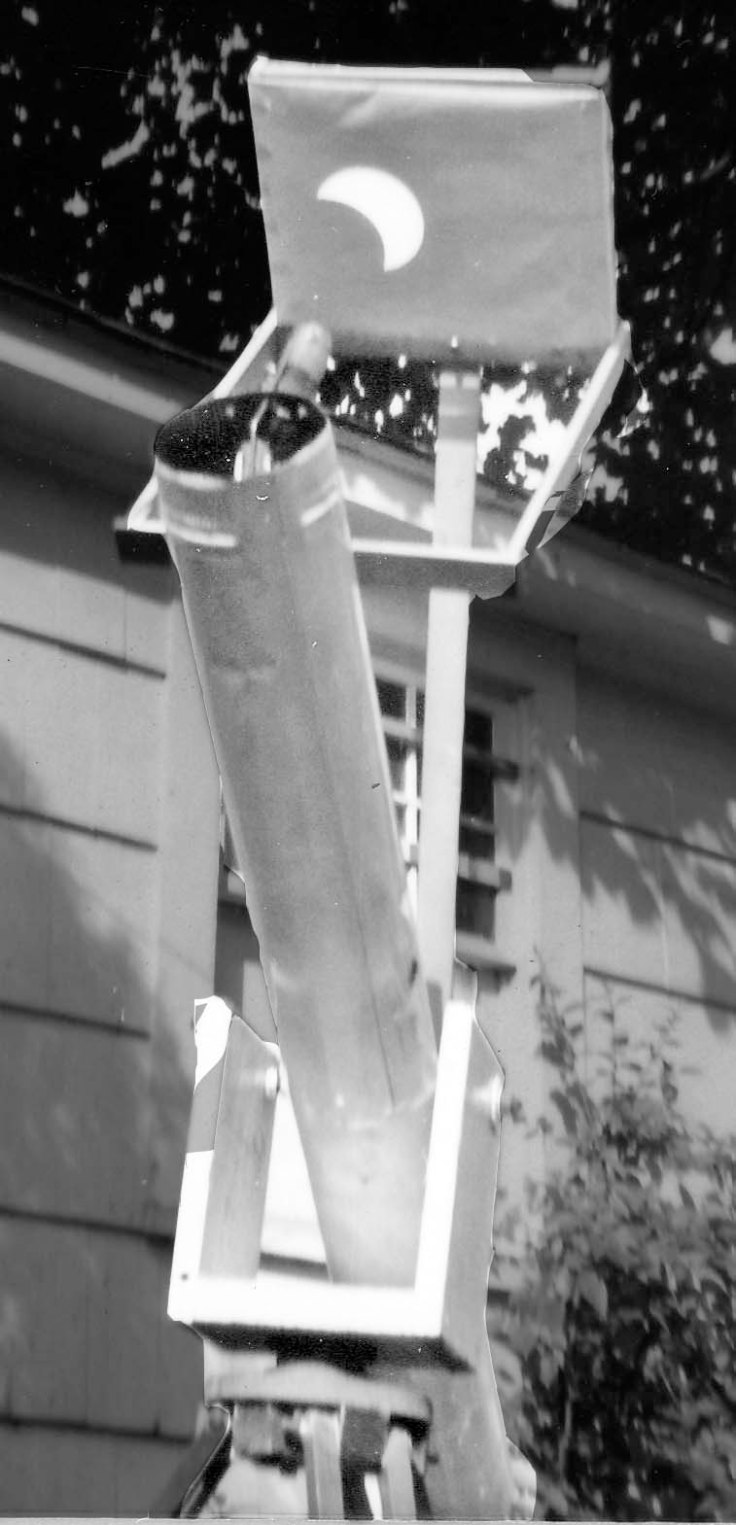
Back in 1963, we watched a partial eclipse by projection.  This method is safe, but could be misused.  If someone had put their hand or face between the eyepiece and the screen, a nasty burn could have happened.


Whenever one reads about solar eclipse-watching, many warnings about eye damage are found.  They tend to be repetitious, but they are very important.  Rather than trying to “reinvent the wheel”, I would like to summarize them as two different types of mistakes that can be made:

First type of mistake: Looking directly at the Sun.  Normally, we find it very painful to look directly at the Sun.  Almost as a reflex, we turn our gaze away from the fiery disk.  However, during the partial phase of a solar eclipse, the sensation of pain is not so strong, because the overall brightness of the Sun isn’t so great.  Unfortunately, the light from the visible portion of the Sun is still very destructive.

“Eclipse glasses” from a reputable source are inexpensive, and allow one to view the sun safely.

Second type of mistake: Looking at the Sun through improperly filtered optics.  This mistake is far more serious than looking directly at the Sun.  A telescope or binocular is designed to concentrate the light from a dim object to make it easier to see.  When it is aimed at the Sun, an enormous amount of energy is delivered to the eyepiece.  Complete, permanent loss of vision can occur quickly.

Telescopes can be safely filtered for looking at the Sun, but mistakes can happen.  I am apprehensive that in some unruly, crowded observing field, a filter will get knocked off of a telescope.  This would expose the viewer to serious injury.  So, in addition to setting up a safe telescope, steps have to be taken to keep it safe.

There are several ways to use a telescope as a projector, and view the image of the Sun indirectly.  These work well, but someone needs to be on the lookout for any misuse of the equipment.

Finally, there is one time when eye protection is not needed: during the total phase of the eclipse.   If you are wearing eclipse glasses, you will see uncovered portion of the Sun getting smaller and smaller.  When you can’t see anything through the eclipse glasses, totality has begun, and you should take the glasses off (otherwise you will miss the reason you went through all of this trouble!).  Enjoy watching the corona, until you notice that the Sun is no longer completely covered.  At this point, put your eclipse glasses back on.

Having said all of this, you shouldn’t be afraid to enjoy solar eclipses.  Like many other things, the extremes are to be avoided.  There is no need to stay indoors and close the curtains.  Likewise, watching the Sun without protection is unwise.  The rules are fairly simple, and will help you have an unforgettable day!


Here is a link to good information on viewing the eclipse safely:

http://eclipse2017.nasa.gov/safety


The Great Eclipse – Part 2 – What is the “Best” Place to See the Eclipse?

On August 21, 2017, a total eclipse of the sun will be visible in 14 states.  More precisely, it will be visible in portions of these 14 states.  Furthermore, some places will be better than others.  Let’s try a few locations, using an interactive map from the NASA website:

http://eclipse.gsfc.nasa.gov/SEgoogle/SEgoogle2001/SE2017Aug21Tgoogle.html

By clicking on any place on the map, a table of statistics pops up. Right now, the important figure is: “Duration of Totality”.  Click on Murfreesboro, Tennessee, which is close to Nashville, Tennessee.  Note that the duration of totality will be approximately one minute.  Next, try a location near the red line above Nashville.  You will find that totality is much longer here, over 2-1/2 minutes.  For the place with the longest possible totality, click on the purple balloon marked “GD” (greatest duration).  For this location, the total portion of the eclipse will be 2 minutes, 40.2 seconds.  For the longest look at the total eclipse, this is the “best” place to be.  All other places will have shorter times of totality.

In summary, one must be between the purple lines to view a total eclipse, and the closer to the red line, the longer it will be visible.  Finally, click on a location outside the purple lines, like Cincinnati or Louisville.  The pop-up indicates that the eclipse will be partial, not total.

The word “best” can be misleading.  For this eclipse, the location with the “Greatest Duration” is a wooded area, so viewing the eclipse may be difficult, if not impossible!  Fortunately, there are many locations which have a very long duration of totality.  To find them, click on places on the red line.

In addition to duration of totality, your “best” location will depend on many things, like how far you can travel, weather, and lodging.  Above all, traffic jams must be avoided.  Millions of people will be interested in this event, but the roads can’t handle all of them at once!

I have booked a motel room in Western Missouri, close to the “red line”.  This location is reasonably close to our home in Michigan, and has a good history of clear skies in August.  As I plan, I may find a better place, but I have a good “fallback” location.

Enjoy your planning!

John


The Coast-to-Coast Eclipse

Of all the things one can see in the sky, the Total Eclipse of the Sun has the reputation of being the most spectacular.  In this event, day turns into night as the Moon covers the bright part of the Sun.  During this time, the outer region of the Sun, called the Corona, is visible.  Unfortunately, a Total Solar Eclipses is visible only to people on a narrow strip of land.  For the rest of the world, the Sun is covered only partially, or not at all.

Fortunately, residents of the continental United States will soon have a chance to see a Total Eclipse of the Sun without making a long journey.  On Monday, August 21, 2017, a Total Eclipse will be visible in 14 states.

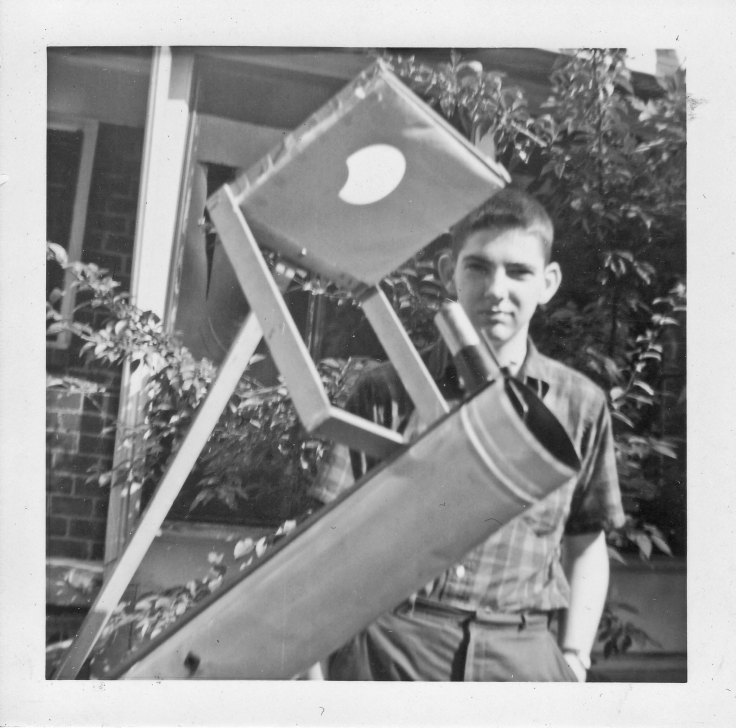
Back in 1963, a Total Eclipse was visible in Canada and upper New England.  At my home in New Jersey, the Sun was partially covered (called a Partial Eclipse).  This photo shows how we used our home-built telescope to project the image of the eclipsed Sun onto a piece of paper.  This is one of the safe ways to view an eclipse.

1963 d

Now – 54 years later – I am starting to make plans to see “the big one”.  There is so much to say, so I have included links to some very good sources of information.

One closing thought: “Eclipse Glasses” are a good tool for safe observing.  They are inexpensive, and will be useful all over the country.  So, they would make good Christmas presents!

John

http://eclipses.gsfc.nasa.gov/SEmono/TSE2017/TSE2017.html

http://www.greatamericaneclipse.com/eclipse-2017/

http://www.eclipse2017.org/


My First blog post

Greetings!  I would like to start by thanking you for your patience with my lack of experience with on-line publishing.  Let’s see if I can get going without too many mishaps!

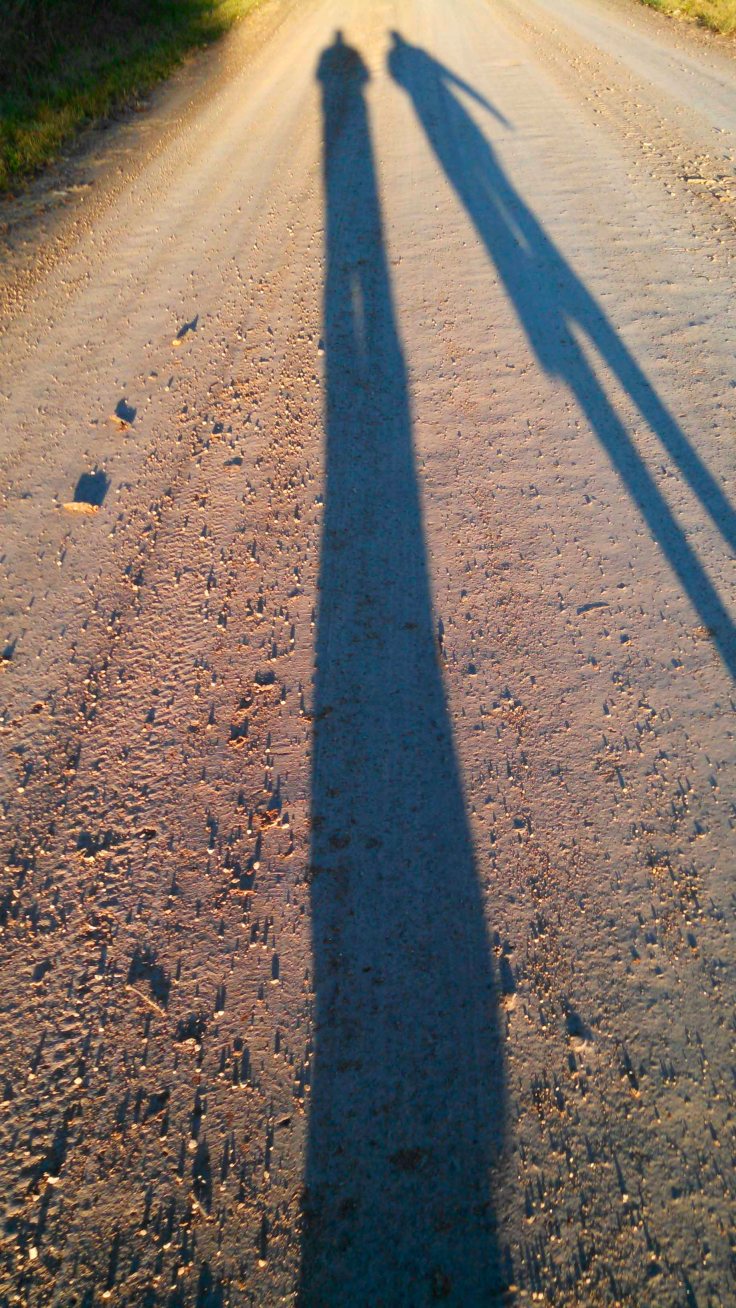
I usually enjoy astronomy when I am looking up into the sky.  However, interesting things can be found by looking at the ground!  A year ago, as my wife and I were on an afternoon walk, our shadows looked strange.  I was surprised to see how long they were and how well they lined up with the road direction.

Here’s the situation: We were out just before sunset on the first day of Autumn.  We were walking Eastward on an East-West road.  On the first day of Autumn, sunset is exactly in the West.  So our shadows were a couple of hundred feet long, without going off the road.

Notice that our shadows are veering to the left.  Since the Sun was still a little bit above the horizon, it wasn’t exactly in the West.  It was a tiny bit to the South.  Therefore, our shadows were pointing a tiny bit to the North.

I will back again soon!

lookin’ up,

John

First Day of Autumn

Blog at WordPress.com.

Up ↑