Comets seem to love surprises. Before astronomers began to make sense of their nature, bright comets would appear without warning, and dominate the night (and sometimes daytime) sky. Quite often, they were thought to be precursors to disasters. Some people with a more cheerful outlook would take a comet’s arrival to indicate that a great king was born.
Today, we are not free from fear of these beautiful visitors. They are large enough and fast enough to devastate any planet that sits in their path. According to a plausible theory, the dinosaur extinction resulted from climate changes triggered by a comet impact 65 million years ago.
A more recent example happened in 1994, when the fragmented comet Shoemaker-Levy 9 collided with the planet Jupiter. When large fragments entered Jupiter’s thick atmosphere, they exploded, and created dark spots in the bright clouds. Many of these spots were larger than Earth!
So much for the scary stuff. We have just heard that comet C/2019 Y4 (ATLAS) has had a large, sudden increase in brightness. A comet will warm up as it approaches the Sun, and vapors and dust will escape the surface to form a cloud. Atlas has suddenly formed an extra large cloud, so it appears much brighter than expected.
So, Atlas has graduated from a “telescopic comet” to one which might be visible to the naked eye.
And here we get to the unpredictability of comets. Although their orbits are calculated very precisely, their visibility and appearance are very hard to predict. Based on the brightening of comet Atlas, we may see a very bright comet in May, 2020. It is possible that it will be visible during daylight; it is also possible that it will disintegrate as it makes its closest approach to the Sun.
A couple of weeks ago, I noticed that one of my favorite stars was a lot dimmer than usual. I soon found out that countless people have noticed the same thing. This star is Betelgeuse, in the constellation Orion the hunter.
Orion is a very prominent constellation in the winter sky of the Northern Hemisphere (summer in the Southern Hemisphere). Many features make Orion easy to find, especially the three bright stars which make up the hunter’s belt. Other striking features include two very bright stars: Rigel and Betelgeuse. Rigel is white, and Betelgeuse has a vivid orange color.
Betelgeuse and Rigel have been nearly equal in brightness, but now the dimming of Betelgeuse is easy to see. Unless you live in the North Polar or South Polar regions, you can step outside and see for yourself. Plus, no telescope is needed.
Betelgeuse is in its last, unstable, phase and will “soon” explode as a supernova. When this happens, you will certainly hear about it without the help of any on-line bulletins! Astronomers predict that it will be bright enough to see in the daytime for many days. It is far enough away that no harm to us Earthlings is expected.
Unfortunately, the word “soon” has a special meaning when spoken by an astronomer. It means: “In the next several hundred thousand years”. So, it could happen tonight, or it could be long after our lifetimes. So, we can look forward to watching the orange star continue to dim, brighten up or … whatever.
Book Review: Road Atlas for the Total Solar Eclipse of 2024
By Fred Espenak – Astropixels Publishing – 40 pages – $19.95 (Color Edition)
On Monday, April 8, 2024, those in North America will have the opportunity to experience a total solar eclipse. Having enjoyed the eclipse of 2017, I am starting to plan for our next opportunity.
The heart of this book is three overview maps and 26 detail maps of the path of totality in Mexico, the United States, and Canada. The base map is the familiar Google Maps rendition of the towns, major roads, major parks, and bodies of water. This base is overlaid with northern and southern limits of totality, the center line, and lines indicating duration of totality. For every 5-minute interval, the location of mid-eclipse is marked on the center line, with a notation of the duration of totality and the elevation of the Sun.
This is the basic information needed to begin to select a place to view the eclipse.
When I was planning for the August 2017 total eclipse, I didn’t buy the 2017 edition of this atlas. Since of the information in the atlas was available elsewhere, I didn’t see the need to buy the book. I learned (the hard way) that planning is more efficient when all the basic information is on the same sheet of paper.
The print clarity of the maps was a disappointment. The major roads are easy to identify, but the secondary roads are almost invisible, especially in the path of totality, which is shaded light gray. To get to a location, better maps or navigation software would be needed.
In 2017, I had a good look at the eclipsed Sun, and enjoyed watching peoples’ reactions to the whole experience. In 2024, I would like to watch the Moon’s shadow as it appears to move across the ground. My “dream location” would include a high point overlooking a valley. I will be able to do the initial screening for possible sites with Espenak’s atlas, combined with other resources.
I bought my 2024 atlas early, so I can combine site exploration with my other travels. My home is only a 3 ½ hour drive from Indianapolis, Indiana, which is near the center line. In the next four years, I hope to have a chance to visit some sites in this area. I would also like to identify some alternate locations further away; in case cloudy skies are predicted.
As eclipse day approaches, weather patterns may change suddenly, necessitating last-minute changes of plans. In this case, the eclipse road atlas could be worth its weight in gold.
This is a link to a vendor for this book, along with a lot of information about eclipses. An image of the book cover is included. This image includes a good sample of the detail maps.
In the process of creating innovative space missions, we have created an environmental disaster consisting of spent rockets, derelict satellites, and debris. I have provided some links to articles on the problem and proposed solutions. I would like to sound off a bit from my own viewpoint:
We are holding onto two faulty notions: 1. Space is so vast that there is negligible risk of harmful interactions. 2. We are keeping track of large items so that we can avoid them. These notions are still invoked, despite the collision of two satellites in 2009.
We are accepting the unacceptable. It seems that we have not yet had a sufficiently serious incident. So far, no one has died from a space junk collision. The International Space Station needs to conduct an avoidance maneuver once a year on the average. Despite this, a hole has been discovered in one of its solar panels. Perhaps we should postpone crewed missions until we can provide a safer environment.
We need to stop leaving unused satellites in orbit. Every satellite should have a very reliable system (or multiple systems) to ensure that it can be deorbited when needed. These systems must able to work even if the main systems fail. If the deorbit system fails, the owner would need to pay for a retrieval mission.
We need to begin to collect hazardous fragments from orbit. This will require technologies which don’t exist at this time. The thousands of cataloged objects vary in their potential for damage, and in the longevity of their orbits. The ones with the greatest potential to do harm should be the object of our first efforts.
To summarize, we need to stop creating space junk, and we need to clean up what is already out there. We may never achieve perfection in either goal, but we need to get serious about keeping space clean and safe.
Keep lookin’ up!
John
(I hope that the tone of this essay isn’t too harsh. It is much milder than my earlier drafts!)
I hope that you are enjoying my blog posts. I certainly enjoy writing them!
Unfortunately, I don’t have any schedule for posting new material. Here is my list of excuses and/or valid reasons:
I want to publish only things which I am excited about. I don’t want to post something simply because there is a scheduled publish date.
I don’t want to try to explain things which other people have already explained very well. I would rather provide links than re-tell a story.
My free time comes and goes. (Currently I have very little free time, but I was excited enough to make a post anyway.)
I know that it is annoying to visit a site, and find that nothing new has been posted for a long time. Each time this happens, I wonder if it is worth my time to keep trying.
I don’t have any good solution to this dilemma, but there is something you can do. This is to sign up for email delivery. This way, you won’t need to keep going to realsimpleastronomy.org.
The “Follow” button is tiny, and easily missed!
Signing up is simple, and ought to be safe. My blog is administered by wordpress.com, which is a well-established company.
To sign up, click on the tiny box at the bottom of your screen called “Follow” . After entering your email address, press the “Sign Me Up” button. You will receive an email requesting confirmation. After you confirm, all new blog posts will appear in your inbox.
I hope that this will save you some time and frustration, and you can devote more time to looking up!
The night sky has many treasures in store for us. Most of these objects are very far away, and don’t appear to change much from year to year. Without precise measurements with telescopes, they seem to be stationary. Others, like the Moon and the planets, are close enough that their motion is obvious.
In addition to the Moon and the planets, comets show visible progress as they move across the sky. Comets are icy objects which orbit the Sun. Unlike planets, comets have elongated orbits which bring them close to the Sun, and then take them far away from the Sun. For example, Comet Halley comes closer to the Sun than the planet Mercury, and then travels out to the vicinity of Neptune and Pluto.
When a comet approaches the Sun, the ice begins to evaporate. The water vapor, combined with soil, moves away from the surface, and forms a visible tail. Energy from the sun can ionize (add or remove electrons from) the water vapor, and cause a second tail to develop.
This month, a comet has made a close (11.6 kilometer) approach to Earth and is now moving away from us. It is called 46P/ Wirtanen. It is high in the sky for observers in the Northern Hemisphere. This week, the Moon is brightening and coming closer to “46P” every night. This interferes with a good look at the comet. Beginning December 23, 2018, the sky will be dark before the Moon has a chance to rise. For the following two weeks, the Moon will not interfere. (As always, don’t miss an opportunity to see 46P, even when the Moon is out.)
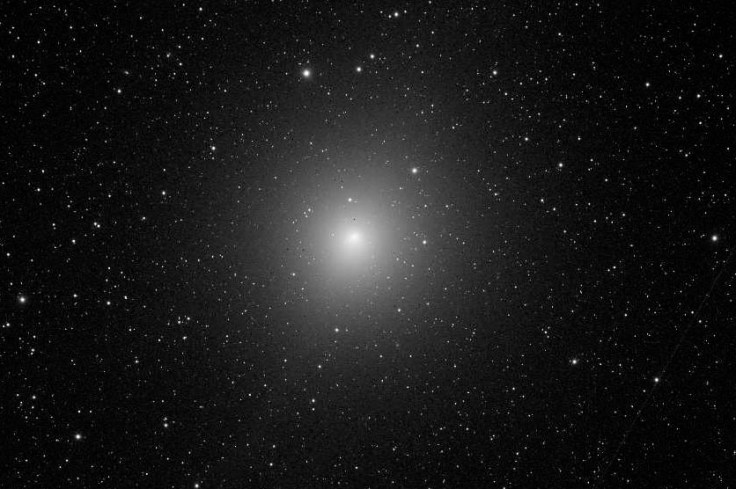
I obtained this image of Comet Wirtanen using a remote rental telescope on December 13, 2018. This comet has a faint tail, which doesn’t appear in this image. (itelescope.net T14; Takahashi 106 mm refractor, 5-minute exposure)
Comet Wirtanen is not bright enough to be seen naked-eye (to my best knowledge). Many people are finding it with binoculars and small telescopes. I have had an excellent view with my 10” (254mm) reflecting telescope.
I admit that finder charts can be difficult to use. In this instance, however, the bright star Capella is a very good reference point. An alternative to paper charts is the free version of the smartphone app “SkySafari”. Once it is installed, simply tap “Search”, then “Brightest Comets”, then “46P Wirtanen”, then “center”.
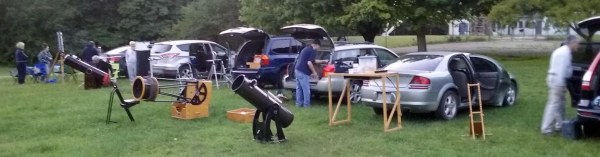
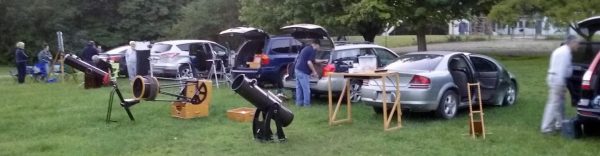
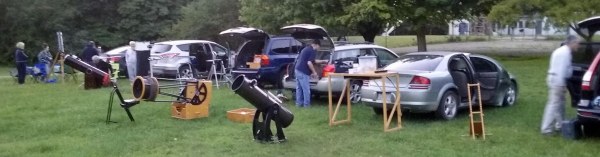
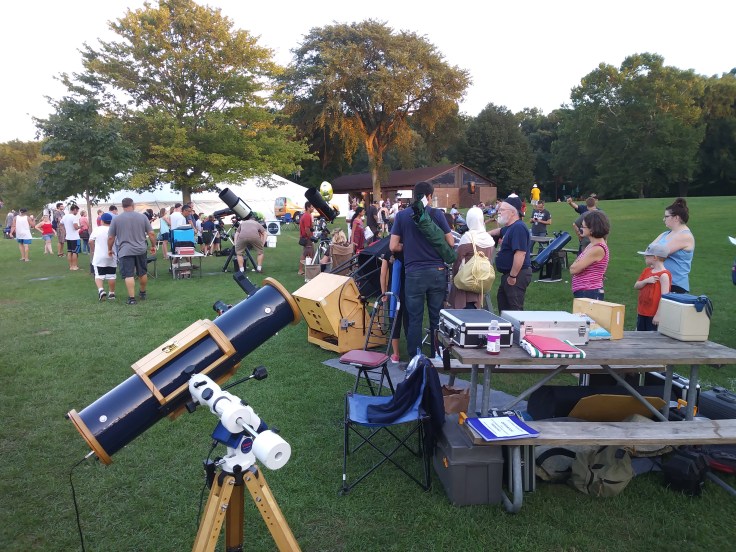
Early guests at our annual 9-club star party. An hour later, it was dark, and very crowded.
I thought I was finished writing about this year’s close encounter with Mars. In fact, I thought I was finished looking at the red planet for a while. For about two months, cloudy skies and Earth-bound activities (things other than astronomy) kept me from using my telescope.
About 3 weeks ago, our astronomy club, together with 8 other clubs, had a giant star party with about 5000 guests. Very early in the evening, I turned the telescope to Mars, and was surprised to see that it still appeared large enough for a good look. I must have said, at least 50 times, “It will be 15 years until we get this good a look at Mars.”
The views early in the evening were very fuzzy, due to the instability of the atmosphere. Regardless, our guests were glad to have a look. Much later, I found that the air was much steadier, and I was able to see the polar ice cap and some dark areas on the disk of the planet. Even though this happened well past our closest encounter with Mars, these were among my best observations for a long time.
The planet-wide dust storm, which had interfered with viewing, has settled down quite a bit. So, we still have a few more weeks to look at our neighboring planet through a telescope. And, that 15-year wait hasn’t started yet!
At this time, Mars has passed its closest approach to Earth. For practical purposes, it’s viewing size is still at the maximum. So, for a few weeks, we can enjoy the best possible views of our neighbor. Afterwards, we begin a 15-year period without a close encounter.
I have made several recent observations with my 10” reflecting telescope. Because Mars is still experiencing a global dust storm, I could see some dark areas, but they were vaguely defined. The southern polar ice cap, however, was visible. Its white color makes a striking contrast to the rest of the planet.
I am enjoying naked-eye views of Mars almost as much telescopic views. Around midnight, Mars is very bright and very red. On several recent nights, I enjoyed this spectacle, although I didn’t have time to set up the telescope.
Although Opposition does not occur until July 26, we can enjoy good observations right now. Today, Mars has attained 89% of its maximum apparent size. If you live in a cloudy region, as I do, taking an early look can prevent anxiety later on.
Speaking of weather, Mars is in a planet-wide dust storm. Unlike dust storms on Earth, Martian dust storms cover vast areas, and can last a long time. So, with a telescope, very few ground features are visible. It is possible that the storm will still be in progress when this year’s observation period ends.
Rather than wish things were different, let’s consider this a unique opportunity to observe the progress of the storm! Observations of the dusty Mars can be compared to past or future observations of the clear Mars.
Here are links to some articles on the dust storm:
The best time to observe Mars is when it is well above the horizon, so that disturbances in our atmosphere are lessened. For this time of the year, the tilt of our planet gives the best views of Mars to residents of the Southern Hemisphere. To use Buenos Aires as an example, on July 26, Mars will be well positioned at 9 PM. It will continue to climb until it is overhead around 1 AM. So, good views can be had for almost the entire night.
For northerners, Mars doesn’t climb very high, and the best viewing occurs during a brief time slot. For New York on July 26, the best viewing time is from approximately 11 PM to 3 AM. Mars reaches its highest position at 1:09 AM. It will then be 24 degrees above the horizon (roughly ¼ of the way to directly overhead). At this elevation, observations can be good, although not the best.
Finding Mars in the sky, is quite easy. Except for the Sun, the Moon, and Venus, it will be the brightest object in the sky!
Here is a link to an online planetarium app, which will help you in your planning:
Of all the planets in our solar system, only three lend themselves to detailed examination with amateur telescopes: Jupiter, Saturn, and Mars. The other planets are interesting, but don’t reveal much detail. Mercury is small, and low in the sky at night. Venus is covered by a permanent cloud deck. Uranus and Neptune are very far away.
I do enjoy looking at Mercury, Venus, Uranus and Neptune and encourage you to do likewise. However, Jupiter, Saturn, and Mars have large and small surface details. Even with the best telescopes, the best sky conditions, and the best observing techniques, there will be details which are just out of reach. We keep coming back, hoping to do better.
Good News for City-Dwellers!
It is not necessary to flee to the country to view of the bright planets, because they stand out against the bright sky. Many observers actually prefer a bright background to a black one.
So, try to find out what will be happening in your area. Some astronomy clubs set up telescopes in downtown locations. Also, many urban observatories which had fallen into disuse, are now open to the public.
Telescopes
In this tiny article, I won’t try to cover the strengths and weaknesses of the diverse types of telescopes. Since Jupiter, Saturn, and Mars are bright, a large diameter objective lens or mirror is not necessary. For planetary observation, pick the telescope with the most precisely crafted optical components. The better the optics, the less the image details will be distorted. As with most things, quality costs money, and high quality costs a lot of money. For this reason, I recommend enjoying the Mars opposition at an observatory or at a star party.
Sky Conditions
Although we are glad to have air to breathe, we wish it wouldn’t distort our view of everything more than a few miles away. If the air was free of dust and mist, and was uniform in density, our planet-watching would be much better. In reality, we must cope with the air we have. The higher the planet is above the horizon, the better the view, since we have less air to look through. There are on-line resources which predict transparency (freedom from haze) and “seeing” (freedom from distortion caused by variations in air density).
How to Observe
“Patience” is the key word in observing the features of the planets. Our goal is to see the delicate details as well as we can. I am not an expert observer, but I will tell what I know. It helps to study good photos of the planets, to know what to look for. Astronomical apps are useful for previews of features like the Great Red Spot of Jupiter and the light and dark areas of Mars. Look at broad features first, and then look for finer ones.
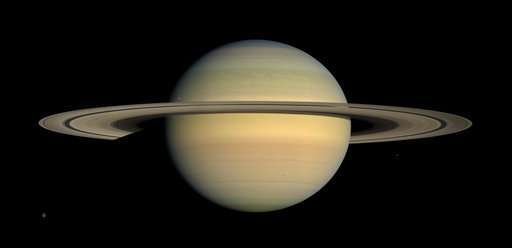
Saturn, From the Cassini Mission
Let’s take Saturn for an example. Even a very small telescope shows the rings, but perhaps not the Cassini Division (the black gap in the outer portion of the ring system). If you find the Cassini Division, can you see any other gaps or features of the rings? At first look, the planet itself seems uniformly white or tan, but can you see bands with subtle color variations?
Your view of a planet will keep changing from bad to good and good to bad. This is not necessarily a problem with your eyesight. Here is where the patience comes in. Because our atmosphere is constantly in motion, the image distortions keep changing. Sometimes the distortion is extreme, and other times it is not so bad. To catch the details, we need to concentrate, but also relax and wait for the brief moments of clarity. These glimpses may last only a fraction of a second, so try to memorize what you see.
“Patience” also applies to the people waiting in line behind you. You should take as much time as you need to grab the best moments of image clarity. Fifteen seconds is not long enough. Two minutes is not unreasonable. At some point, you will decide that there won’t be a better view, and it is time to move on. But don’t leave – go to the end of the line for another try! By the time your turn comes up, the atmosphere will be different – maybe better, maybe worse.
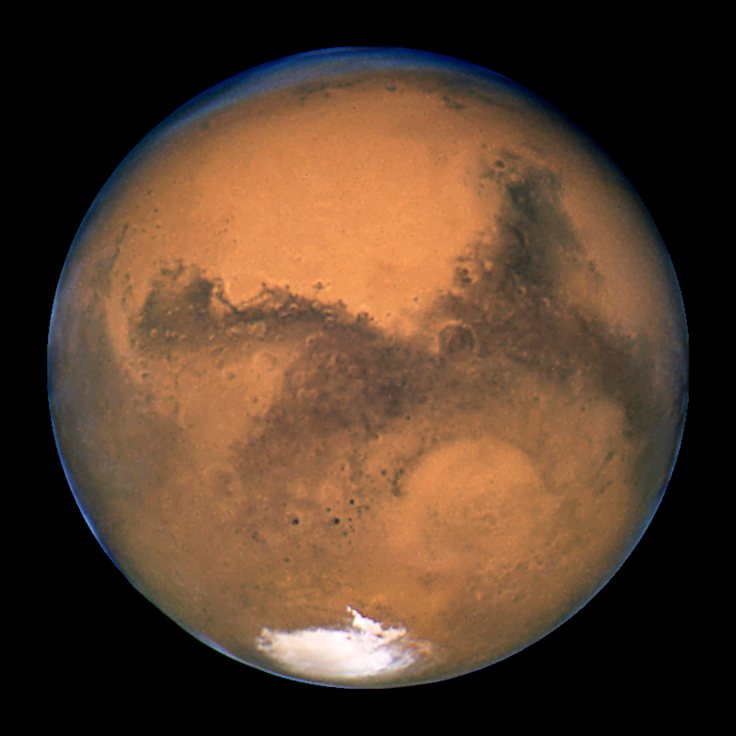
Mars, From the Hubble Space Telescope
The surface details of Mars are very subtle and can be completely missed if one is not patient. The splendid photos we see on line and in print are usually adjusted for enhanced contrast. In visual observation, we don’t have this luxury. In the telescope, Mars can be very bright, and seem devoid of any details. With patience, fleeting glimpses of the dark areas may occur. Depending on the Martian seasons, and orbital positions, one of the polar ice caps may be visible.
My “best-ever” view of Mars was near the opposition of 2014. I was fortunate to look through a very good 24” reflecting telescope. After waiting a while, an ice cap and some of the dark surface features appeared and promptly disappeared. Unfortunately, they did not reappear.
Conclusion
There is much more to say about observing the planets, but I hope I have given you motivation to learn more and watch more. In upcoming articles, I hope to cover best times to observe and how to find resources in your area.
Keep looking up,
John
Resources
Sky conditions, including transparency and seeing for the US and Canada:

 Real Simple Astronomy