Some times I can’t come up with a good topic, and should not burden the reader with a low-quality post.
Today, I was ready to skip the weekly post, but I remembered that Jupiter is in a prominent location in the sky. Jupiter has always been a pleasure to observe, with a telescope, with binoculars, or even naked-eye.
This is an exact quote, from a young student at a star party. When I heard this question, I realized that the new definition of a planet has created confusion for students.
In 2006, the International Astronomical Union adopted a new definition of a planet. It requires that the body be large enough that it naturally assumes a spherical shape, and it requires that the body be large enough to “clear the neighborhood around its orbit.” Pluto does have the spherical shape, but it hasn’t “cleared the neighborhood around its orbit.” Therefore, Pluto was designated as a “Dwarf Planet”, rather than a “Planet”.
A new proposal by Kirby Runyon is the extreme opposite of that of the IAU. Runyon’s definition requires only that the body have a spherical shape. It doesn’t matter what kind of orbit it follows. This would mean that moons would called planets, if they are spherical. This would raise our list of planets to over 100 members!
My proposal is to define a planet to be any object orbiting the Sun, which is known to have a spherical shape. Other objects, such as asteroids and comets, are not spherical, and would not be called planets. There are several large objects, such as Eris, Haumea and Makemake, which are too distant for their shapes to be determined. Until better observations are made, these objects would not be listed as planets.
How big would the new list be? Only ten planets for now!
Here is the proposed list, in order of distance from the Sun:
Venus
Earth
Mars
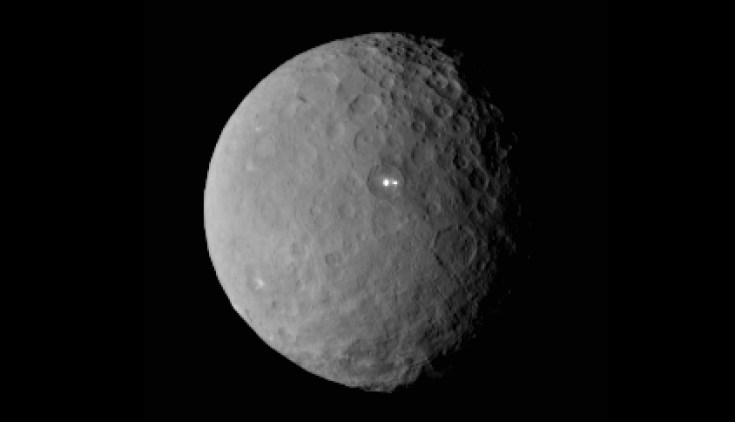
Ceres
Jupiter
Saturn
Uranus
Neptune
Pluto
Note that our old friend Pluto is back on the list. Also, a new member, Ceres, has been added. Since most people have never heard of Ceres, the new list should encourage people to learn something about this planet.
The Dawn spacecraft is currently studying Ceres. This image shows two very unusual bright spots on its surface.
This method of defining the word “planet” may never make it to the text books, but it was fun putting it together!
On April 19, it will be possible to see the motion of an asteroid as it passes close to Earth. Asteroid 2014 JO25 will be close enough that it will be visible with a small telescope. See this article for details:
One reason I like the slogan, “Keep looking up” is that the night sky is full of surprises. Most of the objects in the sky don’t appear to change rapidly, but there are exceptions, like meteors.
Most meteors are very tiny specks of solid material, which make a subtle steak of light as they burn up in the atmosphere. These displays last for a fraction of a second, and are visible to those who are looking up.
At star parties, I often forget to look up while I am waiting to look through a telescope. Someone will exclaim, “Did you see that meteor?” Unfortunately I would have to answer in the negative. After that I try to watch the sky better.
Visibility of Earth satellites can be found on various web sites, but we don’t consult then very often. Thus a speeding satellite can take us by surprise. The International Space Station is the most prominent, but there are many other objects which can be seen by those who are looking up.
Northern or Southern Lights often appear in places far from the polar areas. During times of intense solar activity, they can be anticipated, but they can also appear unexpectedly. These displays may last for only a few minutes or a few seconds. Again, It helps to be looking!
Every day, they show an interesting image and give an explanation by a professional astronomer. Called APOD for short, this site covers a very wide range of topics within Astronomy. Occasionally, related topics, such as Chemistry or atmospheric phenomena are presented.
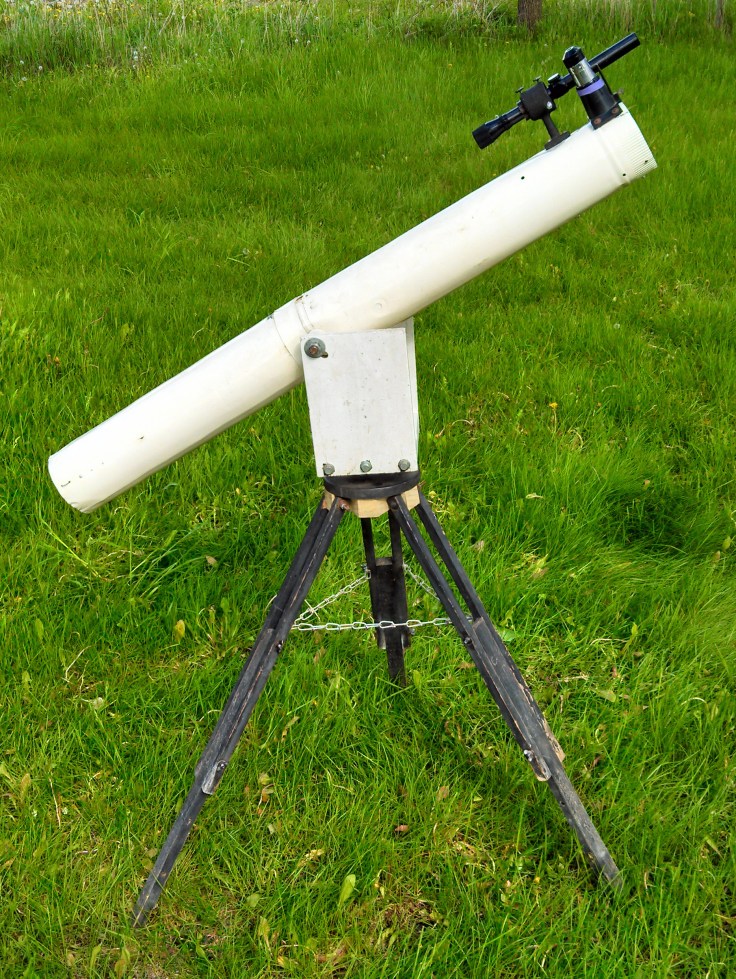
In 1960, factory-made scopes were very expensive, so I built my own (with a lot of help from my Dad). Today, there are many options to buy ready-made ones.
As wonderful as the night sky appears to the naked eye, there is much more to see with the aid of a telescope. If you are like most amateur astronomers, you spend a lot of time thinking about telescopes.
For most people, the challenge is to get the best telescope for the available money.
Rather than tell you how to pick out a telescope, I have included links to some very informative articles. I will just add a few thoughts to consider:
If you can get to a star party, the telescope owners will be glad to show how their instruments work. They will help you to learn the advantages and disadvantages of the various choices.
Your local public library may be lending telescopes. This is a new idea which is working well for many libraries. These telescopes are usually in the very-low price category, but they will help you to learn how to use a telescope.
Binoculars are very useful because of their ease of use and their wide fields of view. Even low-priced binoculars can give you a good view of the Moon, the planets and star clusters.
Stay away from sellers who emphasize the magnification which their telescopes provide. Depending on the eyepiece selection, any telescope can produce 300, 400, or 500 power. This level of magnification is useless for many reasons. Even the finest telescopes are used at 50 to 100 power. For special close-ups, 200 power may be used occasionally.
Some manufacturers of low priced telescopes of good quality: Celestron, Meade, Orion, Sky Watcher.
If you want to do astroimaging, consider doing it with your second telescope. Scopes suitable for imaging are much more expensive than ones for visual use. In addition, astroimaging requires many skills and much patience. For your first telescope, choose one that is easy to set up, and enjoy visual astronomy for a while. Later, you will be able to make a better choice for your imaging scope.
Think about size, weight and ease of setup when making your selection. When the Sun goes down, your energy level may be declining. If the telescope is hard to set up, you may be tempted to stay indoors! If you want to carry it in your car, will it actually fit?
Enjoy your search for a telescope, and keep looking up!
Saturn has a most unusual hexagonal storm system at its North Pole. Image by Cassini.
A very successful space probe is nearing the end of its life. This is the Cassini mission, a joint US and European effort. It left Earth in 1997, spent 7 years traveling to Saturn, and has been collecting images and data ever since.
In 2005, the Huygens lander detached from Cassini, and landed on Titan, Saturn’s largest Moon.
Study of the rings of Saturn has been a high priority for this mission. However, it has been important for Cassini not to get too close. The rings appear to be smooth bands of ribbon, but are streams of solid objects of various sizes, orbiting the planet at very high speeds. A collision with one of these particles could destroy the spacecraft.
Cassini has used up most of its fuel, and won’t be able to perform many more maneuvers. To avoid trouble in the future, the probe will purposely crash on Saturn.
The good news is that the probe is now moving into some hazardous areas. We will be able to get some images which were too risky earlier in Cassini’s mission. Cassini will venture closer to the rings, but still won’t try to enter them.
This is a summary of the Cassini mission. Here are some links to the bigger story:
Today’s release of NASA’s Astronomy Picture of the Day features the Orion Nebula. Although this photo was made with a large telescope, many of its features can be seen with binoculars or a small telescope.
In publications, discussions of the features of a constellation usually include a diagram. For Orion, let’s make an exception and try to find a few things using words only!
Betelgeuse
Of Orion’s two brightest stars, Betelgeuse (pronounced “Beetle juice”) is the distinctly orange one. It is at the “shoulder” of the hunter. Betelgeuse is classified as a “Red Supergiant” star. Its diameter is about 650 times that of our Sun. If it was at the center of our solar system, it would engulf Mercury, Venus, Earth, and Mars.
“Red supergiant” refers to a phase late in the life of many stars. Early in life, Betelgeuse was much smaller. When its supply of hydrogen fuel was used up, the star swelled to its current size. The next major event would be a supernova explosion. This is expected “soon” in astronomical terms, meaning in a thousand years, or so. This event would be quite spectacular, but may also be dangerous because of the gamma rays which would be released.
The Orion Nebula
So much for the end of a star’s life cycle. Moving to the other side of the Hunter’s belt, we find the Orion Nebula, which is full of stars at their beginning stages. The Orion Nebula is very close to the Hunter’s belt of three stars. In Northern latitudes, look below the star at the left of the belt. In Southern latitudes, look above the star the right. The Orion nebula appears as a fuzzy mass. In the city, it may not be visible to the naked eye.
The term nebula means “a cloud of gas or dust in interstellar space”. Virtually all of the gas in a nebula is hydrogen. The hydrogen in a nebula pulls together into a compact mass, through gravity. This process takes millions of years. If enough hydrogen is available, the molecules will be forced together tightly enough to start a nuclear fusion reaction. This is the birth of a star.
With a telescope, many more of Orion’s features come into view. Orion is a favorite of amateur astronomers, and an important study area for researchers. It is a constellation which “has something for everyone”.
This month, a prominent group of stars is easy to find just after sunset.
This constellation is Orion, the hunter. Orion is easily recognized by its “belt” of three bright stars. With a little bit of imagination, one finds stars for the head, a shoulder, a club, two feet, and a sword kept beneath the belt.
Some constellations are visible only from northern latitudes, others only from southern latitudes. A few constellations can be seen from any place on Earth. Orion is one of these. For northerners, Orion stands in the southern part of the sky. For southerners, Orion is in the northern sky. For those on the equator, the hunter will be directly overhead. For the few people who visit the poles, half of Orion is just above the horizon, and the other half is just below the horizon.
If a northerner and a southerner are looking at Orion, they will be facing each other. In the north, the hunter figure will be “right side up”, with the head higher than the feet. In the south, our hunter is “upside down”. (These discussions assume that Orion is viewed just after sunset in March.)





 Real Simple Astronomy