
(Plain Text Version)
The Clear Sky Blues (A Perfect Night Can Be Troublesome)
(Originally Published August, 2020)
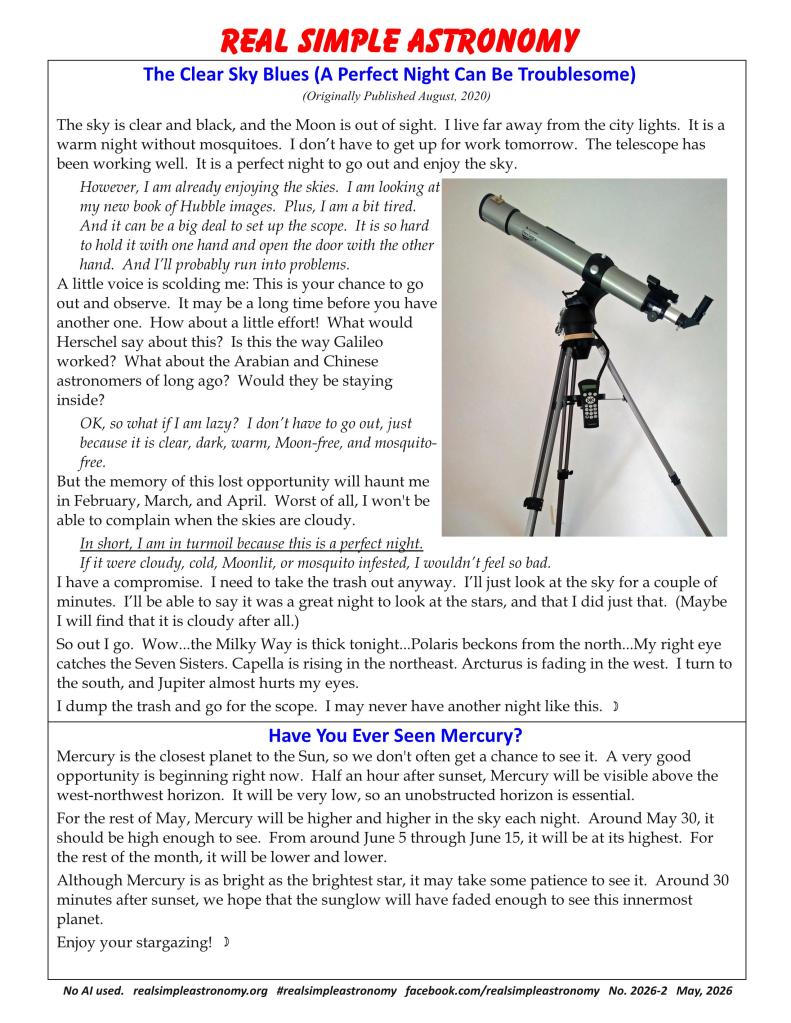
The sky is clear and black, and the Moon is out of sight. I live far away from the city lights. It is a warm night without mosquitoes. I don’t have to get up for work tomorrow. The telescope has been working well. It is a perfect night to go out and enjoy the sky.
However, I am already enjoying the skies. I am looking at my new book of Hubble images. Plus, I am a bit tired. And it can be a big deal to set up the scope. It is so hard to hold it with one hand and open the door with the other hand. And I’ll probably run into problems.
A little voice is scolding me: This is your chance to go out and observe. It may be a long time before you have another one. How about a little effort! What would Herschel say about this? Is this the way Galileo worked? What about the Arabian and Chinese astronomers of long ago? Would they be staying inside?
OK, so what if I am lazy? I don’t have to go out, just because it is clear, dark, warm, Moon-free, and mosquito-free.
But the memory of this lost opportunity will haunt me in February, March, and April. Worst of all, I won’t be able to complain when the skies are cloudy.
In short, I am in turmoil because this is a perfect night. If it were cloudy, cold, Moonlit, or mosquito infested, I wouldn’t feel so bad.
I have a compromise. I need to take the trash out anyway. I’ll just look at the sky for a couple of minutes. I’ll be able to say it was a great night to look at the stars, and that I did just that. (Maybe I will find that it is cloudy after all.)
So out I go. Wow…the Milky Way is thick tonight…Polaris beckons from the north…My right eye catches the Seven Sisters. Capella is rising in the northeast. Arcturus is fading in the west. I turn to the south, and Jupiter almost hurts my eyes.
I dump the trash and go for the scope. I may never have another night like this.
Have You Ever Seen Mercury?
Mercury is the closest planet to the Sun, so we don’t often get a chance to see it. A very good opportunity is beginning right now. Half an hour after sunset, Mercury will be visible above the west-northwest horizon. It will be very low, so an unobstructed horizon is essential.
For the rest of May, Mercury will be higher and higher in the sky each night. Around May 30, it should be high enough to see. From around June 5 through June 15, it will be at its highest. For the rest of the month, it will be lower and lower.
Although Mercury is as bright as the brightest star, it may take some patience to see it. Around 30 minutes after sunset, we hope that the sunglow will have faded enough to see this innermost planet.
Enjoy your stargazing!


Leave a Reply