My goal is to post enjoyable items about the skies. I don't have a schedule for new posts, so please check in from time to time. If you would like, you can sign up for email notifications about new posts. Enjoy!
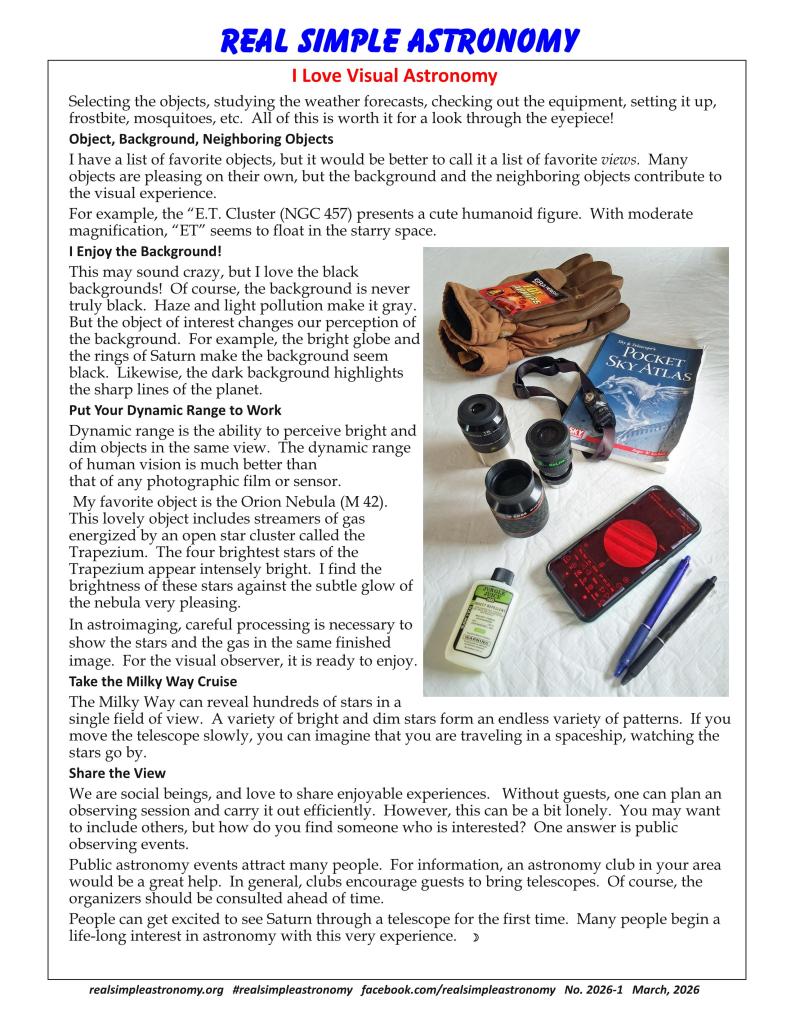
Selecting the objects, studying the weather forecasts, checking out the equipment, setting it up, frostbite, mosquitoes, etc. All of this is worth it for a look through the eyepiece!
Object, Background, Neighboring Objects I have a list of favorite objects, but it would be better to call it a list of favorite views. Many objects are pleasing on their own, but the background and the neighboring objects contribute to the visual experience. For example, the “E.T. Cluster (NGC 457) presents a cute humanoid figure. With moderate magnification, “ET” seems to float in the starry space.
I Enjoy the Background! This may sound crazy, but I love the black backgrounds! Of course, the background is never truly black. Haze and light pollution make it gray. But the object of interest changes our perception of the background. For example, the bright globe and the rings of Saturn make the background seem black. Likewise, the dark background highlights the sharp lines of the planet.
Put Your Dynamic Range to Work Dynamic range is the ability to perceive bright and dim objects in the same view. The dynamic range of human vision is much better than that of any photographic film or sensor. My favorite object is the Orion Nebula (M 42). This lovely object includes streamers of gas energized by an open star cluster called the Trapezium. The four brightest stars of the Trapezium appear intensely bright. I find the brightness of these stars against the subtle glow of the nebula very pleasing. In astroimaging, careful processing is necessary to show the stars and the gas in the same finished image. For the visual observer, it is ready to enjoy.
Take the Milky Way Cruise The Milky Way can reveal hundreds of stars in a single field of view. A variety of bright and dim stars form an endless variety of patterns. If you move the telescope slowly, you can imagine that you are traveling in a spaceship, watching the stars go by.
Share the View We are social beings, and love to share enjoyable experiences. Without guests, one can plan an observing session and carry it out efficiently. However, this can be a bit lonely. You may want to include others, but how do you find someone who is interested? One answer is public observing events. Public astronomy events attract many people. For information, an astronomy club in your area would be a great help. In general, clubs encourage guests to bring telescopes. Of course, the organizers should be consulted ahead of time. People can get excited to see Saturn through a telescope for the first time. Many people begin a life-long interest in astronomy with this very experience.
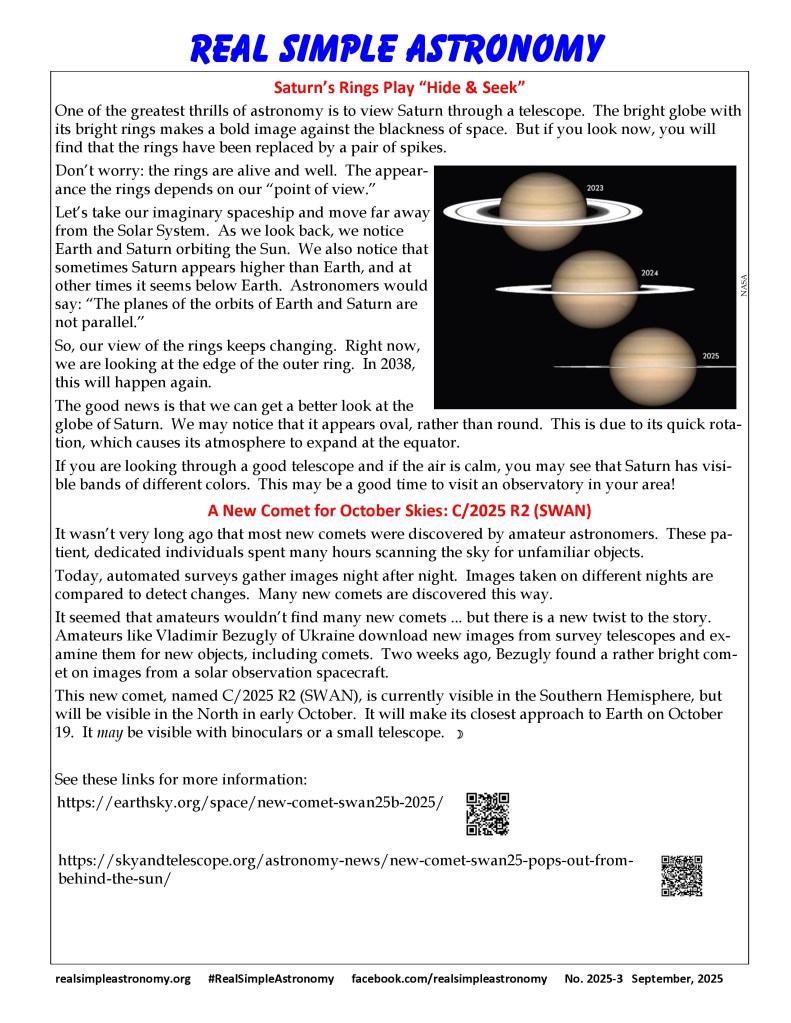
One of the greatest thrills of astronomy is to view Saturn through a telescope. The bright globe with its bright rings makes a bold image against the blackness of space. But if you look now, you will find that the rings have been replaced by a pair of spikes.
Don’t worry: the rings are alive and well. The appearance the rings depends on our “point of view.”
Let’s take our imaginary spaceship and move far away from the Solar System. As we look back, we notice Earth and Saturn orbiting the Sun. We also notice that sometimes Saturn appears higher than Earth, and at other times it seems below Earth. Astronomers would say: “The planes of the orbits of Earth and Saturn are not parallel.”
So, our view of the rings keeps changing. Right now, we are looking at the edge of the outer ring. In 2038, this will happen again.
The good news is that we can get a better look at the globe of Saturn. We may notice that it appears oval, rather than round. This is due to its quick rotation, which causes its atmosphere to expand at the equator.
If you are looking through a good telescope and if the air is calm, you may see that Saturn has visible bands of different colors. This may be a good time to visit an observatory in your area!
A New Comet for October Skies: C/2025 R2 (SWAN)
It wasn’t very long ago that most new comets were discovered by amateur astronomers. These patient, dedicated individuals spent many hours scanning the sky for unfamiliar objects.
Today, automated surveys gather images night after night. Images taken on different nights are compared to detect changes. Many new comets are discovered this way.
It seemed that amateurs wouldn’t find many new comets … but there is a new twist to the story. Amateurs like Vladimir Bezugly of Ukraine download new images from survey telescopes and examine them for new objects, including comets. Two weeks ago, Bezugly found a rather bright comet on images from a solar observation spacecraft.
This new comet, named C/2025 R2 (SWAN), is currently visible in the Southern Hemisphere, but will be visible in the North in early October. It will make its closest approach to Earth on October 19. It may be visible with binoculars or a small telescope.
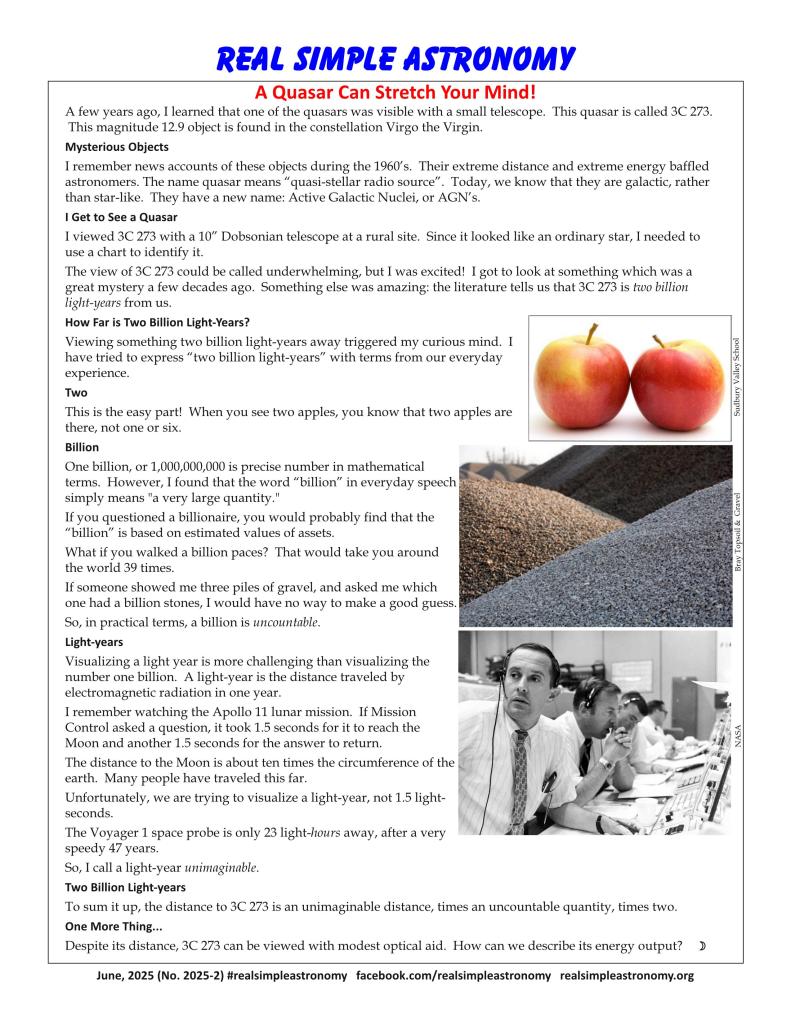
A few years ago, I learned that one of the quasars was visible with a small telescope. This quasar is called 3C 273. This magnitude 12.9 object is found in the constellation Virgo the Virgin. Mysterious Objects I remember news accounts of these objects during the 1960’s. Their extreme distance and extreme energy baffled astronomers. The name quasar means “quasi-stellar radio source”. Today, we know that they are galactic, rather than star-like. They have a new name: Active Galactic Nuclei, or AGN’s. I Get to See a Quasar I viewed 3C 273 with a 10” Dobsonian telescope at a rural site. Since it looked like an ordinary star, I needed to use a chart to identify it. The view of 3C 273 could be called underwhelming, but I was excited! I got to look at something which was a great mystery a few decades ago. Something else was amazing: the literature tells us that 3C 273 is two billion light-years from us. How Far is Two Billion Light-Years? Viewing something two billion light-years away triggered my curious mind. I have tried to express “two billion light-years” with terms from our everyday experience. Two This is the easy part! When you see two apples, you know that two apples are there, not one or six. Billion One billion, or 1,000,000,000 is precise number in mathematical terms. However, I found that the word “billion” in everyday speech simply means “a very large quantity.” If you questioned a billionaire, you would probably find that the “billion” is based on estimated values of assets. What if you walked a billion paces? That would take you around the world 39 times. If someone showed me three piles of gravel, and asked me which one had a billion stones, I would have no way to make a good guess. So, in practical terms, a billion is uncountable. Light-years Visualizing a light year is more challenging than visualizing the number one billion. A light-year is the distance traveled by electromagnetic radiation in one year. I remember watching the Apollo 11 lunar mission. If Mission Control asked a question, it took 1.5 seconds for it to reach the Moon and another 1.5 seconds for the answer to return. The distance to the Moon is about ten times the circumference of the earth. Many people have traveled this far. Unfortunately, we are trying to visualize a light-year, not 1.5 light-seconds. The Voyager 1 space probe is only 23 light-hours away, after a very speedy 47 years. So, I call a light-year unimaginable. Two Billion Light-years To sum it up, the distance to 3C 273 is an unimaginable distance, times an uncountable quantity, times two. One More Thing…
Despite its distance, 3C 273 can be viewed with modest optical aid. How can we describe its energy output?
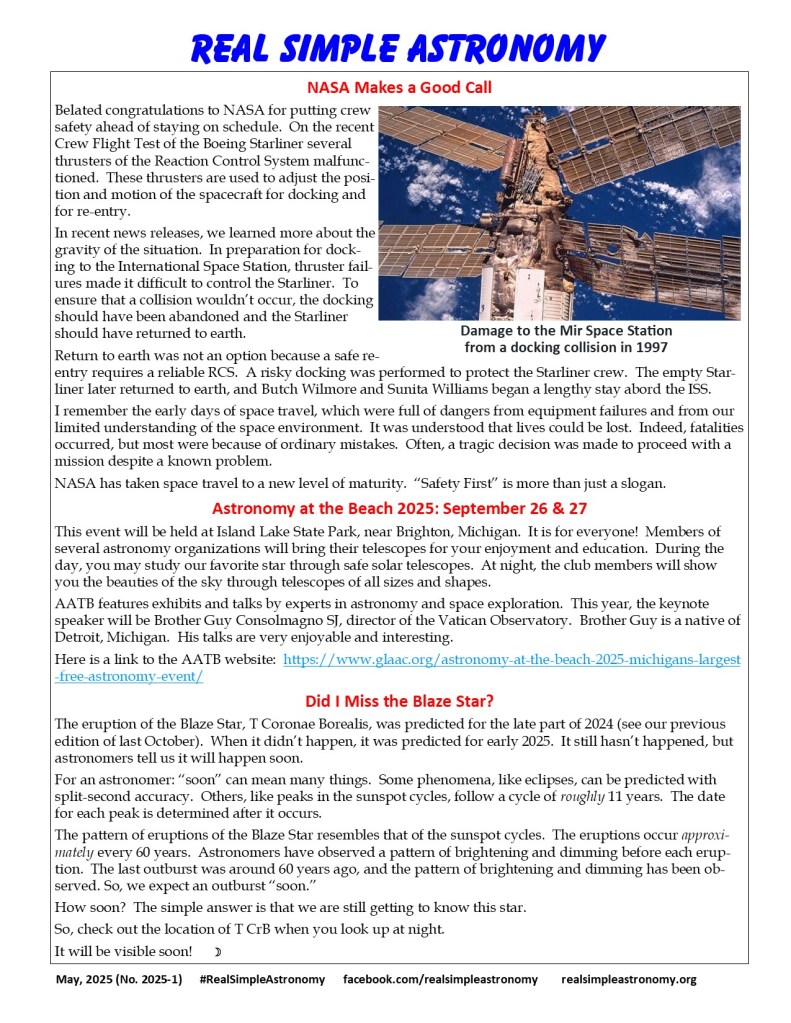
Belated congratulations to NASA for putting crew safety ahead of staying on schedule. On the recent Crew Flight Test of the Boeing Starliner several thrusters of the Reaction Control System malfunctioned. These thrusters are used to adjust the position and motion of the spacecraft for docking and for re-entry.
In recent news releases, we learned more about the gravity of the situation. In preparation for docking to the International Space Station, thruster failures made it difficult to control the Starliner. To ensure that a collision wouldn’t occur, the docking should have been abandoned and the Starliner should have returned to earth.
Return to earth was not an option because a safe re-entry requires a reliable RCS. A risky docking was performed to protect the Starliner crew. The empty Starliner later returned to earth, and Butch Wilmore and Sunita Williams began a lengthy stay abord the ISS.
I remember the early days of space travel, which were full of dangers from equipment failures and from our limited understanding of the space environment. It was understood that lives could be lost. Indeed, fatalities occurred, but most were because of ordinary mistakes. Often, a tragic decision was made to proceed with a mission despite a known problem.
NASA has taken space travel to a new level of maturity. “Safety First” is more than just a slogan.
Astronomy at the Beach 2025: September 26 & 27
This event will be held at Island Lake State Park, near Brighton, Michigan. It is for everyone! Members of several astronomy organizations will bring their telescopes for your enjoyment and education. During the day, you may study our favorite star through safe solar telescopes. At night, the club members will show you the beauties of the sky through telescopes of all sizes and shapes.
AATB features exhibits and talks by experts in astronomy and space exploration. This year, the keynote speaker will be Brother Guy Consolmagno SJ, director of the Vatican Observatory. Brother Guy is a native of Detroit, Michigan. His talks are very enjoyable and interesting.
The eruption of the Blaze Star, T Coronae Borealis, was predicted for the late part of 2024 (see our previous edition of last October). When it didn’t happen, it was predicted for early 2025. It still hasn’t happened, but astronomers tell us it will happen soon.
For an astronomer: “soon” can mean many things. Some phenomena, like eclipses, can be predicted with split-second accuracy. Others, like peaks in the sunspot cycles, follow a cycle of roughly 11 years. The date for each peak is determined after it occurs.
The pattern of eruptions of the Blaze Star resembles that of the sunspot cycles. The eruptions occur approximately every 60 years. Astronomers have observed a pattern of brightening and dimming before each eruption. The last outburst was around 60 years ago, and the pattern of brightening and dimming has been observed. So, we expect an outburst “soon.”
How soon? The simple answer is that we are still getting to know this star.
So, check out the location of T CrB when you look up at night.
A record-keeping system helps to preserve the memory of the ups and downs of stargazing. By looking at the records, we can evaluate different observing sites, equipment, and techniques. Besides, it is enjoyable to re-live some of the experiences, like a time of ultra-good seeing or a night where Jupiter and Saturn were in the same field of view…or the session that ended early for lack of a jacket.
I thought it would be helpful to describe my system so that you can pick up any useful ideas.
Using Microsoft Excel Spreadsheets
My logging system has been evolving as long as I have been observing. I gravitated to Microsoft Excel because I was already familiar with it.
I like Excel because it has a comfortable user interface and gives you the freedom to organize your data any way you like. It allows you to find records and sort them easily.
Starting to use Excel is a bit like moving to a new country. The roads and signs are unfamiliar. You would probably start by learning how to get to work. Once you master that, you could learn other routes. You would learn your way a step at a time.
So, try not to be distracted by the many Excel functions. There will be a few that you will use a lot, and many that you will never use.
The spreadsheet format is very flexible. If you want to create a new category, like “Objects for Kids”, it takes a few seconds to add a column and give it a name. For planning a new observing night, the columns can be moved, so that the useful information is easily visible.
The sort features will help you find specific records.
If you don’t have Microsoft Excel, Apache OpenOffice or Google Sheets can open this file. Unfortunately, many rogue entities offer “free” apps, which function poorly.
The Worksheets
An Excel file is called a workbook. It consists of one or more worksheets identified by tabs. The worksheets are independent of each other (at the beginner level). The following worksheets are in the sample workbook:
Logbook: Contains all of the records. It has three types of records:
Observations: Circumstances and notes for each observation.
Descriptions: Background information for some observed or unobserved objects.
Sessions: Record of Date, Location, and summary of each session.
Constellations: for reference.
Data Explanations: May be helpful for understanding my terminology.
How To: Explanation of some Excel operations.
Using Excel
I would love to do a tutorial, but other people have done a much better job. Why duplicate the effort?
Another approach to learning Excel is to simply start using it and using online resources to answer your questions.
I have listed a few Excel operations in the How-To worksheet.
Easy Sorting
This Excel feature is very useful, and not widely known:
Here is an exercise in sorting:
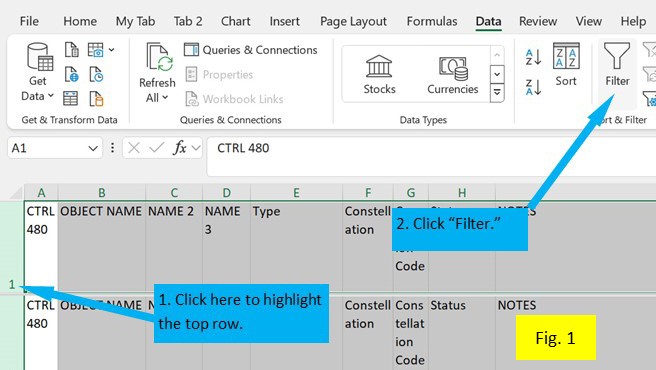
See figure 1. Highlight the first row of the worksheet. Click on “Data” on the top toolbar. Go to the section called “Sort & Filter.” Click on the icon called “Filter.” Note that each cell in the first row now includes a small arrowhead. When you click on the arrowhead, several sorting options appear. The first two options allow the sheet to be listed in alphabetical or reverse-alphabetical order. The bottom section contains a label for each entry in the column with a checkbox. If the box is checked, all rows with that name are displayed.
Here is an exercise, using the Logbook worksheet:
Let’s say you want to list all of your favorite open clusters, grouped by constellation.
1. Click on the arrowhead in the “Type” column.
2. Click the “Select All” box. Note that all of the boxes are now de-selected.
3. Scroll down to the “Open Cluster” label and click on its box, followed by “OK.”
4. The “Type” column will display all of the Open Cluster entries. Note that the arrowhead symbol has been replaced with a funnel-shaped symbol. This is a reminder that only the selected entries are displayed.
5. In the “Status” Column, follow a similar process to show only the lines with the label “Favorites”.
6. In the “Constellation” column, click the arrowhead box and click “Sort A-Z”.
During the Observing Session
On paper, I jot down the items that pertain to the session. These include weather, sky transparency, seeing, start time, end time. If I end the session early, I will include the reason. I also make notes of problems and things to fix later on. For a public event, I try to simply list the objects viewed, rather than make detailed log entries. This information will be transcribed onto the Logbook worksheet.
I use the logging feature of SkySafari to make temporary notes. I select the object, followed by “Create New Observation”. SkySafari stamps the entry with the current date and time (To ensure a correct time stamp, press the “Now” button on the main screen).
I indicate which eyepiece was used, and a three-digit rating for the observation:
First digit: Sky condition, a combination of light pollution, darkness, transparency and seeing. “5” indicates excellent sky condition; “1” indicates near-impossible viewing.
Second digit: Visibility of the object. “5” indicates no trouble in locating the object. “1” indicates the limit of visibility. “0” indicates inability to see the object, despite accurate aim of the telescope. If I am not sure of the scope aim, I write “couldn’t find”.
Third digit: Subjective assessment of the visual appeal of the object. “5” indicates a very pleasing object. Lower numbers indicate less enjoyable objects.
Next, I enter my comments.
Later, I transcribe my SkySafari notes to the Logbook worksheet.
Entering the Observations
I begin by sorting the data in the Logbook worksheet by object name.
I search for earlier observations by entering the Object Name into the Search function (Control F). I then review them.
I insert a blank row and enter the new observation data.
I review what I have learned by this observation:
Do I want to observe this object again?
Can I improve my technique?
Do I want to change the Status to “Favorites” or “Showpieces”?
After I enter all of the observations, I sort the data by Date, newest to oldest. I check for omissions by comparing the worksheet entries with the SkySafari list (click on “Observe”, “Observations” in SkySafari).
Protecting the Data
Keep Some of the Old Workbooks
I have made blunders which have caused loss of information. On one occasion, I deleted data which should have been kept. Another time, several observation notes were matched with the wrong object names.
To repair mistakes, it can be helpful to have the older records. After a major revision, I like to use the “Save As” icon to save the worksheet under a new name. (If I close by hitting the “Save” icon, the earlier version is overwritten).
The Last Row Number
This column helps me to account for each line in the Logbook worksheet. The words “Last Row Number” are followed by a number. This is the row number for the last entry. This number should be the previous number, adjusted for entries added or deleted. For example, if the number is 420, and I add 12 new observations, the new number will be 432.
Your Logging System
My logging system doesn’t need to be your logging system. Everyone has different interests and needs. So, you can modify the sample workbook or start with a blank workbook.
Please let me know if things are unclear. I will try to explain things better.
I hope that this article will help you to remember your times under the stars!
I would like to share a recent edition of my other blog, called “St. John Bosco News and Notes.” If you would like to see more editions, there are links to my website and to my Facebook page at the end of the page. For Instagram and Twitter-X, use: #StJohnBoscoNews.
In the middle of October, comet C/2023 A3 (Tsuchinshan-ATLAS) will be visible after sunset in the Northern hemisphere. Comet Tsuchinshan (pronounced “choo-cheen-SHAHN”) is easily seen with the naked eye.
At the beginning of October, Tsuchinshan will be too close to the Sun to be seen. By mid-month, it will be low in the western sky during twilight. As the month progresses, it will be higher and higher, but it will be moving away from us.
Like all other comets, its orbit has been determined with great accuracy, but its brightness defies prediction.
Some Comet-Watching Resources:
Astronomy.com and Skyandtelescope.org provide easy-to-read articles, including instructions for good observations.
Spaceweather.com is mainly devoted to solar activity and auroras, but they cover many topics of interest, including comets.
http://www.aerith.net/comet/weekly/current.html describes current comets, listed in order of expected visibility. (Don’t worry about the technical details. I don’t understand them either).
The Blaze Star to Wake from a Long Sleep
For professional astronomers, stellar flareups are not unusual. They are usually distant and are not visible to the naked eye. The Blaze Star is an exception. It is a nova, a star which makes a large increase in brightness and then returns to normal.
The Blaze Star, also known as T CrB, is in the constellation Corona Borealis (the Northern Crown). Its normal brightness is too dim to be seen without optical aid. Every 78 to 80 years, it quickly brightens to magnitude 2 or 3. (This is similar to the stars of the Big Dipper.) It will then return to its normal brightness slowly.
Based on current behavior and historical records, astronomers predict that the flareup will happen in the next few months. When it happens, it will reach maximum brightness very quickly. The time for naked-eye observation may be only a couple of days long. It would help to be familiar with Corona Borealis before the flareup occurs.
The articles listed below include finder charts. A planetarium app is very useful because it allows the star display to be adjusted to match your sky conditions.







 Real Simple Astronomy