We are living in an exciting time for the exploration of our cosmic neighborhood. Startling discoveries hardly seem to startle us. For example, the discovery and study of exoplanets (planets orbiting stars other than our Sun) was unknown two decades ago. Now, thousands have been discovered.
This week, there was an announcement that a group of seven “Earth Sized” planets were discovered in orbit around a nearby star. This is certainly an advance in our knowledge of the universe. Unfortunately, many media outlets have written headlines describing them as “Earth Like”. This is highly misleading, because the temperatures, compositions, and radiation levels of these bodies are unknown. (Even the New York Times, which has a reputation for accuracy, suggested: “Scientists could even discover compelling evidence for aliens.”)
It is part of our human nature to want to have answers to all our questions. We would love to have detailed descriptions of the seven new exoplanets, but patience is a must! In the coming years, better observations will likely help us to learn more about these worlds. The new discoveries may or may not be exciting. At each of these junctures, we can expect to hear exaggerated reports in the popular media.
So, try not to get too excited when listening to the news. Enjoy the latest discoveries, but go to a reliable source to find out what has actually been discovered!
Thank you for checking into my blog, even though I haven’t posted anything for a while. I started with the goal of posting a new article every Sunday evening. I have found that it is not easy to come up with a good article on a weekly basis.
So, my new goal is to post something every Sunday, even if it is very brief.
Your Guide to the 2017 Total Solar Eclipse – by Michel Bakich – Springer International Publishing – 395 pages – $23.17
Your Guide is exhaustive. It gives good advice on every topic of viewing a solar eclipse: choosing a site, what to bring, and what to expect. It even points out the importance of taking a restroom break well before totality!
Many topics are covered in this large book, such as:
Science and history of eclipses.
Detailed weather prospects for the localities along the path of totality.
Photography – Although the author cautions that one can miss the eclipse by getting distracted with photography, he tells us how to get good images.
Binoculars and telescopes.
Safe viewing devices for the partial phases of the eclipse. Many of these viewers can be made at home at very little cost.
If you wanted to buy only one book about the August 21, 2017 eclipse, this one should cover all your needs. Even if you won’t be viewing the total eclipse this August, Your Guide is still very interesting and informative.
On Monday, August 21, 2017, residents of the continental United States will have the opportunity to view a solar eclipse. A total eclipse will be visible along a narrow path which goes through 14 states. For the rest of the 48 states, a partial eclipse will be visible.
I have already done a few things to get ready to see the total eclipse:
I have bought 50 pairs of eclipse glasses, most of which I will give to friends.
I have a motel room reserved in Marshall, MO, which is in the “Path of Totality”. A motel isn’t the ideal place, but it will work if I don’t find a better situation.
I have looked on the Internet for accounts of previous total eclipses.
Since so much good material is available, I will not try to write a book. I would like, however, to list some things I have learned:
No equipment is needed to enjoy the total portion of the eclipse. In fact, attempts to use gadgets can waste precious seconds of totality.
To watch the partial eclipse, an inexpensive pair of eclipse glasses are all you need.
The observing location may become so crowded that it won’t be possible to set up camera or telescope tripods. In that case, be thankful that you can still see the eclipse without equipment!
Many towns in the path of totality are trying to provide viewing areas, and to plan for heavy traffic.
The prospects for clear skies are mediocre on the East Coast, but get progressively better as one travels west. On the West Coast, the probability of clear skies is the greatest.
Near heavily populated areas, there is potential for unprecedented traffic jams, as many thousands of people try to get to viewing areas.
When the eclipse is over, traffic jams will be the most intense, since most people will want to go home at the same time.
If the sky turns out to be cloudy, one can still enjoy the experience darkness in the middle of the day!
If things don’t work out, there will be another total eclipse along a path through Mexico, Eastern US, and Eastern Canada in 2024.
My general plan is as follows:
Find a place which will be enjoyable for two or three full days. Arrive a full day before the eclipse, and stay there until the day after the eclipse.
The ideal would be a camping situation with astronomy enthusiasts, with an opportunity for night-time astronomy. (I will let you know if I find one.)
Set up video cameras, not to record the Sun, but to record peoples’ reactions. If this interferes with my watching the eclipse, I will skip it.
Watch the partial phase with eclipse glasses. I will look for changes in temperature and in wildlife behavior.
When the last bit of the Sun is covered, nothing will be visible through the glasses. It is time to take them off, and enjoy the spectacle.
I will look at the eclipsed Sun through binoculars for half a minute. (I will keep them secure, so that no one gets injured by using them at other times.)
I may look around, turning 360 degrees, to see what is going on.
When the glimmer of direct sunlight is again visible, I will put the eclipse glasses back on.
I won’t be in a hurry to leave. Instead it will be time to relax, celebrate, and write some blogs.
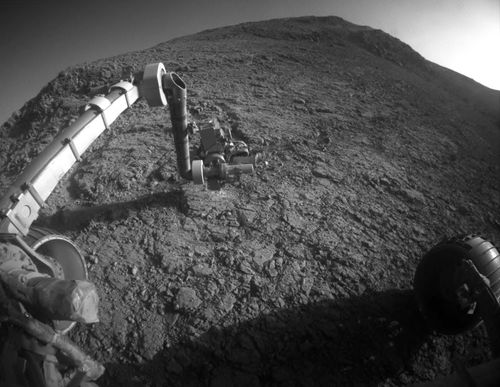
The Opportunity rover has been examining the Martian surface for over 12 years. In this view, a rock is being studied photographically and by chemical analysis.
Cost
To estimate the cost to travel to Mars, it is necessary to identify what needs to be shipped to Mars, what kinds of spacecraft need be built, and what kind of difficulties may arise. Since we cannot easily answer these questions, we can only make a vague guess as to the cost of the program.
Some high-expense items to consider would be:
The spacecraft may need to be large and complex, to provide the ability to recover from a major malfunction.
Because of the distance to Mars and the infrequency of launch windows, critical items will need to be stockpiled there. This will be expensive, and many items will never be used. This is part of the cost of taking safety seriously.
Extra launches may be needed to deal with emergencies. The hardware for these missions would need to be built and ready ahead of time.
To raise the funds for a venture this big, the governments of several countries will need to work together. Each of these participating nations well need to make a firm commitment to staying with the program for many years. Unfortunately, the politics of many countries works against long term participation.
In a democratic country, the voting public would need to be willing to pay high taxes for a long time. They would need to keep paying, even with the inevitable cost overruns. It is doubtful that this would happen.
Currently, in the USA, funding for robotic missions does not come automatically. Each mission must be justified to obtain funding. Given this difficulty, it is difficult to expect that human travel to Mars would be approved.
All of this leads to the third topic:
Value
I won’t dispute the fact that human explorers would be able to do things which robots cannot do. People have intuition, which will enable discoveries which are not anticipated. People can make repairs to equipment, which would be awkward or impossible to do otherwise. People observe on a deeper level than mere instruments. When something new or unusual is found, the human observer wants to understand it, and immediately examines it in detail.
In discussing value, we try to predict what we will accomplish, and decide if it worth the cost. Currently, robotic missions are steadily building up our understanding of Mars. No doubt, more will be launched during the next decade. Eventually, they will bring samples of Martian soil back to Earth.
For the cost of a single human mission, many robotic missions could be launched. These devices would not need to be identical, but could incorporate the lessons from previous successes and failures.
After Mars has been well examined by robots, human exploration could begin. Then human beings could begin to do what machines can’t do. Today, we don’t know what that necessarily human contribution would be.
So, the good news is that we are already exploring Mars in a logical, progressive, and affordable manner!
Next week, I will ask you how your plans for 8/21/17 are coming along!
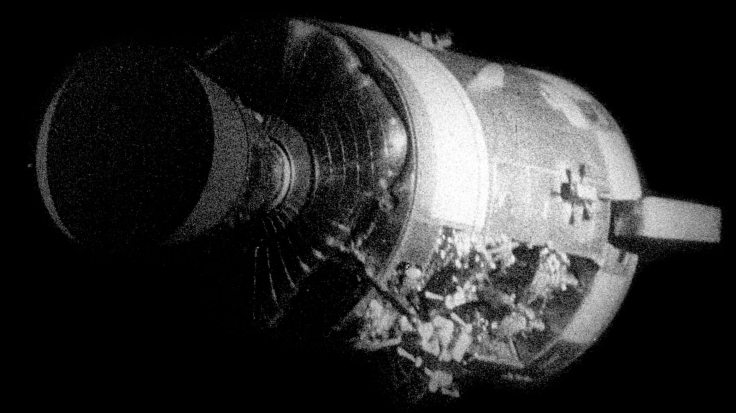
The Service Module of the Apollo 13 mission was damaged by a burst oxygen tank.
Part 1 – Safety
Honestly, I am not having a bad day, and I love space exploration. I am very enthusiastic about exploring Mars. I am amazed at how well some of the robotic craft have performed.
I would like to see larger numbers of roving vehicles traveling the rocky red paths of Mars. I do not think, however, that we are ready to think seriously about human travel to Mars. Also, I don’t take it as a certainty that it will happen “someday in the future”. Here are my reasons: safety, cost, and value.
Safety
I have seen sketches of proposed missions for travel to Mars, and I think that they would have some chance of getting our people to Mars and back home safely. The problem is that they assume that everything will go reasonably well. We have learned a lot about building reliability into our spacecraft, but we have had the option of returning quickly to Earth if malfunctions became too great to handle.
A craft en route to Mars will need the capability of managing and recovering from a major problem. What kind of problem? Since the flight of Yuri Gagarin, we have had fires, a burst oxygen tank, rocket motors which failed to run when needed, attitude thrusters not shutting off, a loss of hull pressure from a docking mishap, failures of modules to undock, release of toxic gas into a crew compartment, and several types of space suit malfunctions.
The Mars spacecraft will need to have extensive countermeasures and backup systems. Even so, to have a high level of safety, it may be necessary to travel in tandem with a complete redundant spacecraft, with a means of getting from one to the other quickly.
Although there may be astronauts willing to take a great risk, I would not wish to put them in danger by paying for a mission which doesn’t have an excellent prospect for success.
In addition to the difficulty of building a robust spacecraft, the problem of radiation must be addressed. When a vehicle moves outside of low-Earth orbit, radiation becomes a serious concern. There is a constant stream of high-energy particles in space. During a solar flare, it becomes much more intense. We have only begun to learn how to provide effective shielding to protect the crew.
Thank you for bearing with my somber treatment of such an exciting topic as space exploration. I promise to wrap up this series with some very encouraging ideas!
A month ago, I visited a cousin in New Jersey, who shared about his experiences at a local star party. I was surprised to hear that there was such an event in his area. This part of New Jersey is one of the most light-polluted areas of the country. It is about 6 miles from New York City.
This observing night was held at the William D. McDowell Observatory in Lyndhurst, NJ. At their viewing nights, they select objects which are bright enough to stand out against the bright background sky.
Here is more information about the McDowell Observatory programs:
It may seem odd to build an observatory in an area where the sky never gets truly dark, but it provides viewing opportunities for millions of people (but not all at the same time!). Consider the opposite extreme: an observatory on top of a mountain in the New Mexico desert. There would be outstanding viewing, but very few people would be able to travel the long distance to enjoy it. So, if you are in northern New Jersey, this ought to be fun!
The Best of the Best Objects to View
When you attend your star party, the astronomers will select objects that are interesting, and are in a good portion of the sky. Here are some of the most interesting things, roughly in order of visual impact:
The Moon – A quick look at the Moon reveals craters of all sizes, mountains, and flat dark “seas”. If you take more time to study the Moon, there is an endless variety of features, too many to describe here.
Saturn – for many people, the first look at Saturn through a telescope is an emotional experience. Even though larger and more detailed views can be found in books and on line, this is not the same as looking at the planet directly. Saturn is very bright, and has a sharp contrast to the background sky.
Jupiter and its moons – Because Jupiter is larger than Saturn, and is closer to us, it makes a larger image in the telescope. There are many features on the surface of Jupiter to enjoy. The main ones are the belts (dark bands which wrap around the globe), and the Great Red Spot (which nowadays is somewhat small and orange). The four largest moons of Jupiter are very bright, and move fast enough for changes to be noticed in a few hours.
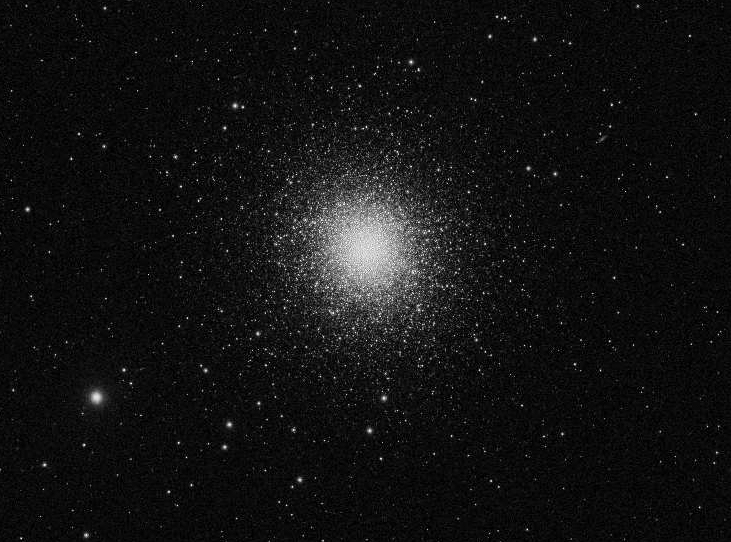
The Hercules Cluster – This object is a globular cluster, a spherical collection of hundreds of thousands of stars orbiting a central point.
The Orion Nebula – This is an immense cloud of gas which is being transformed into new stars.
The Ring Nebula – This object comes from a very old star, which has shed a layer of its surface. This expelled layer has taken a ring shape, and is expanding in size.
Mars – Mars is called “The Red Planet”, but would be better described as orange. A casual view of Mars shows only a bright orange disk. The constantly moving pockets of warm and cold air in our atmosphere prevent a good view of the details of Mars. Persistence pays off, however, because there are occasional moments when a sharp view gets through. During these split-second opportunities, polar ice caps and dark areas can be seen on the surface.
Albireo – This is a “double star”, a pair of stars which orbit each other, or appear to do so. Albireo is unique for its brightness and the colors of its two stars.
The Double Cluster of Perseus – This is a pair of star clusters somewhat close to each other. They are called “open clusters”, which have far fewer stars than globular clusters. In the Double Cluster, many bright stars are beautifully arranged against the dark background sky.
The Andromeda Galaxy – This is the closest large galaxy in our stellar neighborhood. Through a telescope, it appears as a fuzzy oval, a little bit bigger than Jupiter. Looks can be deceiving, because the Andromeda Galaxy is composed of billions of stars, and is over two million light-years away!
That’s all for now. My goal is to post something interesting every Sunday night.
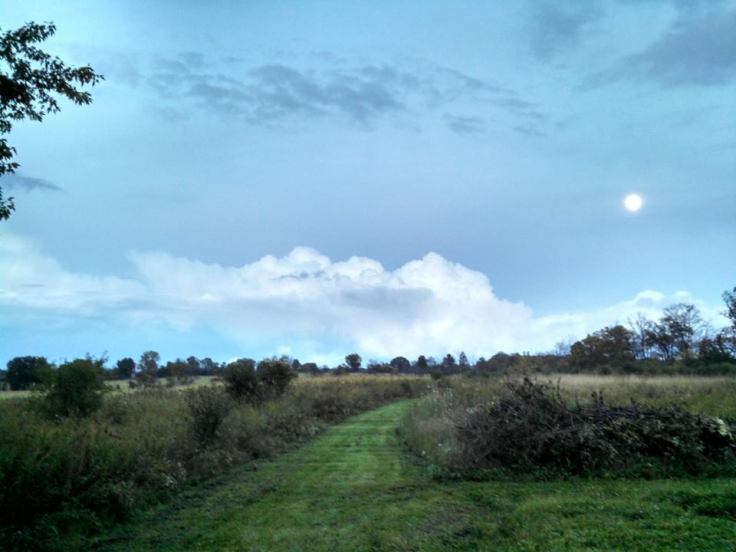
I can take little credit for the composition of this picture. I was working in the yard, and I was stunned by this Moonlit landscape.
Because of the elliptical shape of the Moon’s orbit, its distance from the Earth is constantly changing. This week – Monday, November 14, 2016 – we will have a Full Moon which will be at its closest since 1948. Since it is closer than usual, it will appear larger than usual. Hence, the name, supermoon.
The supermoon has gotten a lot of publicity, although the event will not be very exciting. The visual size difference between the Moon at its closest and the Moon at its farthest is about 14%. If we could view both the “large” Moon and the “small” Moon at the same time, a 14% difference would be obvious. Unfortunately, the Moon doesn’t present itself that way. So, we need some way to measure the Moon’s apparent diameter, so we can compare it with a future sighting. I have added some links to articles on this topic.
In my humble opinion, the easy ways of measuring the Moon’s apparent diameter are not very accurate. However, if you have a camera which can make a large, sharp image of the Moon, try taking pictures this Monday and compare them to future pictures. Of course, you would need to use the same settings for all the images. This would be fairly easy, and fairly accurate.
Another technique would be to take a good look at the supermoon, and examine the finest possible details of it’s surface. Make a sketch or make a mental note of what you could see. Repeat this exercise next month.
My plan is to simply go out and take a good look at the supermoon, and call it a night.
You may not realize it, but there may be opportunities in your area to enjoy the sights of the sky with knowledgeable amateur astronomers who love to have people look through their telescopes.
In the astronomy jargon, a star party is a small or large gathering of people interested in looking at stars, planets, clusters, galaxies and other interesting objects. There are many variations on the general theme of star parties. Some are held away from cities to enjoy the darker skies. Others are held in built-up areas, so that people can see some beautiful sights without having to travel. Some are held at observatories, some in parks, some are informal gatherings at private homes.
A common element of all star parties is a chance to meet people who are excited about exploring the universe. There will be an opportunity to look through a variety of telescopes. One can go from scope to scope, see different objects, and hear explanations. Later in the event, the crowds are smaller and attention shifts to more unusual or difficult objects. This is a great time to make requests.
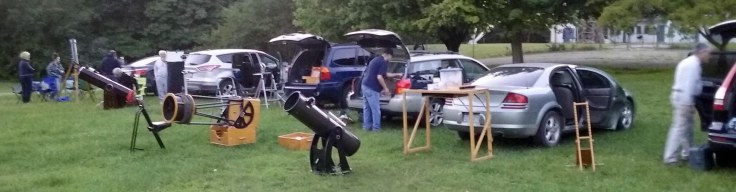
It is hard to get a good photo of a star party in progress, for obvious reasons. Here is a photo of some members of my club setting up their telescopes. My club is the University Lowbrow Astronomers, based in Ann Arbor, Michigan.
How to find the nearest star party? The best way is to find an astronomy club in your area. If the club doesn’t conduct star parties, they should know how to find one. Here is a link to a directory of astronomy clubs:
Having found an event, there are a few courtesies which help everyone have a good time:
After dark, use only a small flashlight with a red filter when walking. This preserves everyone’s night vision.
Ask the owner before using a telescope, and be careful not to push the telescope while looking through it.
Bring your children, but don’t let them run around.
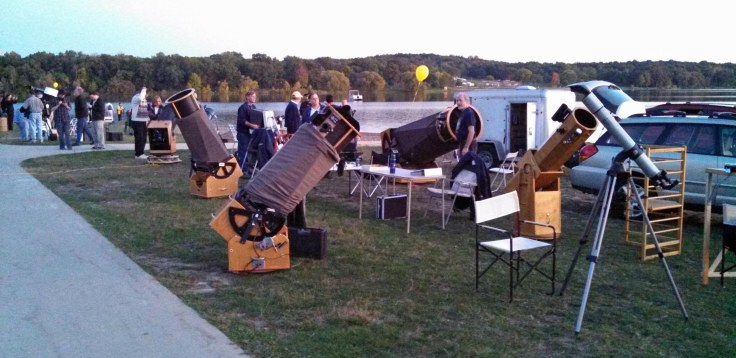
Here is a joint effort of seven astronomy clubs. There were approximately 60 telescopes in use. This annual event is called “Astronomy at the Beach”, and is held in Southeastern Michigan.
In the Northern half of the world, we are experiencing cooler weather as winter approaches. Compared to summer, fall is a great time for star-gazing, because sunset is earlier, and the skies tend to have less haze. So, why not find some people who can help you to enjoy the night sky?
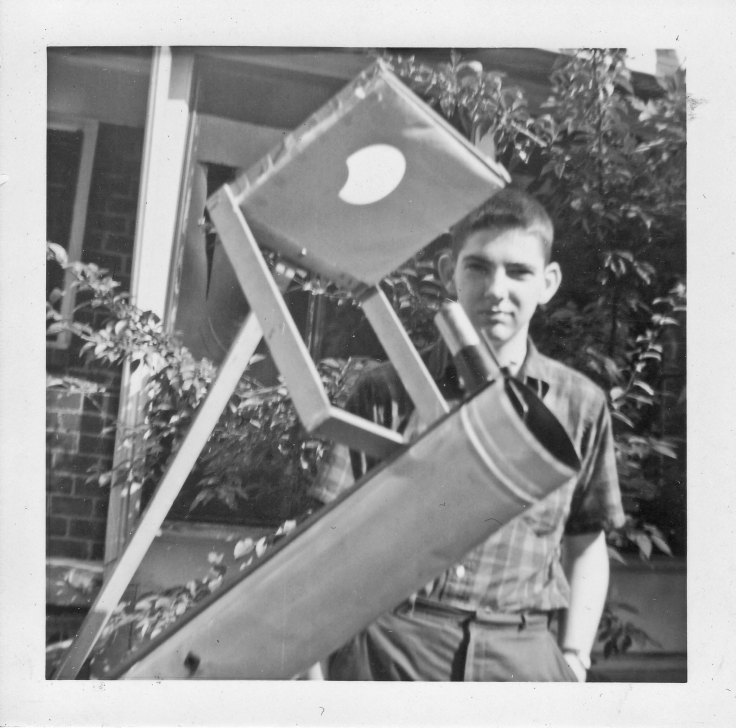
Back in 1963, we watched a partial eclipse by projection. This method is safe, but could be misused. If someone had put their hand or face between the eyepiece and the screen, a nasty burn could have happened.
Whenever one reads about solar eclipse-watching, many warnings about eye damage are found. They tend to be repetitious, but they are very important. Rather than trying to “reinvent the wheel”, I would like to summarize them as two different types of mistakes that can be made:
First type of mistake: Looking directly at the Sun. Normally, we find it very painful to look directly at the Sun. Almost as a reflex, we turn our gaze away from the fiery disk. However, during the partial phase of a solar eclipse, the sensation of pain is not so strong, because the overall brightness of the Sun isn’t so great. Unfortunately, the light from the visible portion of the Sun is still very destructive.
“Eclipse glasses” from a reputable source are inexpensive, and allow one to view the sun safely.
Second type of mistake: Looking at the Sun through improperly filtered optics. This mistake is far more serious than looking directly at the Sun. A telescope or binocular is designed to concentrate the light from a dim object to make it easier to see. When it is aimed at the Sun, an enormous amount of energy is delivered to the eyepiece. Complete, permanent loss of vision can occur quickly.
Telescopes can be safely filtered for looking at the Sun, but mistakes can happen. I am apprehensive that in some unruly, crowded observing field, a filter will get knocked off of a telescope. This would expose the viewer to serious injury. So, in addition to setting up a safe telescope, steps have to be taken to keep it safe.
There are several ways to use a telescope as a projector, and view the image of the Sun indirectly. These work well, but someone needs to be on the lookout for any misuse of the equipment.
Finally, there is one time when eye protection is not needed: during the total phase of the eclipse. If you are wearing eclipse glasses, you will see uncovered portion of the Sun getting smaller and smaller. When you can’t see anything through the eclipse glasses, totality has begun, and you should take the glasses off (otherwise you will miss the reason you went through all of this trouble!). Enjoy watching the corona, until you notice that the Sun is no longer completely covered. At this point, put your eclipse glasses back on.
Having said all of this, you shouldn’t be afraid to enjoy solar eclipses. Like many other things, the extremes are to be avoided. There is no need to stay indoors and close the curtains. Likewise, watching the Sun without protection is unwise. The rules are fairly simple, and will help you have an unforgettable day!
Here is a link to good information on viewing the eclipse safely:









 Real Simple Astronomy